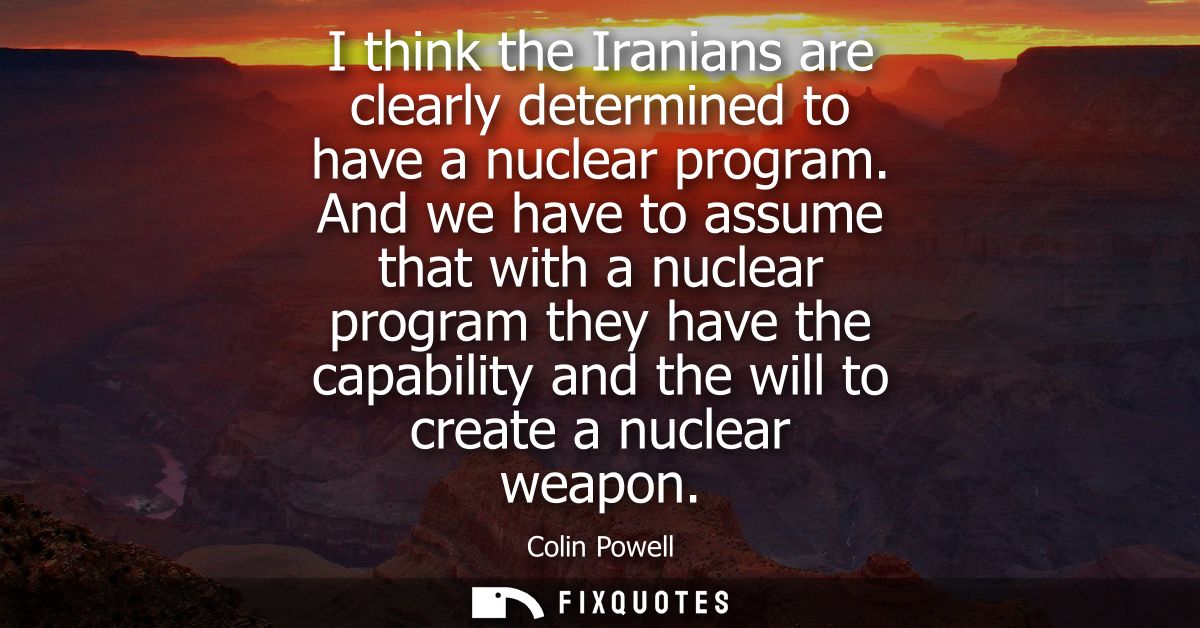
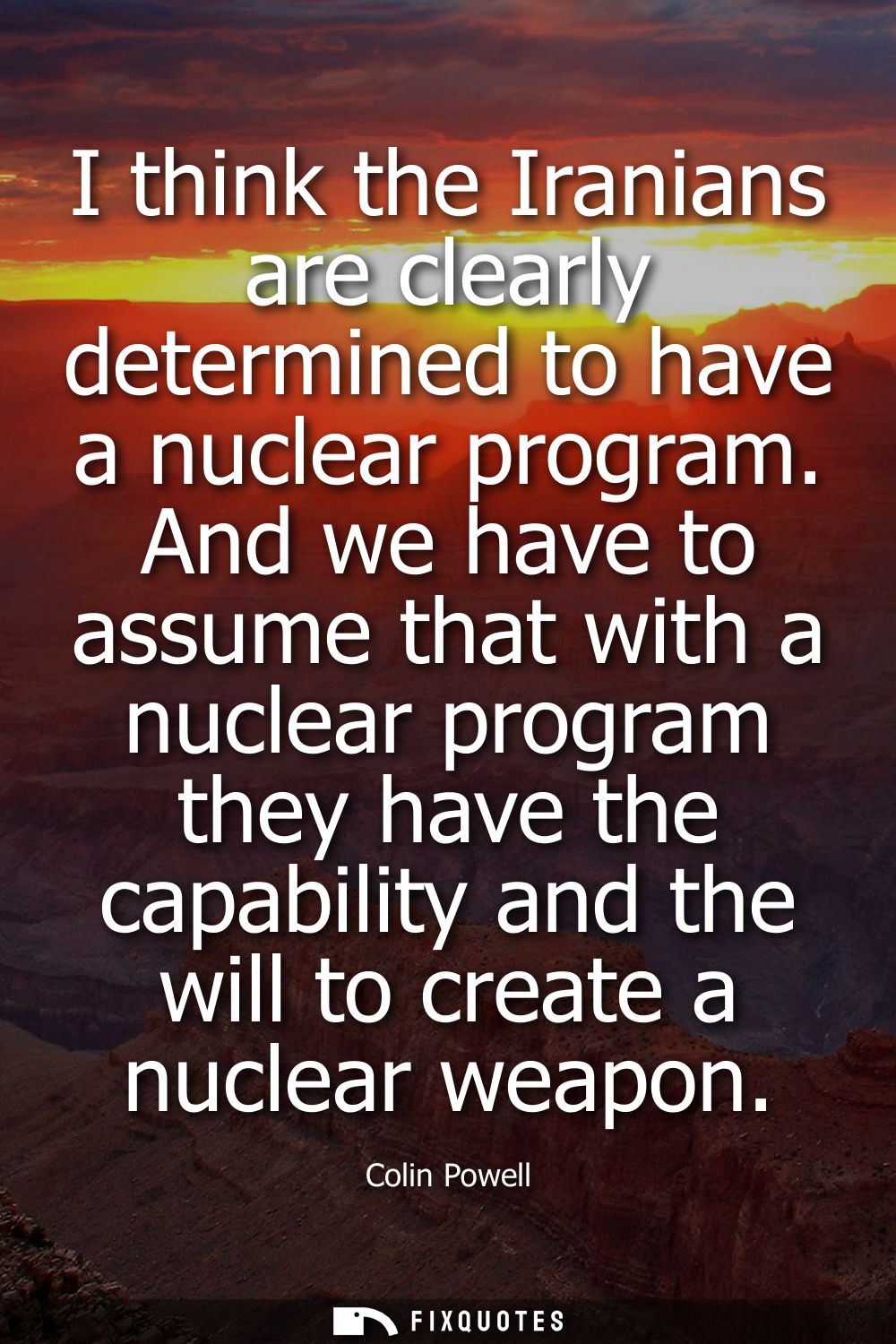
"I think the Iranians are clearly determined to have a nuclear program. And we have to assume that with a nuclear program they have the capability and the will to create a nuclear weapon"
About this Quote
The subtext is a familiar post-9/11 logic: capability plus ambiguity equals threat. Powell links “nuclear program” to “capability and the will” to build a weapon, compressing a major strategic and technical leap into a single breath. Civilian enrichment, deterrence posturing, domestic politics, and bargaining leverage all get flattened into one story: inevitability. The word “will” is doing the most ideological work here; it turns technical capacity into moral certainty about an adversary’s motives.
Context matters: Powell, a careful institutional voice, was operating in an era when American credibility on WMD claims was under intense pressure and when the Iraq experience had made “assume” a loaded verb. The line reveals the security state’s favored persuasion tactic: treat uncertainty as the reason to escalate, not the reason to verify. It’s less an assessment than a permission slip, drafted in the language of inevitability.
Quote Details
| Topic | War |
|---|---|
| Source | Help us find the source |
| Cite |
Citation Formats
APA Style (7th ed.)
Powell, Colin. (2026, January 17). I think the Iranians are clearly determined to have a nuclear program. And we have to assume that with a nuclear program they have the capability and the will to create a nuclear weapon. FixQuotes. https://fixquotes.com/quotes/i-think-the-iranians-are-clearly-determined-to-30657/
Chicago Style
Powell, Colin. "I think the Iranians are clearly determined to have a nuclear program. And we have to assume that with a nuclear program they have the capability and the will to create a nuclear weapon." FixQuotes. January 17, 2026. https://fixquotes.com/quotes/i-think-the-iranians-are-clearly-determined-to-30657/.
MLA Style (9th ed.)
"I think the Iranians are clearly determined to have a nuclear program. And we have to assume that with a nuclear program they have the capability and the will to create a nuclear weapon." FixQuotes, 17 Jan. 2026, https://fixquotes.com/quotes/i-think-the-iranians-are-clearly-determined-to-30657/. Accessed 30 Mar. 2026.