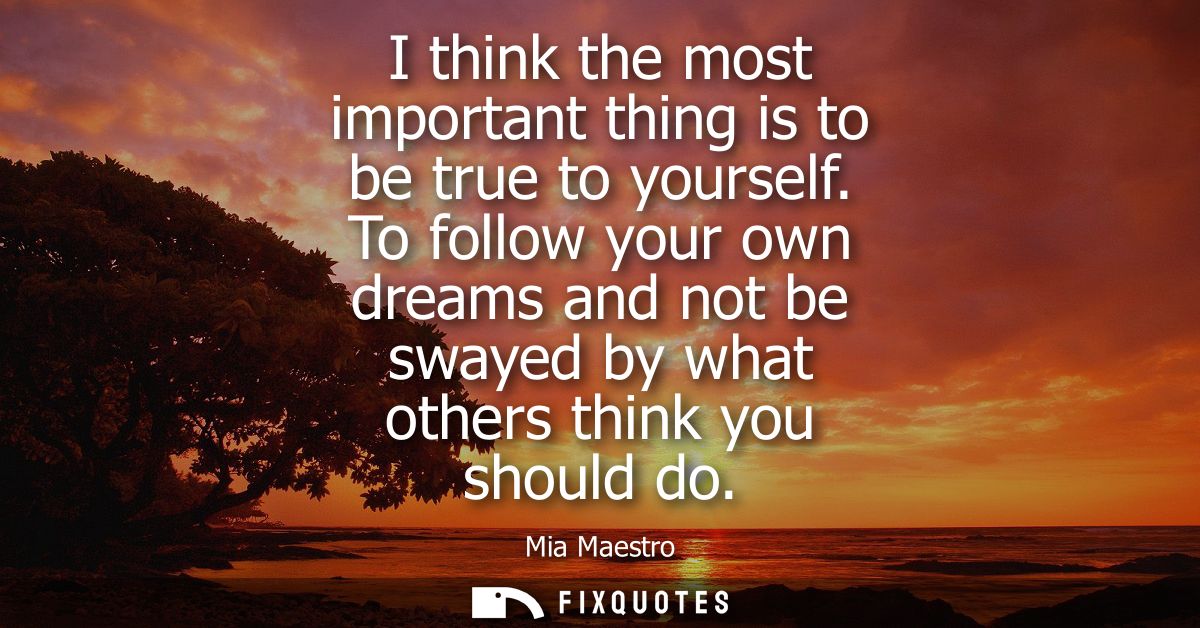
"I think the most important thing is to be true to yourself, to follow your own dreams and not be swayed by what others think you should do"
About this Quote
The phrasing is tellingly practical. “I think” softens the claim, a protective modesty that keeps it from sounding sanctimonious while still asserting authority earned through experience. “Most important” stakes a value hierarchy that competes with the usual ladder of career advice (visibility, networking, momentum). And “follow your own dreams” isn’t just about ambition; it’s about authorship. She’s nudging the listener away from the default script - the roles you’re told to want, the version of success that photographs well - toward choices that may look irrational from the outside but feel coherent from the inside.
The subtext is also about survival. For actors, external validation is intermittent by design; a career can be a long series of near-misses. Anchoring yourself in internal measures of meaning is how you keep rejection from becoming self-definition. Maestro’s line lands because it’s aspirational without pretending the pressure isn’t real. It’s a reminder that the hardest part of “dreams” is defending them from other people’s certainty.
Quote Details
| Topic | Self-Improvement |
|---|---|
| Source | Help us find the source |
| Cite |
Citation Formats
APA Style (7th ed.)
Maestro, Mia. (2026, February 16). I think the most important thing is to be true to yourself, to follow your own dreams and not be swayed by what others think you should do. FixQuotes. https://fixquotes.com/quotes/i-think-the-most-important-thing-is-to-be-true-to-171854/
Chicago Style
Maestro, Mia. "I think the most important thing is to be true to yourself, to follow your own dreams and not be swayed by what others think you should do." FixQuotes. February 16, 2026. https://fixquotes.com/quotes/i-think-the-most-important-thing-is-to-be-true-to-171854/.
MLA Style (9th ed.)
"I think the most important thing is to be true to yourself, to follow your own dreams and not be swayed by what others think you should do." FixQuotes, 16 Feb. 2026, https://fixquotes.com/quotes/i-think-the-most-important-thing-is-to-be-true-to-171854/. Accessed 3 Apr. 2026.