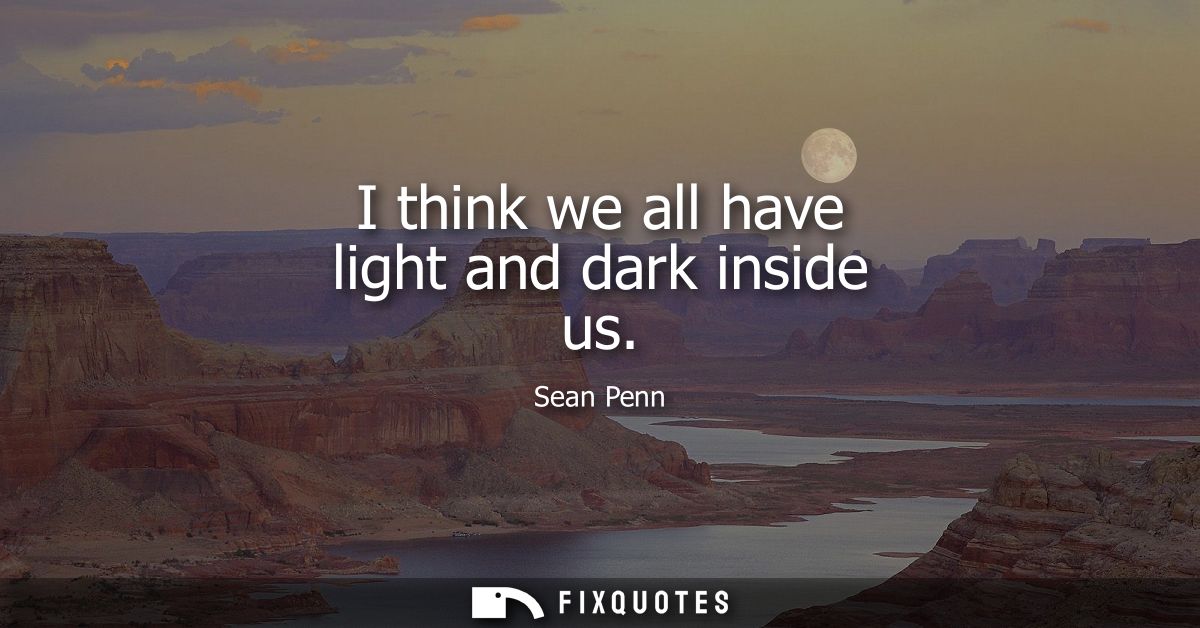
"I think we all have light and dark inside us"
About this Quote
Penn’s line lands like a shrug, but it’s really a permission slip. “I think” lowers the temperature, turning what could be a moral lecture into something more confessional, almost intimate. He’s not diagnosing the audience; he’s leveling with them. The “we” does the heavy lifting: it dissolves the celebrity distance and insists on a shared interior mess, the kind that makes redemption arcs believable and hypocrisy unsurprising.
The light/dark binary is deliberately blunt, closer to movie grammar than philosophy. That’s not a weakness; it’s the point. Actors traffic in legible contrasts because characters need stakes you can feel in a scene. Penn, whose public persona has long braided intensity with volatility, knows how that framing plays culturally: you can be both principled and flawed without the whole narrative collapsing. It’s a way to preempt the purity tests that shadow public figures, especially ones who court controversy. If everyone contains both, then no one gets to pretend they’re only the hero or only the villain.
There’s also a sly recalibration of responsibility. By admitting darkness as common property, the quote normalizes temptation and aggression, but it doesn’t excuse them; it reframes them as material to manage rather than defects to deny. In an era where people are flattened into “good” or “bad” online, Penn’s simplicity reads like resistance: a plea for character as conflict, not branding.
The light/dark binary is deliberately blunt, closer to movie grammar than philosophy. That’s not a weakness; it’s the point. Actors traffic in legible contrasts because characters need stakes you can feel in a scene. Penn, whose public persona has long braided intensity with volatility, knows how that framing plays culturally: you can be both principled and flawed without the whole narrative collapsing. It’s a way to preempt the purity tests that shadow public figures, especially ones who court controversy. If everyone contains both, then no one gets to pretend they’re only the hero or only the villain.
There’s also a sly recalibration of responsibility. By admitting darkness as common property, the quote normalizes temptation and aggression, but it doesn’t excuse them; it reframes them as material to manage rather than defects to deny. In an era where people are flattened into “good” or “bad” online, Penn’s simplicity reads like resistance: a plea for character as conflict, not branding.
Quote Details
| Topic | Deep |
|---|---|
| Source | Help us find the source |
| Cite |
Citation Formats
APA Style (7th ed.)
Penn, Sean. (2026, January 16). I think we all have light and dark inside us. FixQuotes. https://fixquotes.com/quotes/i-think-we-all-have-light-and-dark-inside-us-89978/
Chicago Style
Penn, Sean. "I think we all have light and dark inside us." FixQuotes. January 16, 2026. https://fixquotes.com/quotes/i-think-we-all-have-light-and-dark-inside-us-89978/.
MLA Style (9th ed.)
"I think we all have light and dark inside us." FixQuotes, 16 Jan. 2026, https://fixquotes.com/quotes/i-think-we-all-have-light-and-dark-inside-us-89978/. Accessed 27 Mar. 2026.
More Quotes by Sean
Add to List