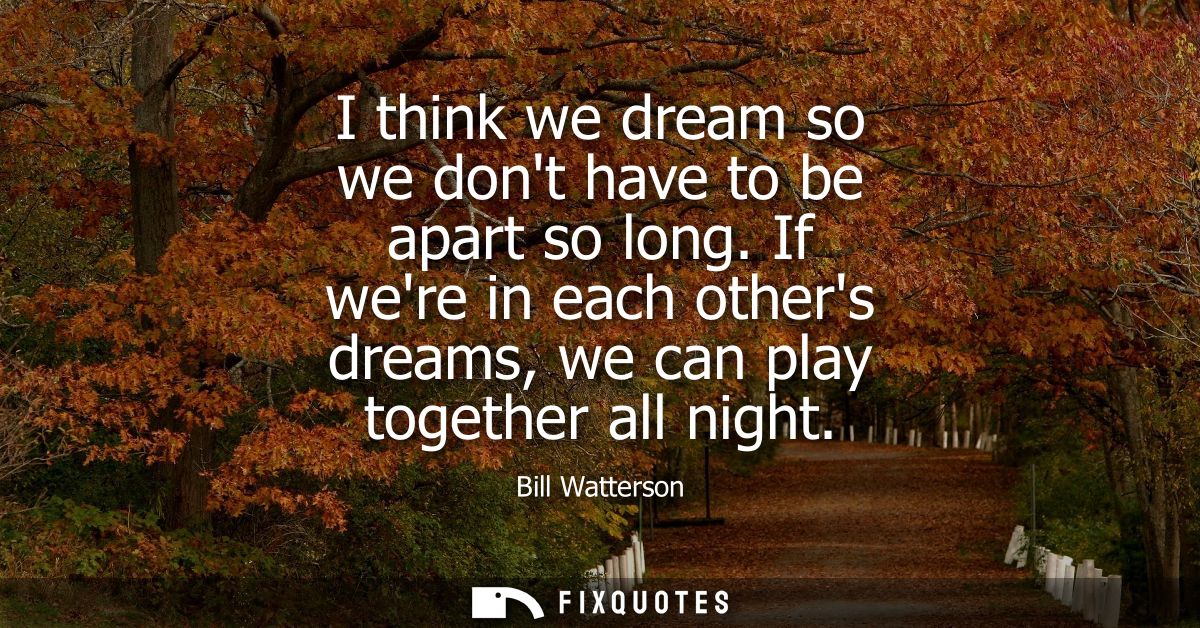
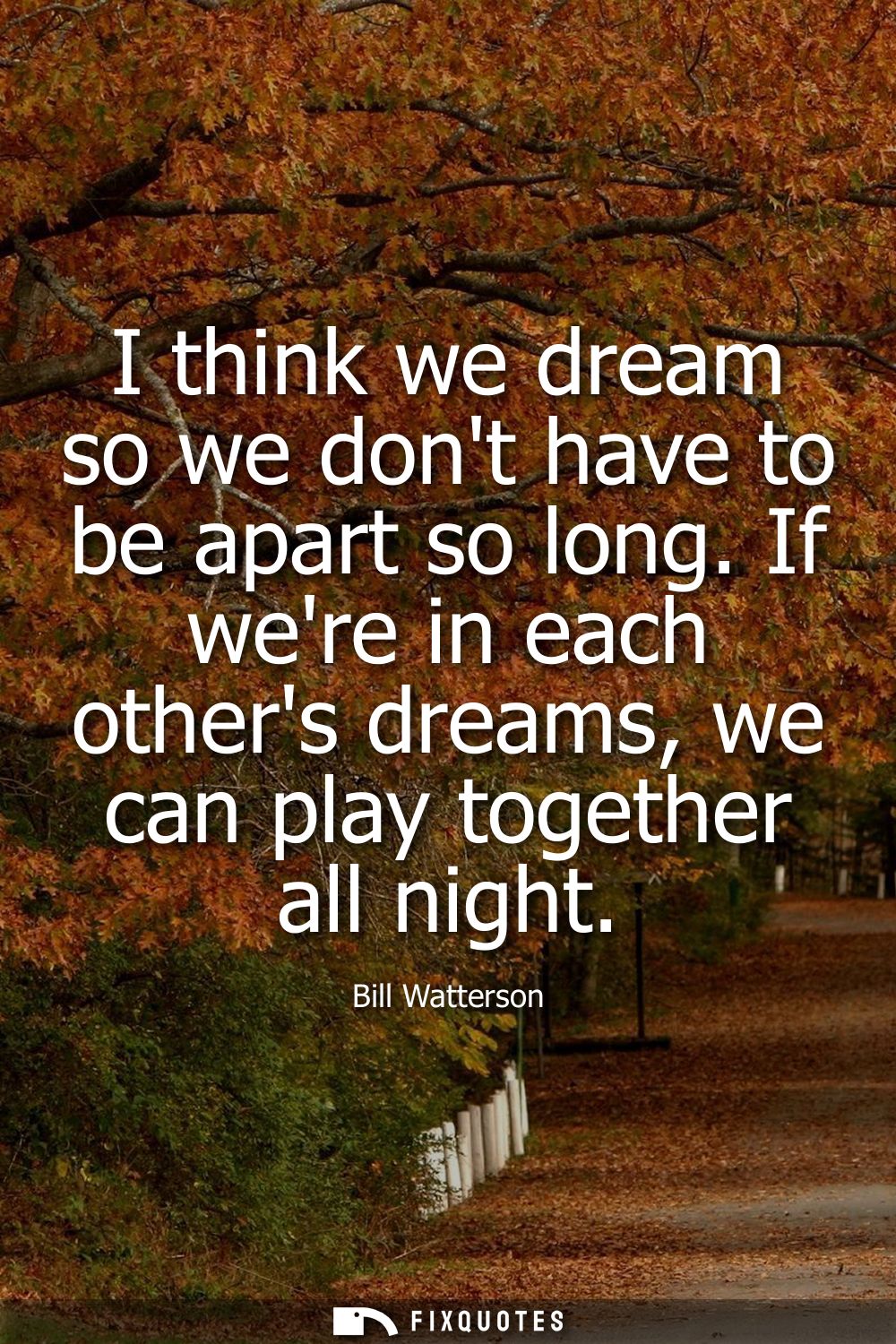
"I think we dream so we don't have to be apart so long. If we're in each other's dreams, we can play together all night"
About this Quote
The intent isn’t to define dreaming scientifically; it’s to dignify longing. Watterson frames absence as the real antagonist, not distance itself. “Apart so long” telescopes a child’s time sense - an afternoon can feel like exile - and makes the bedtime border between together and alone feel political, like a rule imposed from outside. Dreams become a contraband meeting place, a private jurisdiction where the world’s separations can’t enforce themselves.
Subtextually, it’s also Watterson defending imagination against the adult insistence on “real.” Calvin’s idea turns the intangible into a shared space with agency: if we’re in each other’s dreams, “we can play together all night.” Play isn’t a distraction; it’s companionship, continuity, survival. In the context of a strip that constantly interrogates growing up, this reads like a protest against the way adulthood narrows possibility. You can almost hear the quiet dread underneath the sweetness: morning is coming, and the laws of waking life will reassert themselves.
Quote Details
| Topic | Long-Distance Friendship |
|---|---|
| Source | Help us find the source |
| Cite |
Citation Formats
APA Style (7th ed.)
Watterson, Bill. (2026, January 17). I think we dream so we don't have to be apart so long. If we're in each other's dreams, we can play together all night. FixQuotes. https://fixquotes.com/quotes/i-think-we-dream-so-we-dont-have-to-be-apart-so-30156/
Chicago Style
Watterson, Bill. "I think we dream so we don't have to be apart so long. If we're in each other's dreams, we can play together all night." FixQuotes. January 17, 2026. https://fixquotes.com/quotes/i-think-we-dream-so-we-dont-have-to-be-apart-so-30156/.
MLA Style (9th ed.)
"I think we dream so we don't have to be apart so long. If we're in each other's dreams, we can play together all night." FixQuotes, 17 Jan. 2026, https://fixquotes.com/quotes/i-think-we-dream-so-we-dont-have-to-be-apart-so-30156/. Accessed 8 Apr. 2026.