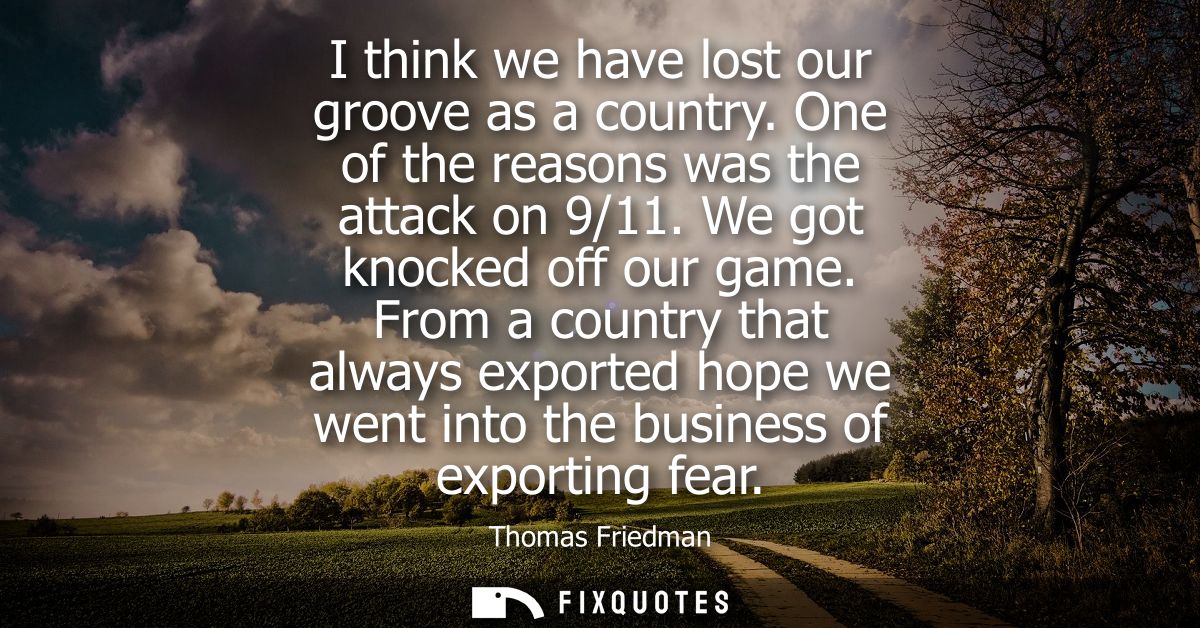
"I think we have lost our groove as a country. One of the reasons was the attack on 9/11. We got knocked off our game. From a country that always exported hope, we went into the business of exporting fear"
About this Quote
The real lever is the export metaphor. Countries export goods, culture, ideology; Friedman turns national identity into a brand with a balance sheet. "Exported hope" invokes postwar soft power: the Marshall Plan, Hollywood optimism, the idea of upward mobility as an American product. "Exporting fear" is the inverse brand campaign: airport security theater, surveillance, preemptive war, the language of threats and terror baked into policy and media. He's not just critiquing Iraq or Guantanamo; he's describing a shift in the emotional commodity the U.S. circulates globally.
Subtext: fear is contagious and profitable. Once a superpower reorganizes itself around vulnerability, it starts needing enemies to justify the posture. The line also absolves and blames at once. 9/11 becomes the causal explanation, but the "business" phrasing implies choice, habit, even addiction. It's a lament dressed as a market analysis: America didn't only get hurt; it pivoted, and the pivot remade its story.
Quote Details
| Topic | Fear |
|---|---|
| Source | Help us find the source |
| Cite |
Citation Formats
APA Style (7th ed.)
Friedman, Thomas. (2026, February 16). I think we have lost our groove as a country. One of the reasons was the attack on 9/11. We got knocked off our game. From a country that always exported hope, we went into the business of exporting fear. FixQuotes. https://fixquotes.com/quotes/i-think-we-have-lost-our-groove-as-a-country-one-131083/
Chicago Style
Friedman, Thomas. "I think we have lost our groove as a country. One of the reasons was the attack on 9/11. We got knocked off our game. From a country that always exported hope, we went into the business of exporting fear." FixQuotes. February 16, 2026. https://fixquotes.com/quotes/i-think-we-have-lost-our-groove-as-a-country-one-131083/.
MLA Style (9th ed.)
"I think we have lost our groove as a country. One of the reasons was the attack on 9/11. We got knocked off our game. From a country that always exported hope, we went into the business of exporting fear." FixQuotes, 16 Feb. 2026, https://fixquotes.com/quotes/i-think-we-have-lost-our-groove-as-a-country-one-131083/. Accessed 5 Apr. 2026.