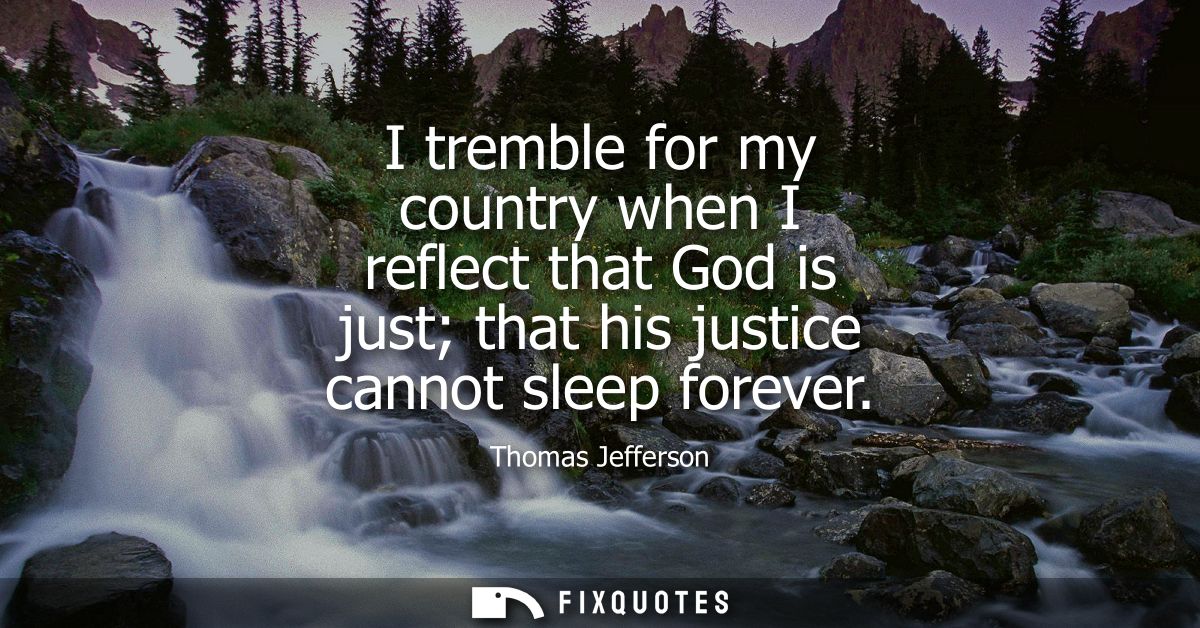
"I tremble for my country when I reflect that God is just; that his justice cannot sleep forever"
About this Quote
The context sharpens the blade. Jefferson wrote this in Notes on the State of Virginia while defending the economic and social machinery of slavery even as he recognized its corrosive consequences. That tension is the subtext: he’s speaking as someone who understands the contradiction and cannot—or will not—resolve it. The phrase “cannot sleep forever” is the rhetorical masterstroke. It implies a long national delay, a comfortable half-consciousness where a society can normalize cruelty, congratulate itself on liberty, and treat moral reckoning as a problem for later. But “forever” is denied. History, like conscience, eventually wakes.
What makes the sentence work is its refusal to specify the punishment. Jefferson doesn’t name rebellion, war, or divine wrath; he leaves an open space the reader fills with dread. It’s politically shrewd (no direct policy commitment) and morally damning (an admission that the nation is built on a crime that even Providence won’t indefinitely ignore). The tremble is America’s, but it begins in Jefferson’s own unresolved ledger.
Quote Details
| Topic | Justice |
|---|---|
| Source | Unverified source: Notes on the State of Virginia (Thomas Jefferson, 1785)
Evidence: Query XVIII ("Manners"). This sentence appears in Jefferson’s own book, in Query XVIII (commonly titled "Manners"), in the slavery discussion: “Indeed I tremble for my country when I reflect that God is just: that his justice cannot sleep for ever …”. The earliest *publication* of Jefferson’s tex... Other candidates (2) The Writings of Thomas Jefferson: 1781-1784 (Thomas Jefferson, 1894) compilation95.0% ... I tremble for my country when I reflect that God is just that his justice cannot sleep forever : that considering... Thomas Jefferson (Thomas Jefferson) compilation36.2% discredit to my country theodore roosevelt to f s oliver august 8 1906 quoted in joseph bucklin bishop theodore roos |
| Cite |
Citation Formats
APA Style (7th ed.)
Jefferson, Thomas. (2026, January 13). I tremble for my country when I reflect that God is just; that his justice cannot sleep forever. FixQuotes. https://fixquotes.com/quotes/i-tremble-for-my-country-when-i-reflect-that-god-27362/
Chicago Style
Jefferson, Thomas. "I tremble for my country when I reflect that God is just; that his justice cannot sleep forever." FixQuotes. January 13, 2026. https://fixquotes.com/quotes/i-tremble-for-my-country-when-i-reflect-that-god-27362/.
MLA Style (9th ed.)
"I tremble for my country when I reflect that God is just; that his justice cannot sleep forever." FixQuotes, 13 Jan. 2026, https://fixquotes.com/quotes/i-tremble-for-my-country-when-i-reflect-that-god-27362/. Accessed 19 Mar. 2026.