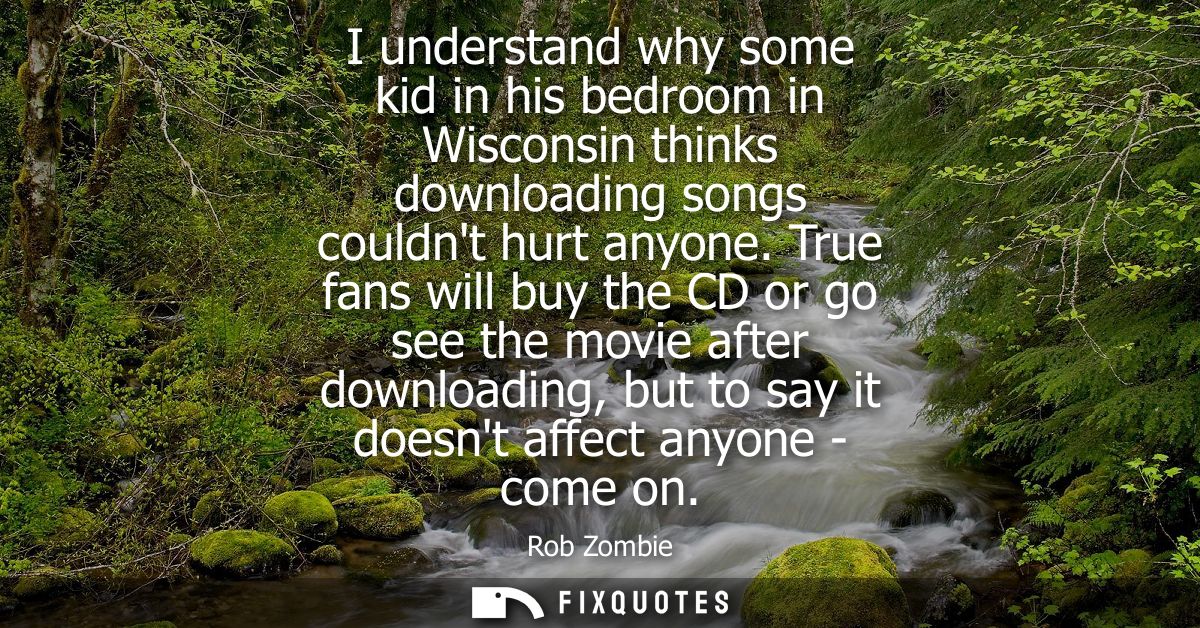
"I understand why some kid in his bedroom in Wisconsin thinks downloading songs couldn't hurt anyone. True fans will buy the CD or go see the movie after downloading, but to say it doesn't affect anyone - come on"
About this Quote
The subtext is an argument with a specific era of digital optimism, when file-sharing was framed as victimless, even promotional. Zombie swats at the familiar defense that “true fans will buy later,” because it turns an industry into a morality play: good fans pay, bad fans don’t, so the artist shouldn’t complain. His rebuttal isn’t abstract ethics; it’s material impact. “To say it doesn’t affect anyone - come on” aims at the willful blindness baked into early-2000s download culture, where the distance between click and cost made the cost feel imaginary.
Coming from a musician who also traffics in film and merch-heavy spectacle, the line doubles as a reminder that creative work is a supply chain, not just a vibe. Piracy isn’t just stealing from a millionaire frontman; it leaks value from the crew, the label, the budgets that let the next record exist at all.
Quote Details
| Topic | Music |
|---|---|
| Source | Help us find the source |
| Cite |
Citation Formats
APA Style (7th ed.)
Zombie, Rob. (2026, January 16). I understand why some kid in his bedroom in Wisconsin thinks downloading songs couldn't hurt anyone. True fans will buy the CD or go see the movie after downloading, but to say it doesn't affect anyone - come on. FixQuotes. https://fixquotes.com/quotes/i-understand-why-some-kid-in-his-bedroom-in-105908/
Chicago Style
Zombie, Rob. "I understand why some kid in his bedroom in Wisconsin thinks downloading songs couldn't hurt anyone. True fans will buy the CD or go see the movie after downloading, but to say it doesn't affect anyone - come on." FixQuotes. January 16, 2026. https://fixquotes.com/quotes/i-understand-why-some-kid-in-his-bedroom-in-105908/.
MLA Style (9th ed.)
"I understand why some kid in his bedroom in Wisconsin thinks downloading songs couldn't hurt anyone. True fans will buy the CD or go see the movie after downloading, but to say it doesn't affect anyone - come on." FixQuotes, 16 Jan. 2026, https://fixquotes.com/quotes/i-understand-why-some-kid-in-his-bedroom-in-105908/. Accessed 8 Apr. 2026.