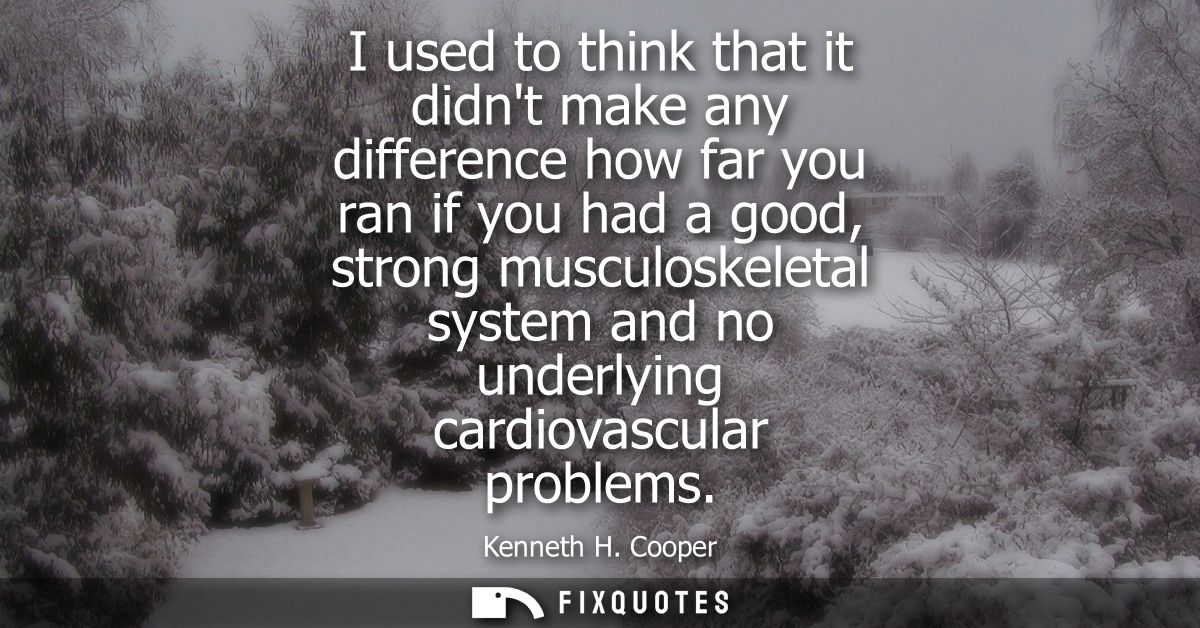
"I used to think that it didn't make any difference how far you ran if you had a good, strong musculoskeletal system and no underlying cardiovascular problems"
About this Quote
The specificity of the medical language matters. Cooper doesn’t say “strong legs” or “good shape”; he invokes systems, as if the body were a machine with checkable parts. That’s the mindset of mid-century training culture and military conditioning: observable toughness, measurable capacity, obvious failure modes. The subtext is that this model is seductively incomplete. It mistakes the absence of diagnosed disease for readiness, and it frames endurance as a simple test of components rather than a dynamic adaptation problem.
Contextually, Cooper’s larger project (the aerobics revolution) was about re-centering cardiovascular conditioning and long-term health, not just performance. This line performs the pivot: it marks a break from a brute-force view of fitness toward an evidence-based recognition that mileage interacts with metabolism, recovery, and risk in non-obvious ways. The intent isn’t merely to confess a past error; it’s to authorize a new orthodoxy by showing he once believed the old one. In military terms, it’s a strategic retreat that wins the campaign.
Quote Details
| Topic | Fitness |
|---|---|
| Source | Help us find the source |
| Cite |
Citation Formats
APA Style (7th ed.)
Cooper, Kenneth H. (2026, January 16). I used to think that it didn't make any difference how far you ran if you had a good, strong musculoskeletal system and no underlying cardiovascular problems. FixQuotes. https://fixquotes.com/quotes/i-used-to-think-that-it-didnt-make-any-difference-113951/
Chicago Style
Cooper, Kenneth H. "I used to think that it didn't make any difference how far you ran if you had a good, strong musculoskeletal system and no underlying cardiovascular problems." FixQuotes. January 16, 2026. https://fixquotes.com/quotes/i-used-to-think-that-it-didnt-make-any-difference-113951/.
MLA Style (9th ed.)
"I used to think that it didn't make any difference how far you ran if you had a good, strong musculoskeletal system and no underlying cardiovascular problems." FixQuotes, 16 Jan. 2026, https://fixquotes.com/quotes/i-used-to-think-that-it-didnt-make-any-difference-113951/. Accessed 12 Feb. 2026.