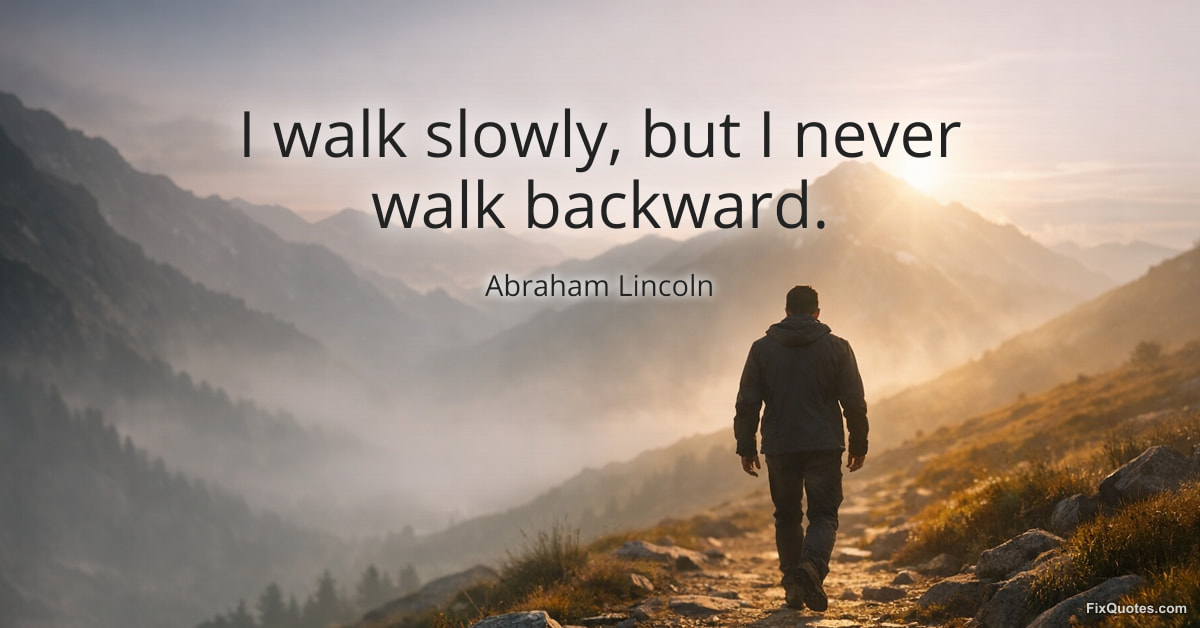
"I walk slowly, but I never walk backward"
About this Quote
The line has the steady, iron-forward cadence of a man trying to make “change” sound less like disruption and more like moral gravity. Lincoln admits the pace: slow. Not because he lacks conviction, but because governing a fractured republic is an exercise in drag forces - Congress, courts, public opinion, border states, battlefield realities. The brilliance is that the concession disarms criticism. He names the impatience in the room, then refuses its implied alternative: retreat.
“I never walk backward” is the hinge. It turns incrementalism into a form of courage. Lincoln’s subtext is that progress, once ethically claimed, must be directional even when it’s cautious. That’s a politician’s reassurance to allies who fear betrayal and a warning to opponents who assume pressure will reverse him. The phrase also carries a personal stamp: Lincoln’s reputation for deliberation, his habit of testing arguments, his reluctance to rush the nation into irreversible commitments. Slow walking reads like restraint; not walking backward reads like principle.
Placed against the Civil War era, it doubles as strategy. Emancipation itself unfolded as a sequence of steps - constrained early, bolder as conditions made it possible - and critics on both sides accused him of either timidity or tyranny. This sentence tries to reframe that entire controversy as a disciplined march: patient, yes, but aligned with a fixed moral compass.
It works rhetorically because it’s plainspoken and kinetic. You can see the gait. You can measure the direction. Lincoln makes history feel like a body moving through resistance, refusing the comfort of undoing what conscience has already learned.
“I never walk backward” is the hinge. It turns incrementalism into a form of courage. Lincoln’s subtext is that progress, once ethically claimed, must be directional even when it’s cautious. That’s a politician’s reassurance to allies who fear betrayal and a warning to opponents who assume pressure will reverse him. The phrase also carries a personal stamp: Lincoln’s reputation for deliberation, his habit of testing arguments, his reluctance to rush the nation into irreversible commitments. Slow walking reads like restraint; not walking backward reads like principle.
Placed against the Civil War era, it doubles as strategy. Emancipation itself unfolded as a sequence of steps - constrained early, bolder as conditions made it possible - and critics on both sides accused him of either timidity or tyranny. This sentence tries to reframe that entire controversy as a disciplined march: patient, yes, but aligned with a fixed moral compass.
It works rhetorically because it’s plainspoken and kinetic. You can see the gait. You can measure the direction. Lincoln makes history feel like a body moving through resistance, refusing the comfort of undoing what conscience has already learned.
Quote Details
| Topic | Perseverance |
|---|---|
| Source | Later attribution: Quotes: The Famous and Not so Famous (Terence M. Dorn Ph.D., 2021) modern compilationISBN: 9781662447952 · ID: ptZSEAAAQBAJ
Evidence: ... Abraham Lincoln Sir, my concern is not whether God is on our side; my greatest concern is to be on God's side, for God is always right.— Abraham Lincoln I walk slowly, but I never walk backward.—Abraham Lincoln I am struggling to ... Other candidates (1) Abraham Lincoln (Abraham Lincoln) compilation62.5% st not to swap horses when crossing a stream i am a slow walker but i never walk |
| Cite |
Citation Formats
APA Style (7th ed.)
Lincoln, Abraham. (2026, February 16). I walk slowly, but I never walk backward. FixQuotes. https://fixquotes.com/quotes/i-walk-slowly-but-i-never-walk-backward-17740/
Chicago Style
Lincoln, Abraham. "I walk slowly, but I never walk backward." FixQuotes. February 16, 2026. https://fixquotes.com/quotes/i-walk-slowly-but-i-never-walk-backward-17740/.
MLA Style (9th ed.)
"I walk slowly, but I never walk backward." FixQuotes, 16 Feb. 2026, https://fixquotes.com/quotes/i-walk-slowly-but-i-never-walk-backward-17740/. Accessed 31 Mar. 2026.
More Quotes by Abraham
Add to List