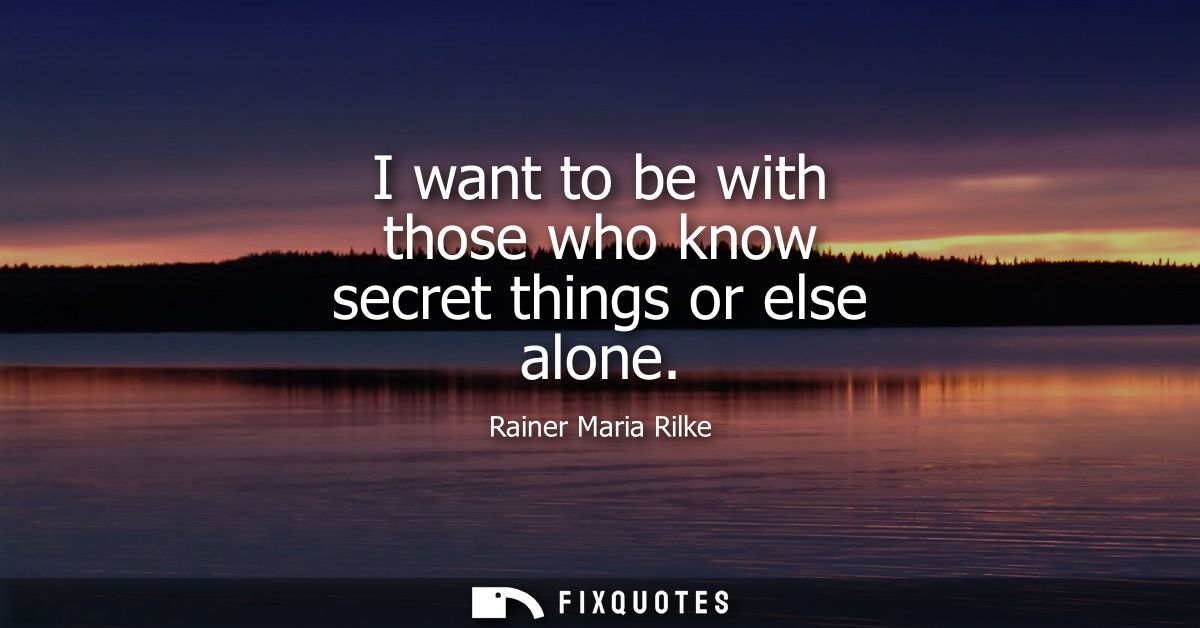
"I want to be with those who know secret things or else alone"
About this Quote
Rilke isn’t romanticizing loneliness here so much as issuing a quality-control ultimatum. “Those who know secret things” aren’t mere confidants; they’re initiates. The line divides humanity into two tolerable categories: people who can meet him at the depth where experience turns private and incommunicable, and the clean silence of being alone. Everyone else is noise.
The sentence works because it refuses the polite middle ground. Most of us settle for company that’s pleasant, easy, socially legible. Rilke makes that option feel like a betrayal of perception itself. “Secret things” signals more than gossip or hidden facts; it points to the unsayable truths that art tries to smuggle into language: fear, ecstasy, shame, the strange meanings objects accrue when you’re truly paying attention. To “know” them is to have lived in a way that produces inner evidence, not just opinions.
There’s also a bracing ethics implied: intimacy isn’t about proximity, it’s about capacity. If you can’t bear another person’s inwardness, or they can’t bear yours, solitude becomes the more honest choice. That’s very Rilke, whose work keeps circling the idea that real creation requires a kind of disciplined aloneness, and that love itself should protect each person’s solitude rather than cancel it.
Written in the shadow of early modernity’s dislocations - new cities, new speeds, a thinning of inherited meaning - the line reads like a survival strategy: choose the rare communion of depth, or choose yourself. Anything else is a dilution.
The sentence works because it refuses the polite middle ground. Most of us settle for company that’s pleasant, easy, socially legible. Rilke makes that option feel like a betrayal of perception itself. “Secret things” signals more than gossip or hidden facts; it points to the unsayable truths that art tries to smuggle into language: fear, ecstasy, shame, the strange meanings objects accrue when you’re truly paying attention. To “know” them is to have lived in a way that produces inner evidence, not just opinions.
There’s also a bracing ethics implied: intimacy isn’t about proximity, it’s about capacity. If you can’t bear another person’s inwardness, or they can’t bear yours, solitude becomes the more honest choice. That’s very Rilke, whose work keeps circling the idea that real creation requires a kind of disciplined aloneness, and that love itself should protect each person’s solitude rather than cancel it.
Written in the shadow of early modernity’s dislocations - new cities, new speeds, a thinning of inherited meaning - the line reads like a survival strategy: choose the rare communion of depth, or choose yourself. Anything else is a dilution.
Quote Details
| Topic | Deep |
|---|---|
| Source | Later attribution: Selected Poems of Rainer Maria Rilke (Rainer Maria Rilke, 1981) modern compilation
Evidence: Rainer Maria Rilke. I am too alone in the world , and not alone enough to make every minute holy . I am too tiny in ... I want to be with those who know secret things or else alone . I want to be a mirror for your whole body , and I ... Other candidates (2) Rainer Maria Rilke (Rainer Maria Rilke) compilation76.9% when something is approaching i want to be with those who are wise or else alone Poems (Rilke, Rainer Maria, 1926) primary39.2% ing winds and must bend with them while the things beneath are not yet stirring |
| Cite |
Citation Formats
APA Style (7th ed.)
Rilke, Rainer Maria. (2026, February 7). I want to be with those who know secret things or else alone. FixQuotes. https://fixquotes.com/quotes/i-want-to-be-with-those-who-know-secret-things-or-14915/
Chicago Style
Rilke, Rainer Maria. "I want to be with those who know secret things or else alone." FixQuotes. February 7, 2026. https://fixquotes.com/quotes/i-want-to-be-with-those-who-know-secret-things-or-14915/.
MLA Style (9th ed.)
"I want to be with those who know secret things or else alone." FixQuotes, 7 Feb. 2026, https://fixquotes.com/quotes/i-want-to-be-with-those-who-know-secret-things-or-14915/. Accessed 2 Apr. 2026.
More Quotes by Rainer
Add to List