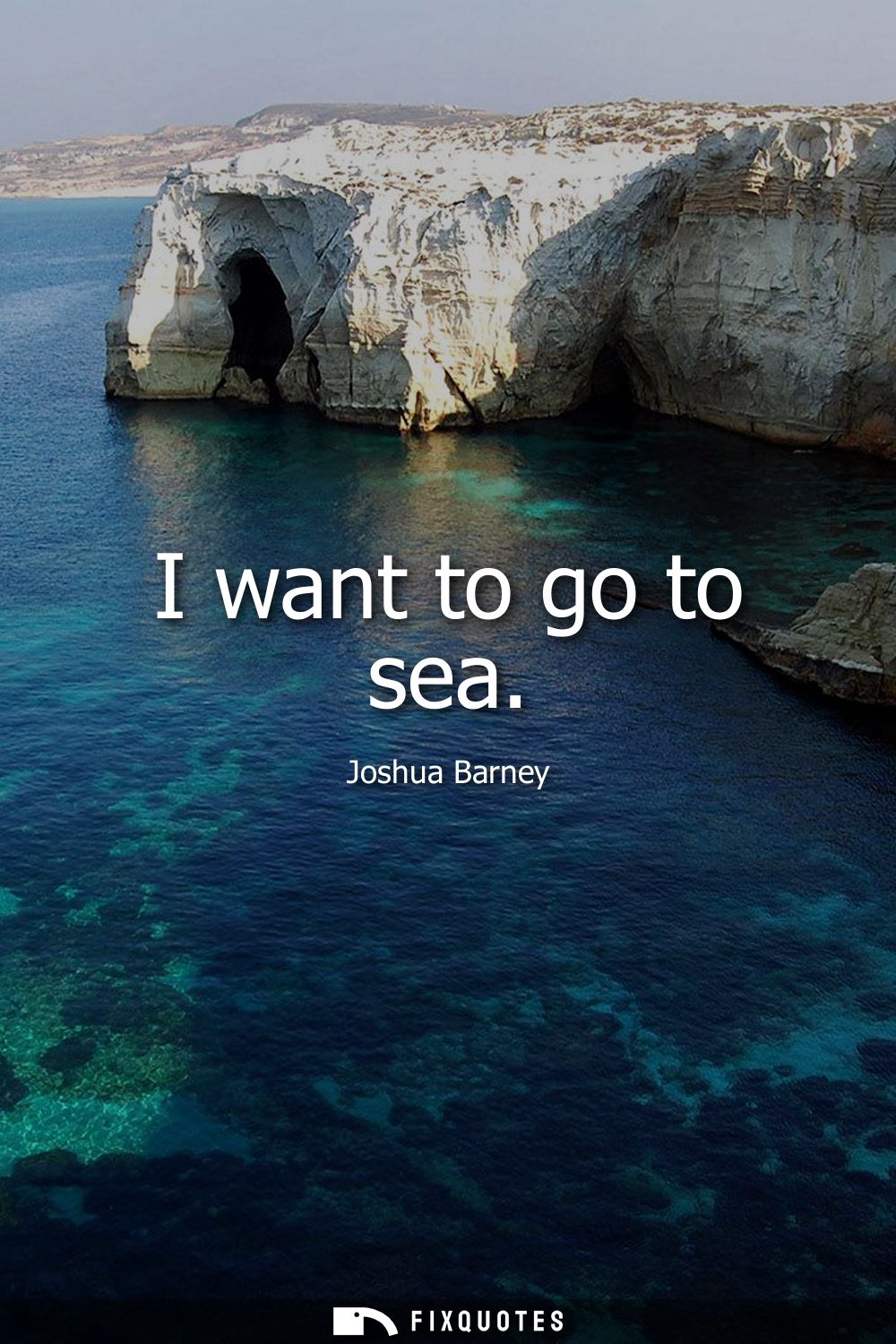
"I want to go to sea"
About this Quote
A soldier saying "I want to go to sea" lands like a small mutiny against the life he already knows. In four plain words, Barney pivots from the disciplined, mud-and-march world of armies to the volatile promise of the ocean. The intent is practical on the surface - a career move, a change of theater, a bid for wages or advancement - but the phrasing makes it feel like craving rather than strategy. "Want" is doing the heavy lifting: it frames the sea not as assignment, but as desire, a place where the speaker imagines agency.
The subtext is restless ambition shaped by an era when the Atlantic was both opportunity and danger. For an 18th-century Anglo-American world, the sea meant commerce, privateering, naval prestige, and a different kind of masculinity: less rank-and-file obedience, more improvisation under pressure. A soldier longing for the sea is also confessing a dissatisfaction with landbound hierarchies. He wants motion, risk, and the clean drama of horizons.
Context sharpens the line. Barney's lifetime spans revolutions, imperial wars, and the young United States scrambling to define itself. Maritime service was a front row seat to national fate: blockades, raids, prizes, and the fragile economics of war. The quote's minimalism works because it refuses rhetoric. No patriotism, no grand cause - just appetite. That bluntness reads as confidence: he doesn't need to persuade you, only to declare where history feels most alive.
The subtext is restless ambition shaped by an era when the Atlantic was both opportunity and danger. For an 18th-century Anglo-American world, the sea meant commerce, privateering, naval prestige, and a different kind of masculinity: less rank-and-file obedience, more improvisation under pressure. A soldier longing for the sea is also confessing a dissatisfaction with landbound hierarchies. He wants motion, risk, and the clean drama of horizons.
Context sharpens the line. Barney's lifetime spans revolutions, imperial wars, and the young United States scrambling to define itself. Maritime service was a front row seat to national fate: blockades, raids, prizes, and the fragile economics of war. The quote's minimalism works because it refuses rhetoric. No patriotism, no grand cause - just appetite. That bluntness reads as confidence: he doesn't need to persuade you, only to declare where history feels most alive.
Quote Details
| Topic | Ocean & Sea |
|---|
More Quotes by Joshua
Add to List