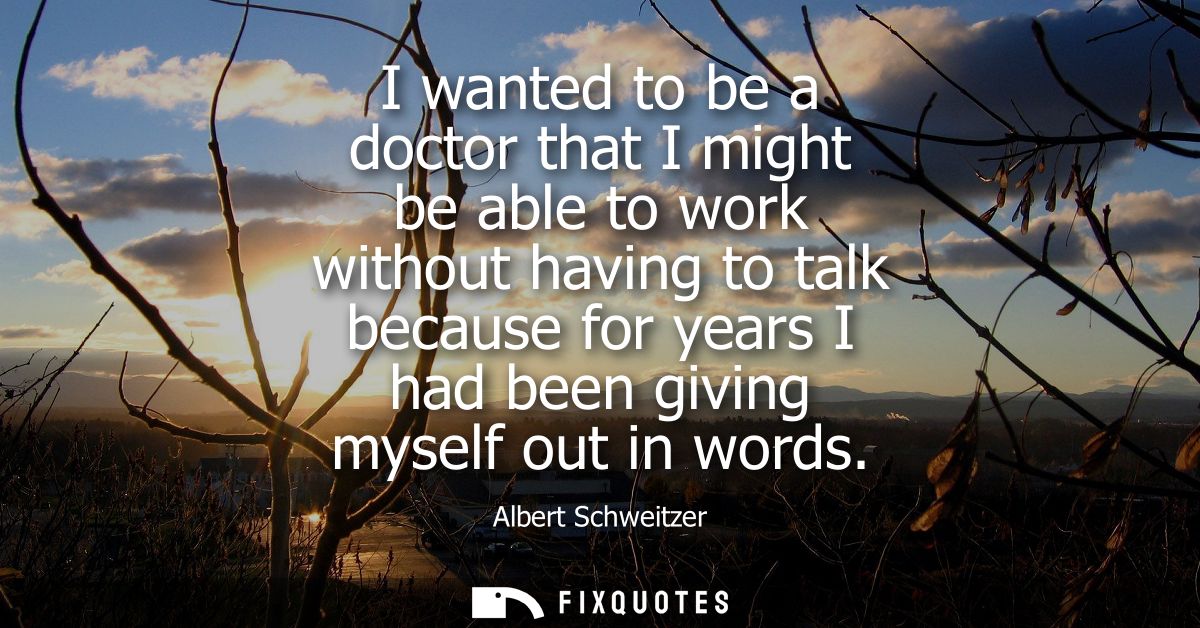
"I wanted to be a doctor that I might be able to work without having to talk because for years I had been giving myself out in words"
About this Quote
The subtext is fatigue with performance. "Giving myself out in words" suggests expenditure, a slow leak of attention and spirit. Schweitzer isn’t rejecting thought; he’s rejecting the social machinery that turns thought into ceaseless output. Medicine, in his imagination, offers a different kind of authority: tactile, immediate, judged by relief rather than rhetoric. It’s not anti-intellectualism; it’s a shift from persuasion to presence.
Context sharpens the stakes. Schweitzer’s era prized grand systems and moral pronouncements, and he was trained to supply them. His later turn to medical work (and to Lambarene) is often packaged as heroic renunciation. This sentence complicates the legend. It implies that the move toward hands-on care was also self-preservation, a way to stop being endlessly legible. Schweitzer makes vocation sound like an escape hatch: not from responsibility, but from the exhaustion of constantly having to prove your soul in public.
Quote Details
| Topic | Doctor |
|---|---|
| Source | Verified source: Out of My Life and Thought: An Autobiography (Albert Schweitzer, 1933)
Evidence:
I wanted to be a doctor that I might be able to work without having to talk. For years I had been giving myself out in words and it was with joy that I had followed the calling of theological teacher and of preacher.. Primary-source match found in Albert Schweitzer’s autobiography, commonly published in English as “Out of My Life and Thought: An Autobiography” (English edition widely listed as 1933). The Nobel Prize presentation speech for the 1952 Peace Prize quotes Schweitzer with very similar wording (“I wanted to become a doctor in order to be able to work without words...”), indicating the line was already in his published writings. I did not verify a specific page number in a publisher-scanned/print-verified copy within this search session; the quote appears in digitized copies of the autobiography, but those copies don’t reliably preserve original pagination. For ‘first published’, this points to Schweitzer’s autobiography as the original publication context for the English form of the quote; earlier-first publication may exist in the original-language edition prior to 1933. |
| Cite |
Citation Formats
APA Style (7th ed.)
Schweitzer, Albert. (2026, March 4). I wanted to be a doctor that I might be able to work without having to talk because for years I had been giving myself out in words. FixQuotes. https://fixquotes.com/quotes/i-wanted-to-be-a-doctor-that-i-might-be-able-to-22939/
Chicago Style
Schweitzer, Albert. "I wanted to be a doctor that I might be able to work without having to talk because for years I had been giving myself out in words." FixQuotes. March 4, 2026. https://fixquotes.com/quotes/i-wanted-to-be-a-doctor-that-i-might-be-able-to-22939/.
MLA Style (9th ed.)
"I wanted to be a doctor that I might be able to work without having to talk because for years I had been giving myself out in words." FixQuotes, 4 Mar. 2026, https://fixquotes.com/quotes/i-wanted-to-be-a-doctor-that-i-might-be-able-to-22939/. Accessed 8 Apr. 2026.