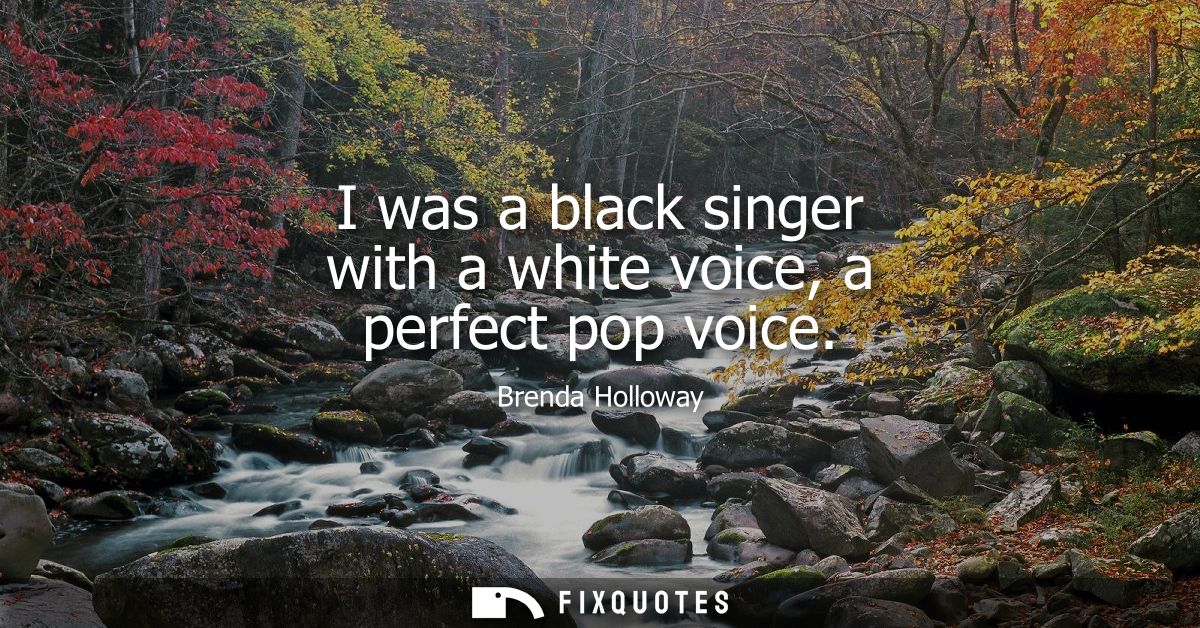
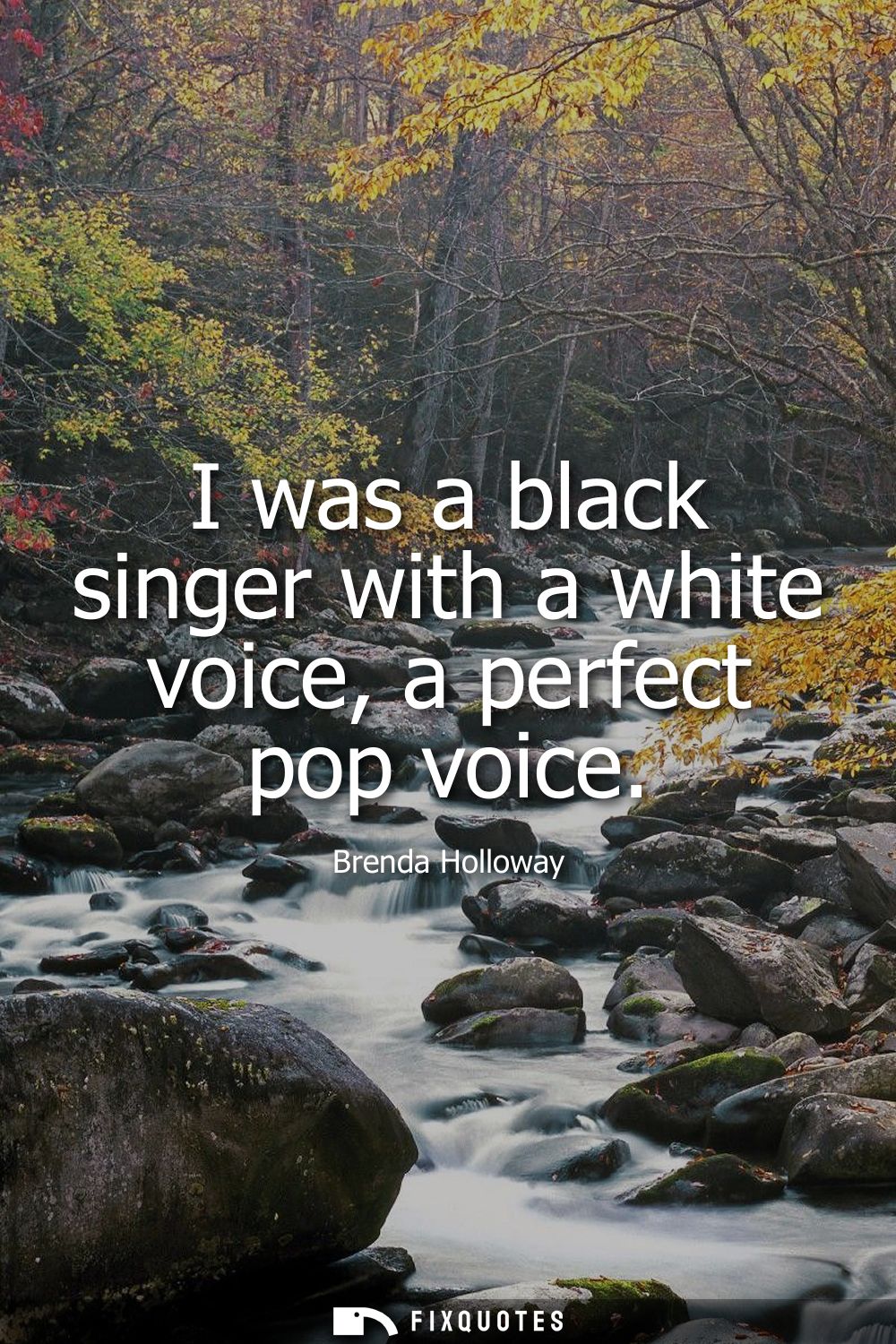
"I was a black singer with a white voice, a perfect pop voice"
About this Quote
Brenda Holloway’s line lands like a confession and an indictment. “A black singer with a white voice” isn’t just autobiography; it’s the brutally efficient shorthand of an era when “pop” was coded as white, and marketability depended on how safely a Black artist could be packaged for mainstream ears. By calling it “a perfect pop voice,” Holloway signals pride in her instrument while exposing the trap door beneath the compliment: perfection defined by someone else’s yardstick.
The phrasing is doing double work. On the surface, it’s about timbre and diction, the smoothness that Motown and other hit factories prized for crossover radio. Underneath, it’s about gatekeeping. A “white voice” implies acceptability, a passport through the industry’s segregated channels, where Blackness could be tolerated as long as it arrived wrapped in familiar sonic cues. The line also carries the sting of self-awareness: to even describe her voice this way is to acknowledge how deeply those categories were baked into the business, and into artists’ own self-conceptions.
Context matters: Holloway came up in the mid-1960s, when Motown’s polished sound was engineered for national consumption, and when Black women performers were often pushed to be glamorous, controlled, and non-threatening. Her quote captures the bargain: immense talent, carefully managed presentation, and still the lingering question of who gets to own “pop.” It’s a reminder that genre labels aren’t neutral; they’re cultural border patrol.
The phrasing is doing double work. On the surface, it’s about timbre and diction, the smoothness that Motown and other hit factories prized for crossover radio. Underneath, it’s about gatekeeping. A “white voice” implies acceptability, a passport through the industry’s segregated channels, where Blackness could be tolerated as long as it arrived wrapped in familiar sonic cues. The line also carries the sting of self-awareness: to even describe her voice this way is to acknowledge how deeply those categories were baked into the business, and into artists’ own self-conceptions.
Context matters: Holloway came up in the mid-1960s, when Motown’s polished sound was engineered for national consumption, and when Black women performers were often pushed to be glamorous, controlled, and non-threatening. Her quote captures the bargain: immense talent, carefully managed presentation, and still the lingering question of who gets to own “pop.” It’s a reminder that genre labels aren’t neutral; they’re cultural border patrol.
Quote Details
| Topic | Music |
|---|---|
| Source | Help us find the source |
| Cite |
Citation Formats
APA Style (7th ed.)
Holloway, Brenda. (2026, January 15). I was a black singer with a white voice, a perfect pop voice. FixQuotes. https://fixquotes.com/quotes/i-was-a-black-singer-with-a-white-voice-a-perfect-142034/
Chicago Style
Holloway, Brenda. "I was a black singer with a white voice, a perfect pop voice." FixQuotes. January 15, 2026. https://fixquotes.com/quotes/i-was-a-black-singer-with-a-white-voice-a-perfect-142034/.
MLA Style (9th ed.)
"I was a black singer with a white voice, a perfect pop voice." FixQuotes, 15 Jan. 2026, https://fixquotes.com/quotes/i-was-a-black-singer-with-a-white-voice-a-perfect-142034/. Accessed 12 Feb. 2026.
More Quotes by Brenda
Add to List