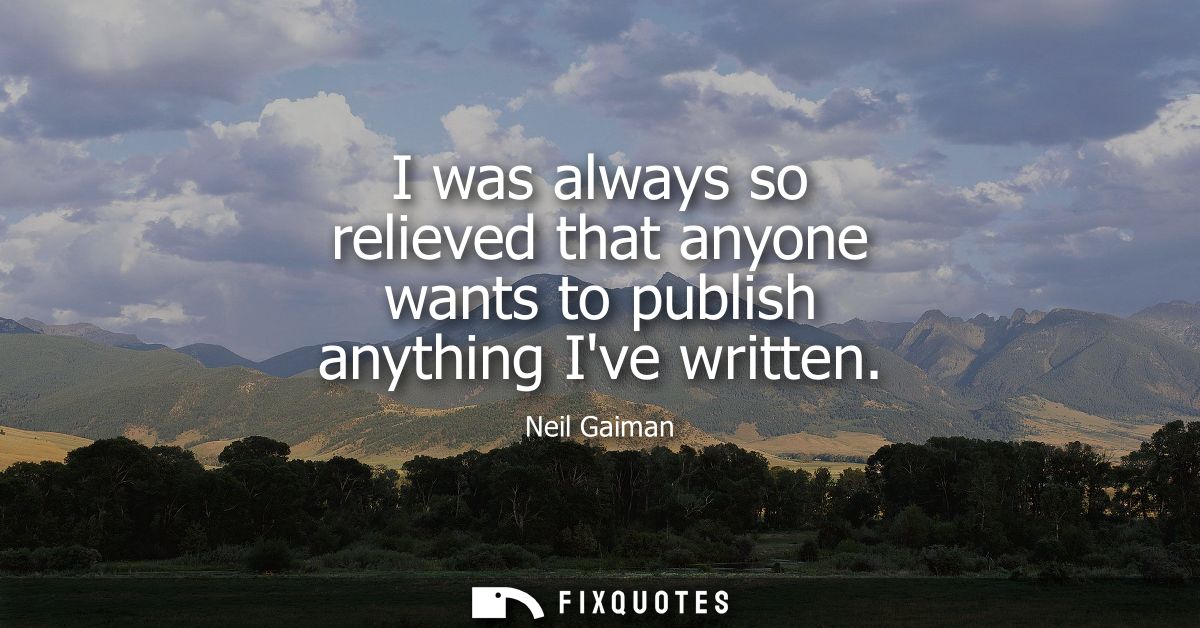
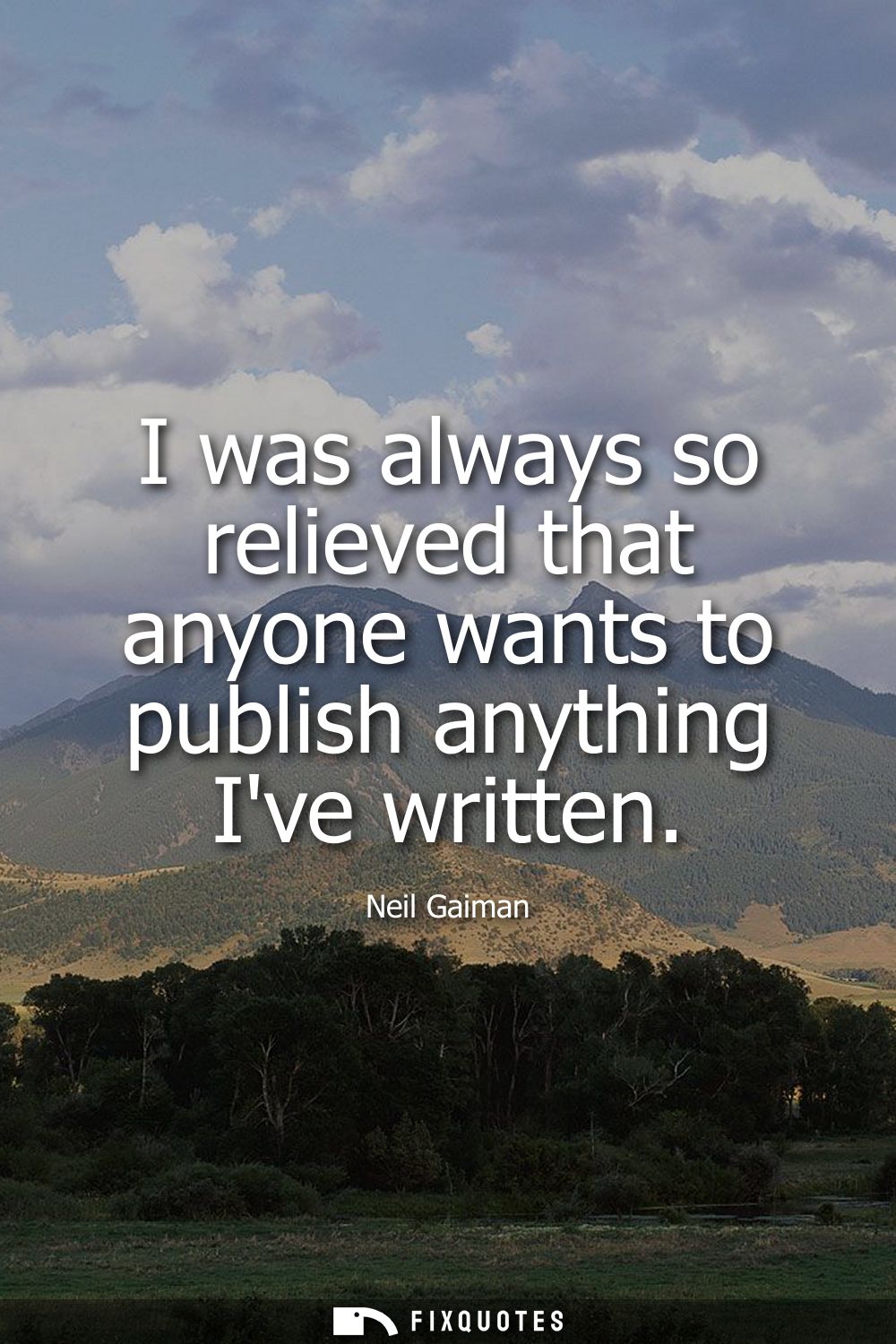
"I was always so relieved that anyone wants to publish anything I've written"
About this Quote
The subtext is a familiar syndrome among creatives who look outward and see only the precariousness: the unread manuscript, the fickle market, the taste-makers who can kill a book with a shrug. By framing publication as something granted by “anyone,” Gaiman also collapses hierarchy. The editor, the magazine, the small press, the last-minute anthology slot - all count. That’s not just humility; it’s a worldview shaped by years of freelancing, pitching, and writing across forms (comics, journalism, children’s books, novels), where each new project restarts the audition.
Context matters: Gaiman came up in industries where reputation doesn’t fully transfer between mediums, and where genre work was long treated as second-class. The line carries a quiet defense of the so-called marginal: fantasy, myth, pop culture alchemy. If you’re relieved to be published, you’re also admitting you still feel outside the velvet rope. That tension - celebrated, yet never entirely safe - is a big part of why his work keeps its human pulse.
Quote Details
| Topic | Writing |
|---|---|
| Source | Help us find the source |
| Cite |
Citation Formats
APA Style (7th ed.)
Gaiman, Neil. (2026, January 17). I was always so relieved that anyone wants to publish anything I've written. FixQuotes. https://fixquotes.com/quotes/i-was-always-so-relieved-that-anyone-wants-to-25871/
Chicago Style
Gaiman, Neil. "I was always so relieved that anyone wants to publish anything I've written." FixQuotes. January 17, 2026. https://fixquotes.com/quotes/i-was-always-so-relieved-that-anyone-wants-to-25871/.
MLA Style (9th ed.)
"I was always so relieved that anyone wants to publish anything I've written." FixQuotes, 17 Jan. 2026, https://fixquotes.com/quotes/i-was-always-so-relieved-that-anyone-wants-to-25871/. Accessed 9 Mar. 2026.