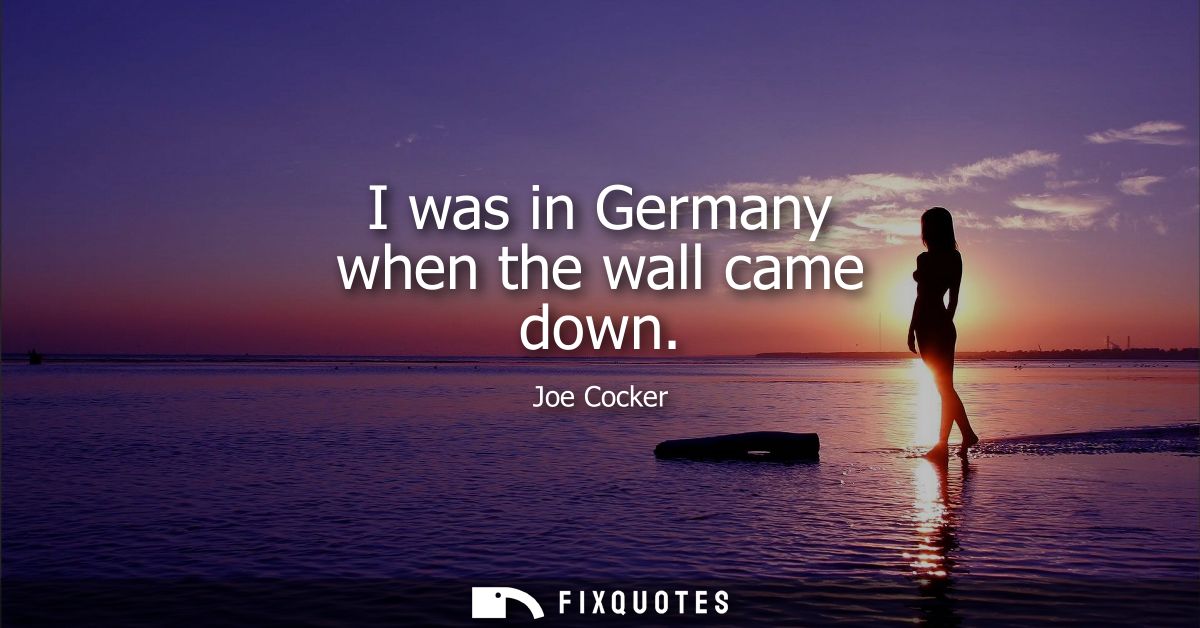
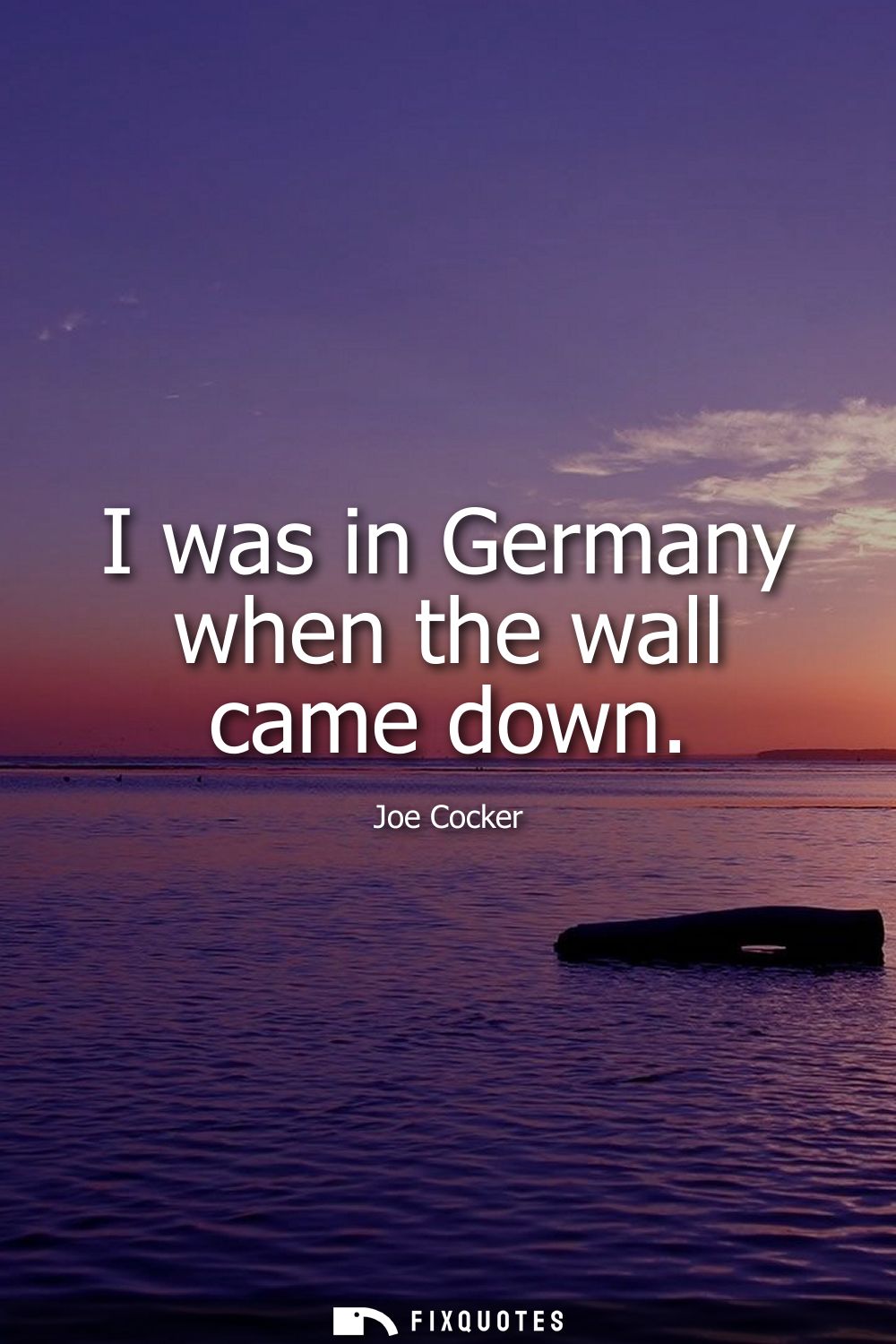
"I was in Germany when the wall came down"
About this Quote
Joe Cocker’s line lands with the blunt force of a tour anecdote and the quiet authority of a witness statement. “I was in Germany when the wall came down” isn’t a thesis; it’s a positioning. Cocker isn’t claiming to have caused history, just to have been close enough to feel its heat. That humility matters coming from a musician whose whole career traded in rawness and lived-in credibility. He’s telling you: I didn’t read about it later, I didn’t mythologize it from afar. I was there.
The subtext is about proximity as legitimacy. Pop culture figures are often treated as passengers on the world’s events, floating above politics in a bubble of backstage passes. Cocker flips that. By pinning himself to a precise moment and place, he collapses the distance between “serious history” and the touring life. It suggests how the late Cold War era was experienced not just through policy speeches, but through crowds, venues, border checks, and the sudden reshuffling of what “Europe” meant in real time.
Context does a lot of work: the fall of the Berlin Wall in 1989 is shorthand for the end of an order, the release of pressure, the idea that the future can suddenly unfreeze. Cocker’s music has always been about voice as abrasion and release, so the moment echoes his aesthetic. The sentence is so simple it feels almost stunned, like the only honest response to watching a world redraw itself overnight.
The subtext is about proximity as legitimacy. Pop culture figures are often treated as passengers on the world’s events, floating above politics in a bubble of backstage passes. Cocker flips that. By pinning himself to a precise moment and place, he collapses the distance between “serious history” and the touring life. It suggests how the late Cold War era was experienced not just through policy speeches, but through crowds, venues, border checks, and the sudden reshuffling of what “Europe” meant in real time.
Context does a lot of work: the fall of the Berlin Wall in 1989 is shorthand for the end of an order, the release of pressure, the idea that the future can suddenly unfreeze. Cocker’s music has always been about voice as abrasion and release, so the moment echoes his aesthetic. The sentence is so simple it feels almost stunned, like the only honest response to watching a world redraw itself overnight.
Quote Details
| Topic | Freedom |
|---|---|
| Source | Help us find the source |
| Cite |
Citation Formats
APA Style (7th ed.)
Cocker, Joe. (2026, January 16). I was in Germany when the wall came down. FixQuotes. https://fixquotes.com/quotes/i-was-in-germany-when-the-wall-came-down-117722/
Chicago Style
Cocker, Joe. "I was in Germany when the wall came down." FixQuotes. January 16, 2026. https://fixquotes.com/quotes/i-was-in-germany-when-the-wall-came-down-117722/.
MLA Style (9th ed.)
"I was in Germany when the wall came down." FixQuotes, 16 Jan. 2026, https://fixquotes.com/quotes/i-was-in-germany-when-the-wall-came-down-117722/. Accessed 27 Mar. 2026.
More Quotes by Joe
Add to List