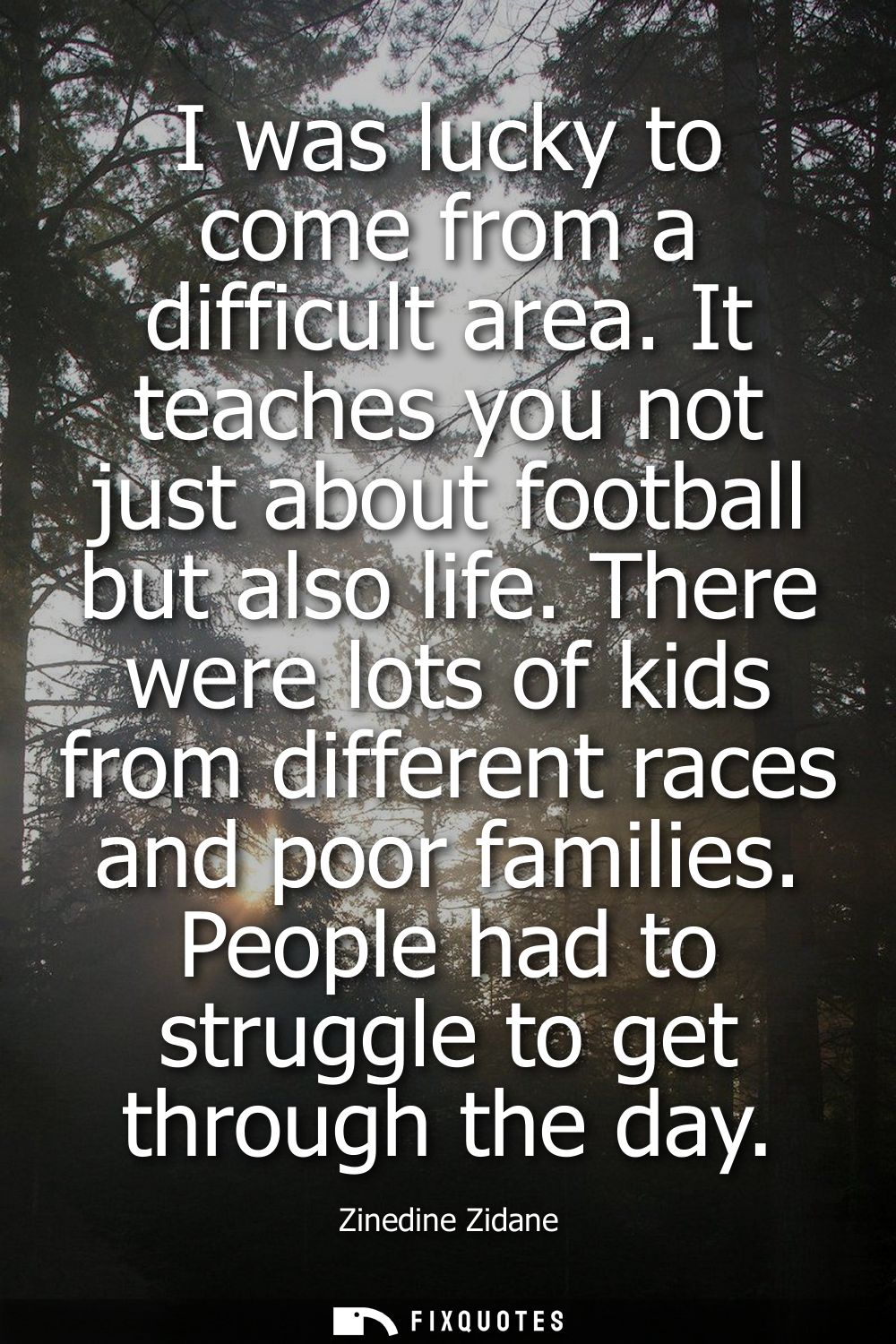
"I was lucky to come from a difficult area. It teaches you not just about football but also life. There were lots of kids from different races and poor families. People had to struggle to get through the day"
About this Quote
The subtext is biography. Zidane grew up in La Castellane, a working-class, immigrant-heavy housing estate in Marseille, a place routinely framed by French media as a problem to be managed. By foregrounding "different races and poor families", he’s gently rejecting the sanitized origin stories that make stars seem inevitable. Instead, he points to a social ecosystem: kids sharing cramped circumstances, learning code-switching and solidarity because the alternative is getting swallowed by the day-to-day grind. "People had to struggle" is doing a lot of work here; it widens the lens from personal grit to structural pressure.
There’s also a subtle political move in how he talks about race. Zidane doesn’t perform outrage or preach policy. He normalizes multiracial life as the baseline and struggle as the common denominator, which is its own rebuke to the nationalist story that Frenchness is singular and comfortable. The intent isn’t to ask for pity. It’s to explain why he’s unshakeable - and why the calm you saw on the pitch was forged long before the stadium lights.
Quote Details
| Topic | Overcoming Obstacles |
|---|---|
| Source | Help us find the source |
| Cite |
Citation Formats
APA Style (7th ed.)
Zidane, Zinedine. (2026, January 16). I was lucky to come from a difficult area. It teaches you not just about football but also life. There were lots of kids from different races and poor families. People had to struggle to get through the day. FixQuotes. https://fixquotes.com/quotes/i-was-lucky-to-come-from-a-difficult-area-it-122227/
Chicago Style
Zidane, Zinedine. "I was lucky to come from a difficult area. It teaches you not just about football but also life. There were lots of kids from different races and poor families. People had to struggle to get through the day." FixQuotes. January 16, 2026. https://fixquotes.com/quotes/i-was-lucky-to-come-from-a-difficult-area-it-122227/.
MLA Style (9th ed.)
"I was lucky to come from a difficult area. It teaches you not just about football but also life. There were lots of kids from different races and poor families. People had to struggle to get through the day." FixQuotes, 16 Jan. 2026, https://fixquotes.com/quotes/i-was-lucky-to-come-from-a-difficult-area-it-122227/. Accessed 12 Feb. 2026.