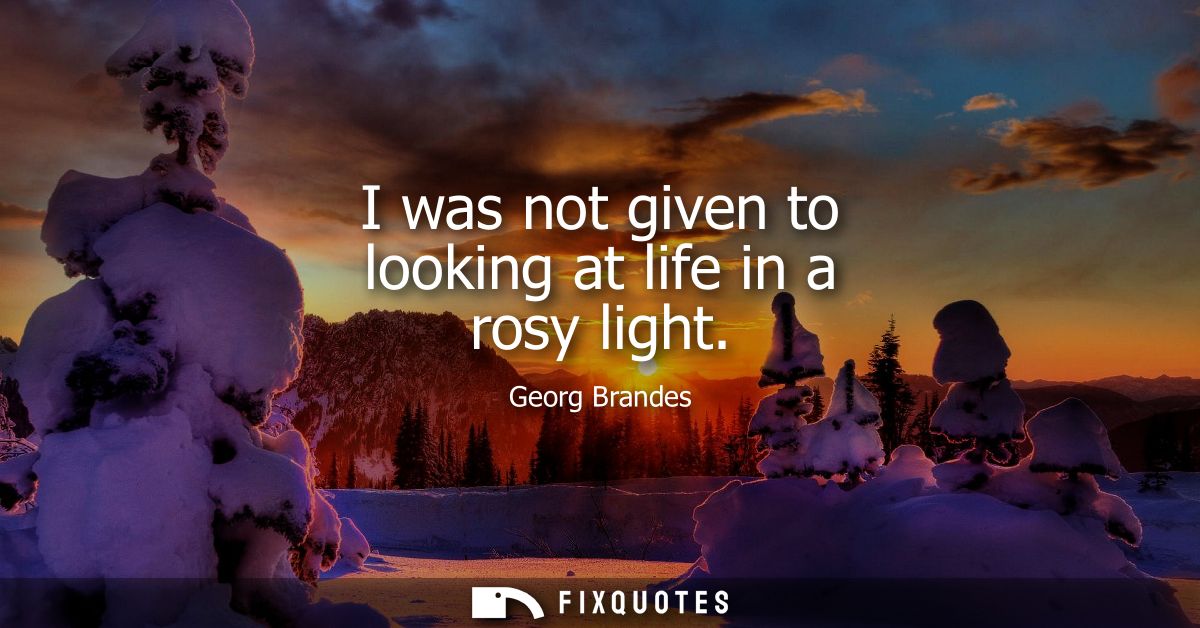
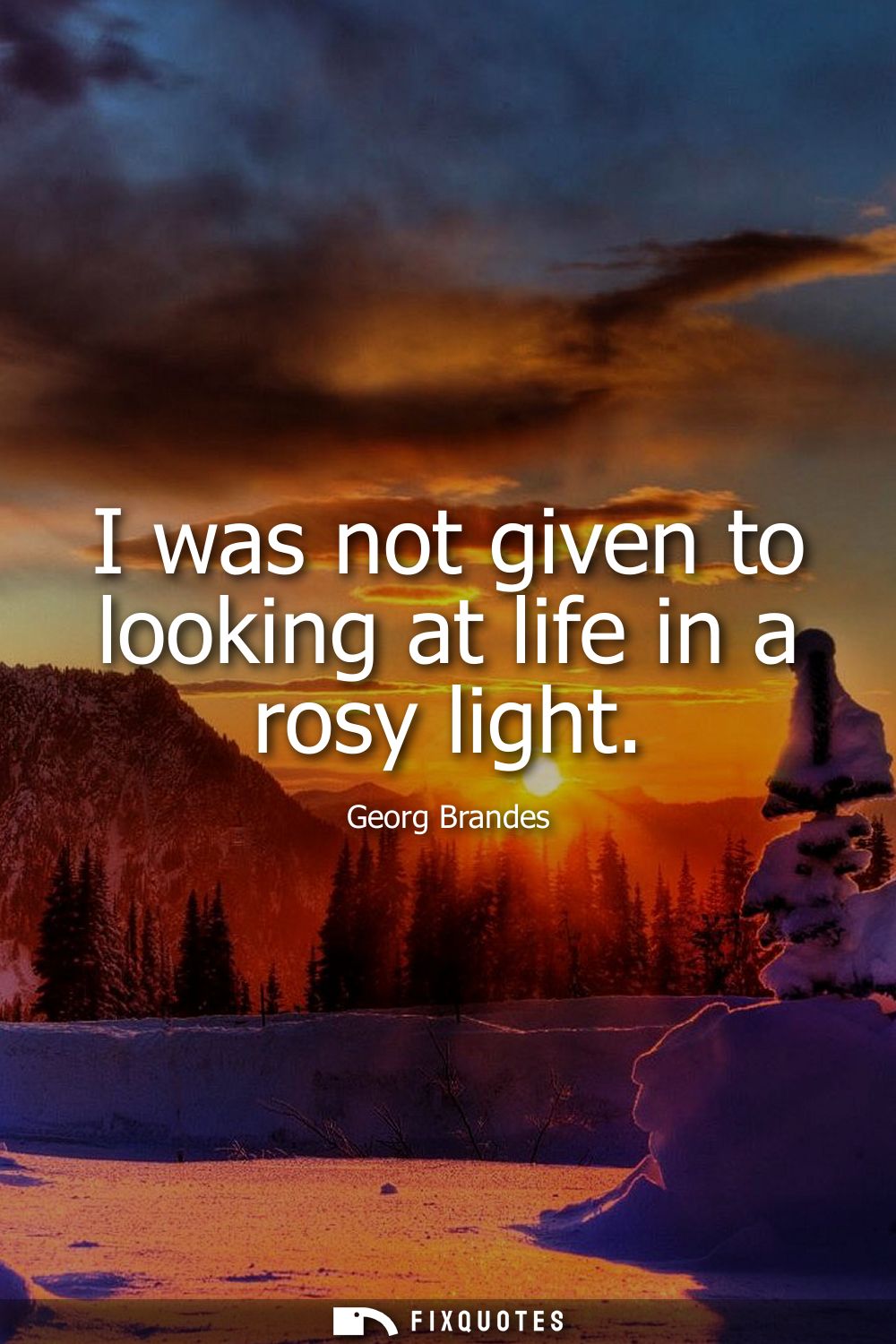
"I was not given to looking at life in a rosy light"
About this Quote
A small sentence that quietly rejects the most marketable posture in public life: optimism. Brandes frames his temperament as something closer to a discipline than a mood. “Not given to” is doing sly work here. It’s modest, almost apologetic, as if he’s merely reporting a limitation. But the subtext is a claim of credibility: he won’t flatter life into meaning, and he won’t flatter readers into comfort.
As a critic in the late 19th century, Brandes made his name by demanding that literature confront the real conditions of modernity - sex, power, hypocrisy, class - rather than retreat into respectable fog. The “rosy light” is the Victorian lamp shade: aesthetic prettification, moral reassurance, nationalism packaged as uplift. By declining it, he positions himself against the consoling narratives that cultures tell when they’re anxious about change. This is not melancholy for its own sake; it’s a refusal of sentimentality as ideology.
The line also has the protective chill of self-description. Critics are often accused of negativity because they describe what’s broken; Brandes preempts that charge by presenting unsparing perception as his baseline setting. The effect is to make pessimism sound like hygiene. In an era that prized “edification,” Brandes insists on illumination - harsher, clearer, less forgiving. That’s why it works: he turns a personal trait into an ethical stance, and turns ethics into style.
As a critic in the late 19th century, Brandes made his name by demanding that literature confront the real conditions of modernity - sex, power, hypocrisy, class - rather than retreat into respectable fog. The “rosy light” is the Victorian lamp shade: aesthetic prettification, moral reassurance, nationalism packaged as uplift. By declining it, he positions himself against the consoling narratives that cultures tell when they’re anxious about change. This is not melancholy for its own sake; it’s a refusal of sentimentality as ideology.
The line also has the protective chill of self-description. Critics are often accused of negativity because they describe what’s broken; Brandes preempts that charge by presenting unsparing perception as his baseline setting. The effect is to make pessimism sound like hygiene. In an era that prized “edification,” Brandes insists on illumination - harsher, clearer, less forgiving. That’s why it works: he turns a personal trait into an ethical stance, and turns ethics into style.
Quote Details
| Topic | Life |
|---|---|
| Source | Help us find the source |
| Cite |
Citation Formats
APA Style (7th ed.)
Brandes, Georg. (2026, January 16). I was not given to looking at life in a rosy light. FixQuotes. https://fixquotes.com/quotes/i-was-not-given-to-looking-at-life-in-a-rosy-light-90055/
Chicago Style
Brandes, Georg. "I was not given to looking at life in a rosy light." FixQuotes. January 16, 2026. https://fixquotes.com/quotes/i-was-not-given-to-looking-at-life-in-a-rosy-light-90055/.
MLA Style (9th ed.)
"I was not given to looking at life in a rosy light." FixQuotes, 16 Jan. 2026, https://fixquotes.com/quotes/i-was-not-given-to-looking-at-life-in-a-rosy-light-90055/. Accessed 13 Mar. 2026.
More Quotes by Georg
Add to List