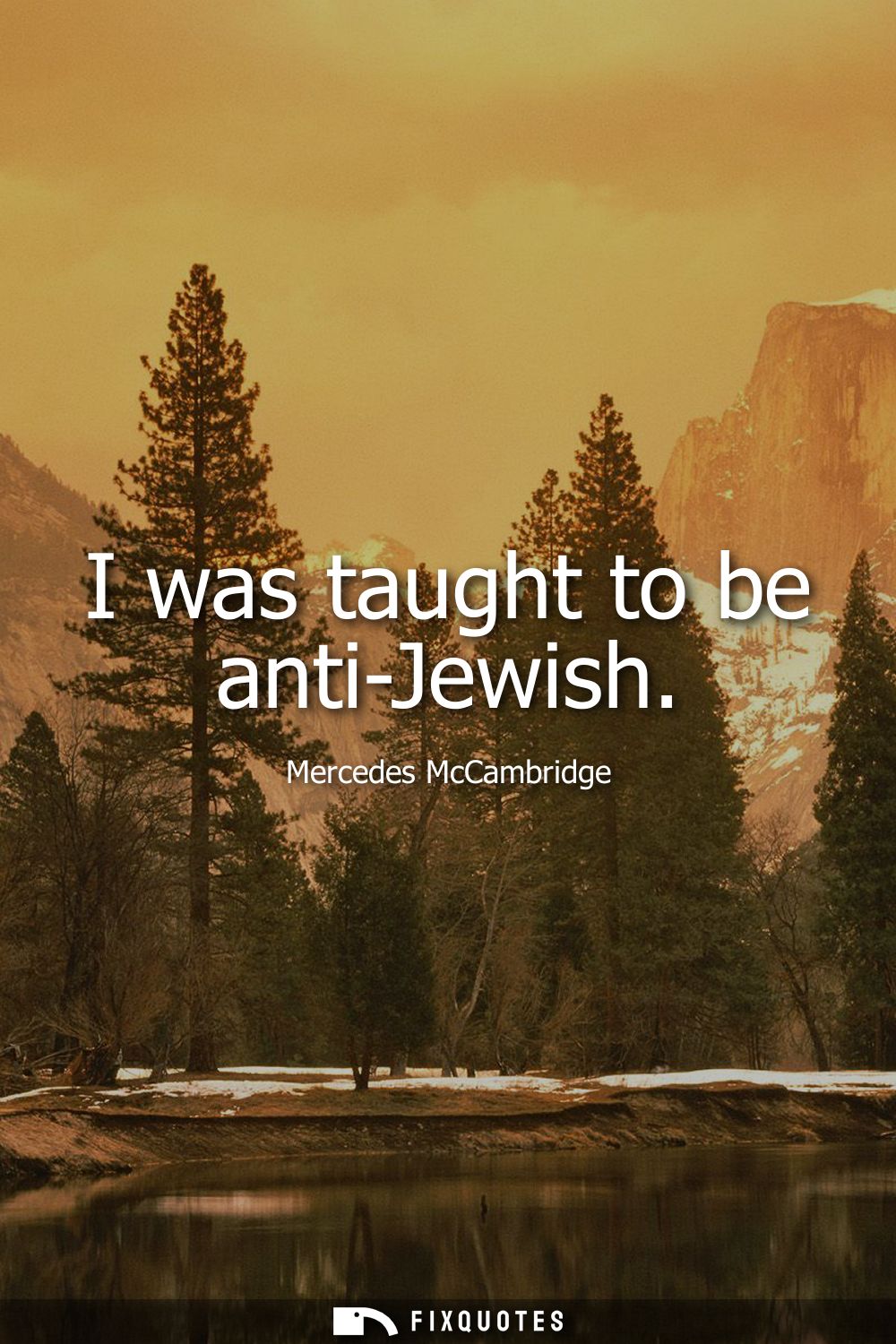
"I was taught to be anti-Jewish"
About this Quote
A sentence like this lands with the thud of confession and the precision of an indictment. McCambridge doesn’t say, “I was anti-Jewish,” as if prejudice were a personality quirk or private failing. She says, “I was taught,” moving the blame upstream to the social machinery that manufactures bigotry: family talk, church culture, casual jokes, the “normal” assumptions of a community. It’s a small grammatical choice that opens a much larger moral frame. If hate is learned, it can be unlearned - but only after someone admits it was never innate.
Coming from an actress, the line carries an extra meta-charge. Acting is a profession built on inhabiting scripts written by others; here she’s exposing the ugliest script she inherited. The passive construction also hints at how prejudice often works in practice: not through overt declarations but through education-by-osmosis, a curriculum of insinuations that trains reflexes before it trains thoughts.
The intent feels less like self-exoneration than a demand for accountability without melodrama. The subtext is: don’t comfort me for my honesty; ask who did the teaching, what institutions benefited, who stayed silent. In the 20th-century American entertainment world - where Jewish creators were foundational and antisemitism still circulated socially and professionally - that admission reads as both personal reckoning and cultural critique. It’s one line that refuses the easy narrative of “good people vs. bad people” and points instead to systems that make bad ideas feel like common sense.
Coming from an actress, the line carries an extra meta-charge. Acting is a profession built on inhabiting scripts written by others; here she’s exposing the ugliest script she inherited. The passive construction also hints at how prejudice often works in practice: not through overt declarations but through education-by-osmosis, a curriculum of insinuations that trains reflexes before it trains thoughts.
The intent feels less like self-exoneration than a demand for accountability without melodrama. The subtext is: don’t comfort me for my honesty; ask who did the teaching, what institutions benefited, who stayed silent. In the 20th-century American entertainment world - where Jewish creators were foundational and antisemitism still circulated socially and professionally - that admission reads as both personal reckoning and cultural critique. It’s one line that refuses the easy narrative of “good people vs. bad people” and points instead to systems that make bad ideas feel like common sense.
Quote Details
| Topic | Human Rights |
|---|---|
| Source | Help us find the source |
| Cite |
Citation Formats
APA Style (7th ed.)
McCambridge, Mercedes. (2026, January 16). I was taught to be anti-Jewish. FixQuotes. https://fixquotes.com/quotes/i-was-taught-to-be-anti-jewish-88059/
Chicago Style
McCambridge, Mercedes. "I was taught to be anti-Jewish." FixQuotes. January 16, 2026. https://fixquotes.com/quotes/i-was-taught-to-be-anti-jewish-88059/.
MLA Style (9th ed.)
"I was taught to be anti-Jewish." FixQuotes, 16 Jan. 2026, https://fixquotes.com/quotes/i-was-taught-to-be-anti-jewish-88059/. Accessed 31 Mar. 2026.
More Quotes by Mercedes
Add to List