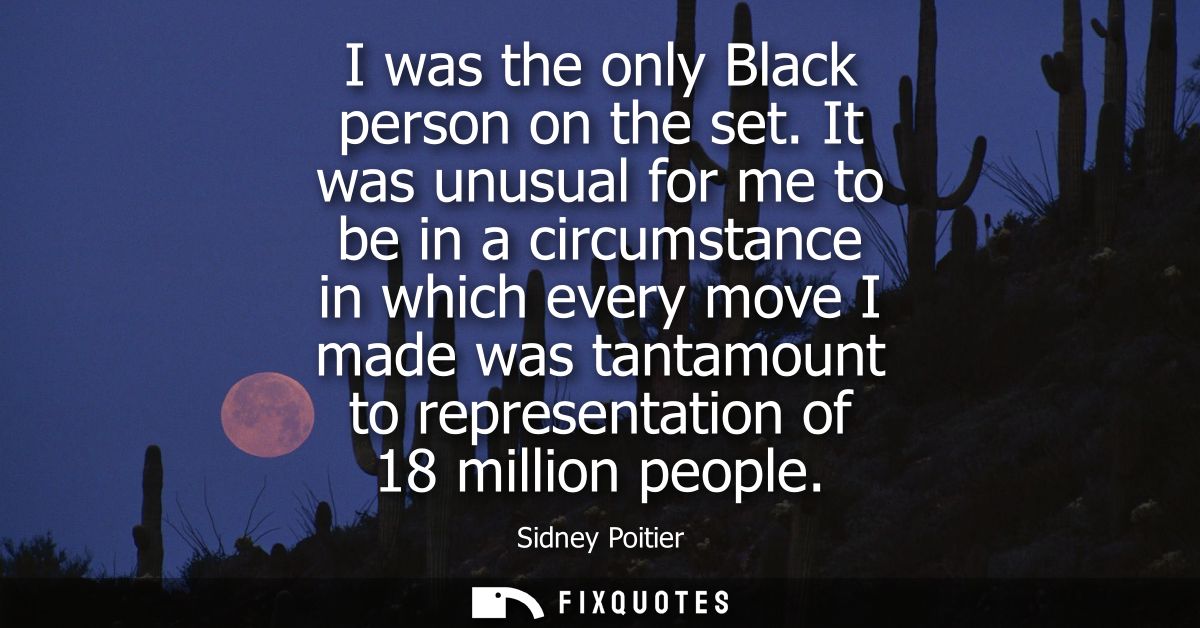
"I was the only Black person on the set. It was unusual for me to be in a circumstance in which every move I made was tantamount to representation of 18 million people"
About this Quote
The intent is bluntly diagnostic. Poitier isn’t celebrating trailblazing; he’s exposing the trap hidden inside it. Hollywood’s tokenism doesn’t merely exclude Black artists, it overburdens the ones it lets through. Any stumble becomes proof of a stereotype, any anger becomes "too much", any softness becomes suspect. The set turns into a courtroom where he’s both defendant and defense attorney, aware that his performance will be read not as craft but as character evidence for millions.
The subtext is a critique of the industry’s alibi-making. By limiting access, studios could treat Poitier’s success as a solution rather than an exception, while expecting him to be impeccably legible to white audiences. The historical context matters: mid-century American film offered few roles not designed to reassure or contain. Poitier’s stardom came with a punishing bargain - visibility in exchange for constant self-monitoring - and he’s articulating the psychological cost of being cast as progress itself.
Quote Details
| Topic | Equality |
|---|---|
| Source | Help us find the source |
| Cite |
Citation Formats
APA Style (7th ed.)
Poitier, Sidney. (2026, January 18). I was the only Black person on the set. It was unusual for me to be in a circumstance in which every move I made was tantamount to representation of 18 million people. FixQuotes. https://fixquotes.com/quotes/i-was-the-only-black-person-on-the-set-it-was-22786/
Chicago Style
Poitier, Sidney. "I was the only Black person on the set. It was unusual for me to be in a circumstance in which every move I made was tantamount to representation of 18 million people." FixQuotes. January 18, 2026. https://fixquotes.com/quotes/i-was-the-only-black-person-on-the-set-it-was-22786/.
MLA Style (9th ed.)
"I was the only Black person on the set. It was unusual for me to be in a circumstance in which every move I made was tantamount to representation of 18 million people." FixQuotes, 18 Jan. 2026, https://fixquotes.com/quotes/i-was-the-only-black-person-on-the-set-it-was-22786/. Accessed 28 Mar. 2026.