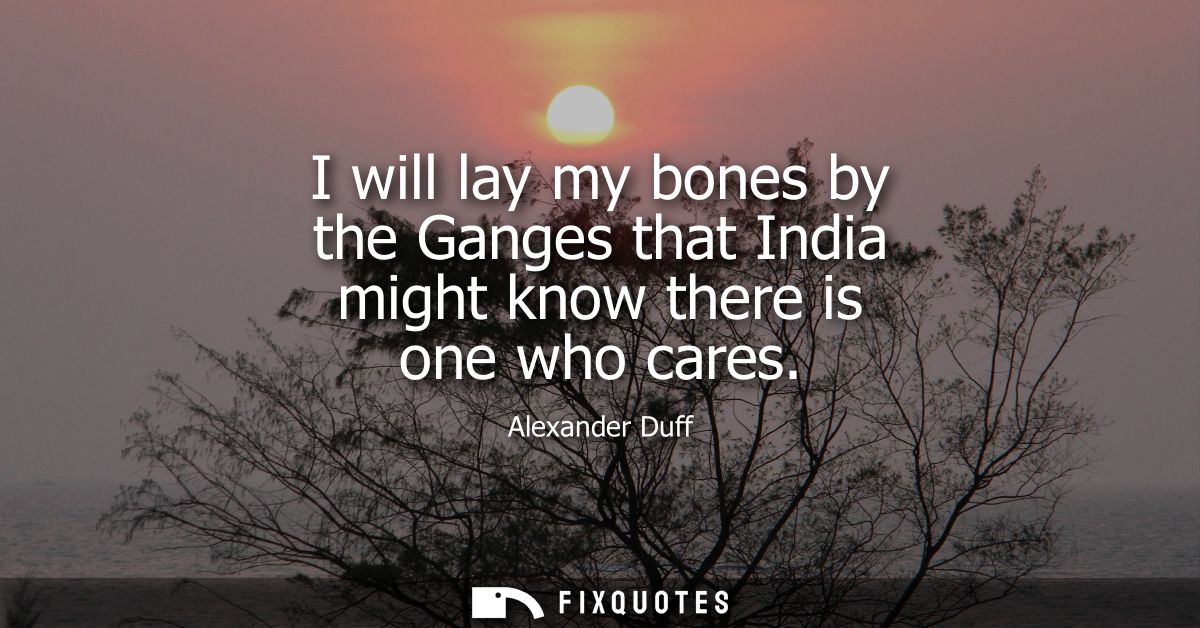
"I will lay my bones by the Ganges that India might know there is one who cares"
About this Quote
The intent is missionary persuasion, but the subtext is institutional. Duff, a leading Scottish Presbyterian missionary, arrived in Calcutta in the 1830s and became influential through English-language education aimed at producing an Indian elite receptive to Christian ideas. In that light, “cares” isn’t neutral compassion; it’s care with a program attached. He frames devotion to India as personal love, yet the implied endpoint is transformation: India “might know” not only his feeling, but his creed.
The paternalism is subtle and effective. India is cast as a singular listener who needs reassurance that someone finally cares, a move that quietly displaces existing networks of belonging and spiritual authority. The line also flatters its speaker: martyr-adjacent, self-denying, incorruptible. In the colonial context, that posture does double work, separating the missionary from the harsher face of empire while still benefiting from the empire’s infrastructure. It’s empathy written in the grammar of possession: I will be here, even in death, so you will recognize my claim.
Quote Details
| Topic | Legacy & Remembrance |
|---|---|
| Source | Help us find the source |
| Cite |
Citation Formats
APA Style (7th ed.)
Duff, Alexander. (2026, January 16). I will lay my bones by the Ganges that India might know there is one who cares. FixQuotes. https://fixquotes.com/quotes/i-will-lay-my-bones-by-the-ganges-that-india-138124/
Chicago Style
Duff, Alexander. "I will lay my bones by the Ganges that India might know there is one who cares." FixQuotes. January 16, 2026. https://fixquotes.com/quotes/i-will-lay-my-bones-by-the-ganges-that-india-138124/.
MLA Style (9th ed.)
"I will lay my bones by the Ganges that India might know there is one who cares." FixQuotes, 16 Jan. 2026, https://fixquotes.com/quotes/i-will-lay-my-bones-by-the-ganges-that-india-138124/. Accessed 22 Mar. 2026.