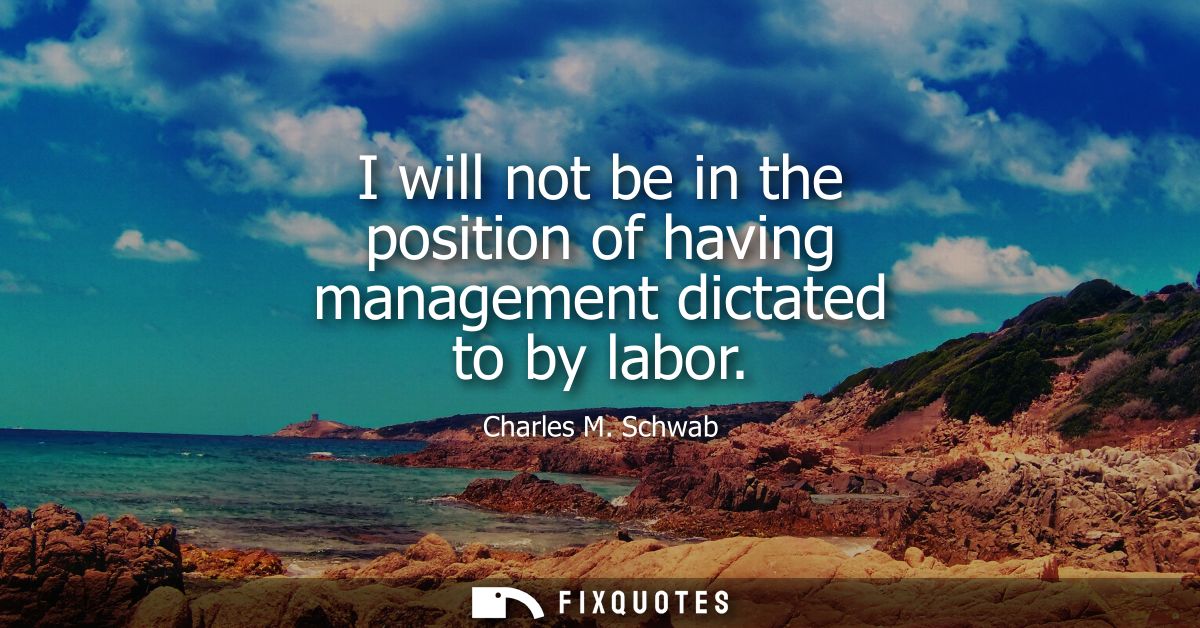
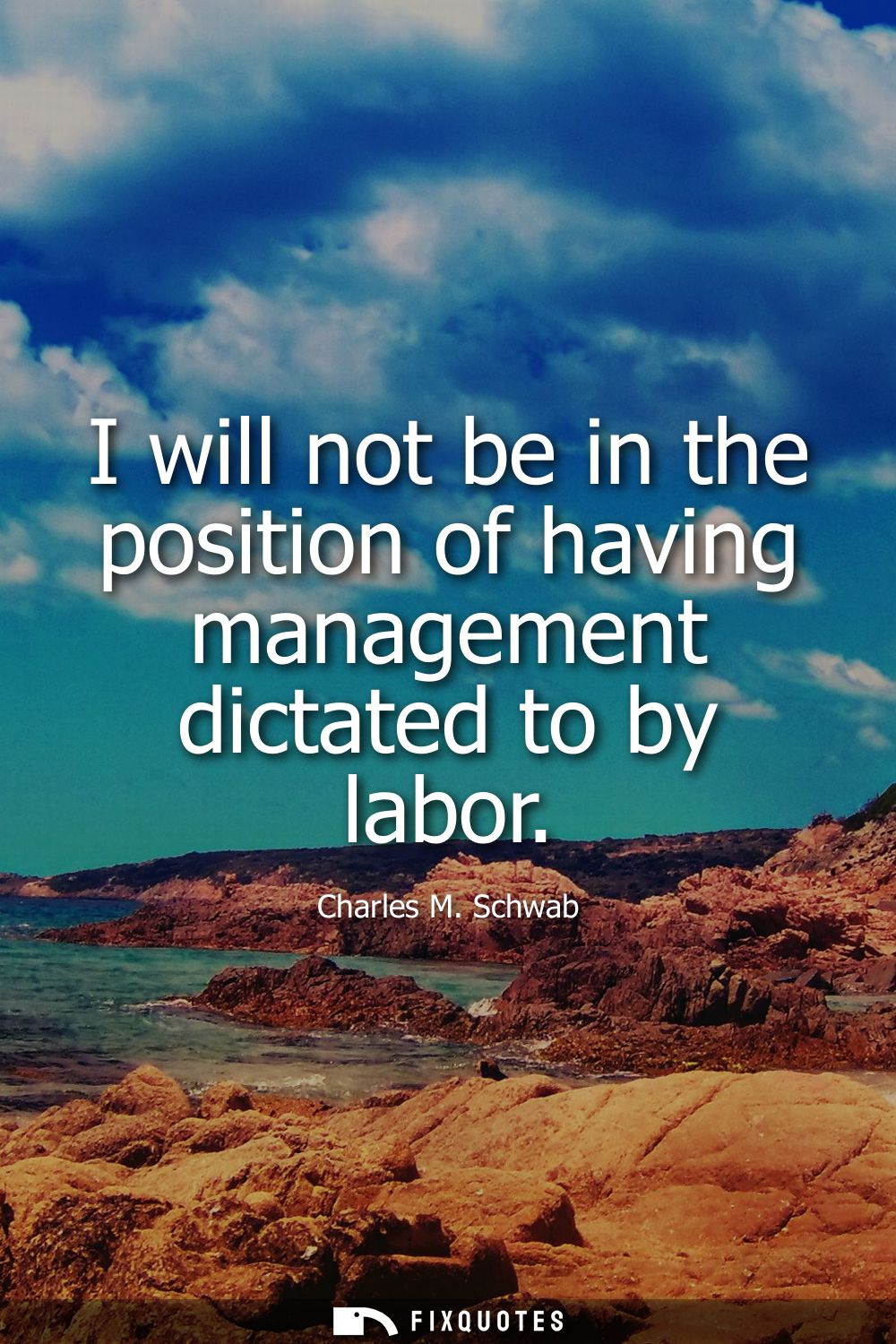
"I will not be in the position of having management dictated to by labor"
About this Quote
Draw a hard line, then dare the other side to cross it. Schwab’s sentence is less a management philosophy than a power move: “I will not be in the position” frames authority as a personal dignity issue, not a negotiable workplace arrangement. The phrase “management dictated to” is calibrated to sound like humiliation, suggesting that any meaningful worker input is not participation but usurpation. And “labor,” used as an impersonal bloc rather than “workers” or “employees,” reduces human beings to a collective force to be contained.
The intent is disciplinary clarity. Schwab isn’t arguing about wages, safety, or hours; he’s defending the command structure itself. That’s why it lands with such bluntness: it treats the workplace as a hierarchy whose legitimacy precedes any debate about conditions. The subtext is a warning to both labor organizers and fellow executives: compromise can be spun as surrender, and surrender is contagious.
Context matters. Schwab rose with Carnegie Steel and later led Bethlehem Steel during an era of violent labor conflict, expanding unions, and a managerial class trying to professionalize “scientific” control over production. In that world, worker “dictation” wasn’t just an affront; it threatened the emerging ideology that expertise, capital, and coordination entitled owners and managers to rule. The quote works rhetorically because it converts a structural clash into a moral posture: he’s not refusing negotiation, he’s refusing inversion. It’s a sentence designed to sound inevitable, even as it reveals exactly how contested that inevitability was.
The intent is disciplinary clarity. Schwab isn’t arguing about wages, safety, or hours; he’s defending the command structure itself. That’s why it lands with such bluntness: it treats the workplace as a hierarchy whose legitimacy precedes any debate about conditions. The subtext is a warning to both labor organizers and fellow executives: compromise can be spun as surrender, and surrender is contagious.
Context matters. Schwab rose with Carnegie Steel and later led Bethlehem Steel during an era of violent labor conflict, expanding unions, and a managerial class trying to professionalize “scientific” control over production. In that world, worker “dictation” wasn’t just an affront; it threatened the emerging ideology that expertise, capital, and coordination entitled owners and managers to rule. The quote works rhetorically because it converts a structural clash into a moral posture: he’s not refusing negotiation, he’s refusing inversion. It’s a sentence designed to sound inevitable, even as it reveals exactly how contested that inevitability was.
Quote Details
| Topic | Management |
|---|---|
| Source | Help us find the source |
| Cite |
Citation Formats
APA Style (7th ed.)
Schwab, Charles M. (2026, January 15). I will not be in the position of having management dictated to by labor. FixQuotes. https://fixquotes.com/quotes/i-will-not-be-in-the-position-of-having-140132/
Chicago Style
Schwab, Charles M. "I will not be in the position of having management dictated to by labor." FixQuotes. January 15, 2026. https://fixquotes.com/quotes/i-will-not-be-in-the-position-of-having-140132/.
MLA Style (9th ed.)
"I will not be in the position of having management dictated to by labor." FixQuotes, 15 Jan. 2026, https://fixquotes.com/quotes/i-will-not-be-in-the-position-of-having-140132/. Accessed 29 Mar. 2026.
More Quotes by Charles
Add to List