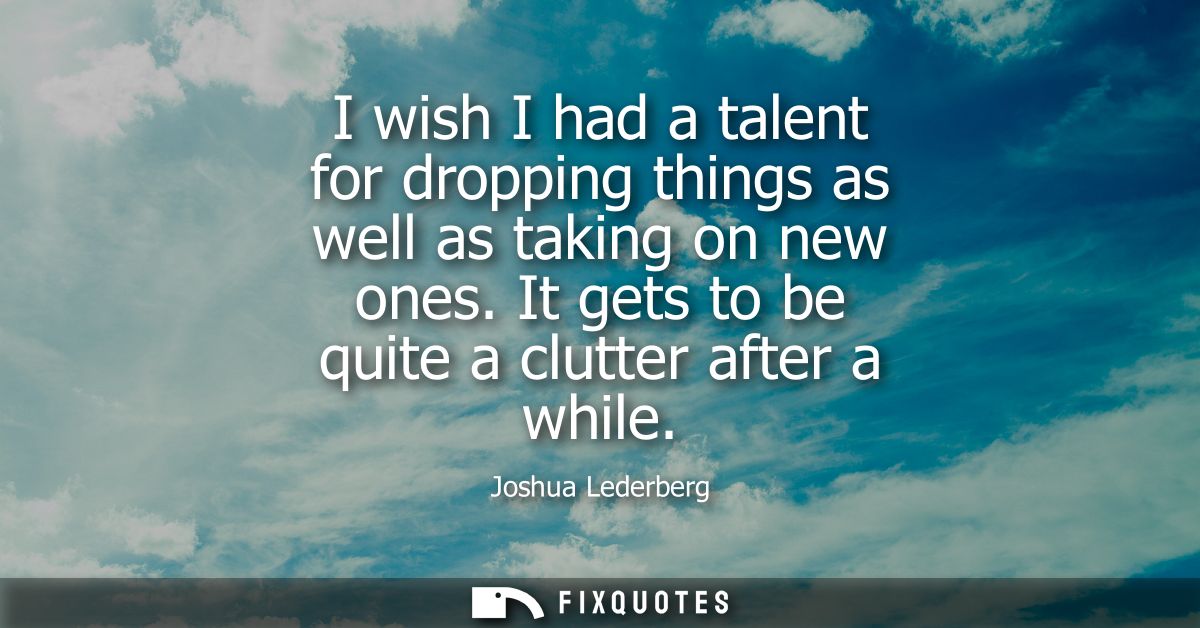
"I wish I had a talent for dropping things as well as taking on new ones. It gets to be quite a clutter after a while"
About this Quote
“I wish I had a talent” frames letting go as a skill, not a moral failing. That’s the subtext doing the heavy lifting. Clutter isn’t just a messy desk; it’s an overloaded mind, an overgrown portfolio of commitments, an attention span chopped into too many simultaneous experiments. He’s gently mocking the heroic narrative of the endlessly productive genius. The wit is that “dropping things” sounds like negligence until he pairs it with “taking on new ones,” revealing how professional virtue (ambition) quietly breeds professional vice (hoarding).
Context matters: Lederberg worked in an era when science became increasingly institutional, bureaucratic, and interdisciplinary. The more you succeed, the more the system hands you: panels, committees, advisory roles, invitations to “help shape the field.” That’s clutter with prestige attached, which makes it harder to discard. His sentence reads like an early diagnosis of what we now call burnout or opportunity overload, but without self-pity. It’s a compact plea for intellectual hygiene: progress depends not only on what you can discover, but on what you can refuse to carry.
Quote Details
| Topic | Witty One-Liners |
|---|---|
| Source | Help us find the source |
| Cite |
Citation Formats
APA Style (7th ed.)
Lederberg, Joshua. (2026, January 16). I wish I had a talent for dropping things as well as taking on new ones. It gets to be quite a clutter after a while. FixQuotes. https://fixquotes.com/quotes/i-wish-i-had-a-talent-for-dropping-things-as-well-86876/
Chicago Style
Lederberg, Joshua. "I wish I had a talent for dropping things as well as taking on new ones. It gets to be quite a clutter after a while." FixQuotes. January 16, 2026. https://fixquotes.com/quotes/i-wish-i-had-a-talent-for-dropping-things-as-well-86876/.
MLA Style (9th ed.)
"I wish I had a talent for dropping things as well as taking on new ones. It gets to be quite a clutter after a while." FixQuotes, 16 Jan. 2026, https://fixquotes.com/quotes/i-wish-i-had-a-talent-for-dropping-things-as-well-86876/. Accessed 18 Mar. 2026.