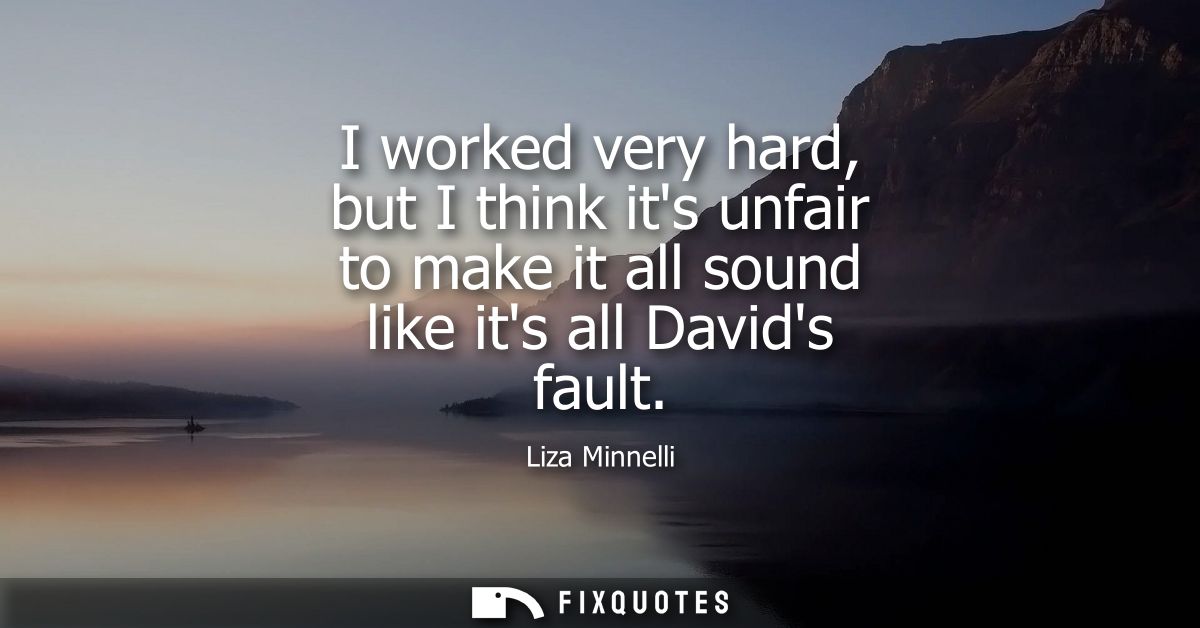
"I worked very hard, but I think it's unfair to make it all sound like it's all David's fault"
About this Quote
The repetition of “all” (“make it all sound like it’s all David’s fault”) matters. It’s not just emphasis; it’s a critique of the public’s hunger for totalizing explanations. Somebody must be the genius, somebody must be the saboteur, and the story must fit in a headline. Minnelli rejects that compression. She’s also protecting herself from appearing vindictive, a trap that punishes famous women for expressing anger too directly: name the harm and you’re “bitter”; ignore it and you’re “complicit.” Her solution is a calibrated ambiguity.
“David” lands like an offstage character the audience is presumed to recognize - a private relationship dragged into public bookkeeping. The subtext is messy accountability: yes, there were problems; no, it’s not a single-person morality play. In one sentence, Minnelli tries to reclaim authorship of her work and her life, while refusing to let the culture turn complexity into a scapegoat.
Quote Details
| Topic | Work Ethic |
|---|---|
| Source | Help us find the source |
| Cite |
Citation Formats
APA Style (7th ed.)
Minnelli, Liza. (2026, January 16). I worked very hard, but I think it's unfair to make it all sound like it's all David's fault. FixQuotes. https://fixquotes.com/quotes/i-worked-very-hard-but-i-think-its-unfair-to-make-87338/
Chicago Style
Minnelli, Liza. "I worked very hard, but I think it's unfair to make it all sound like it's all David's fault." FixQuotes. January 16, 2026. https://fixquotes.com/quotes/i-worked-very-hard-but-i-think-its-unfair-to-make-87338/.
MLA Style (9th ed.)
"I worked very hard, but I think it's unfair to make it all sound like it's all David's fault." FixQuotes, 16 Jan. 2026, https://fixquotes.com/quotes/i-worked-very-hard-but-i-think-its-unfair-to-make-87338/. Accessed 1 Apr. 2026.