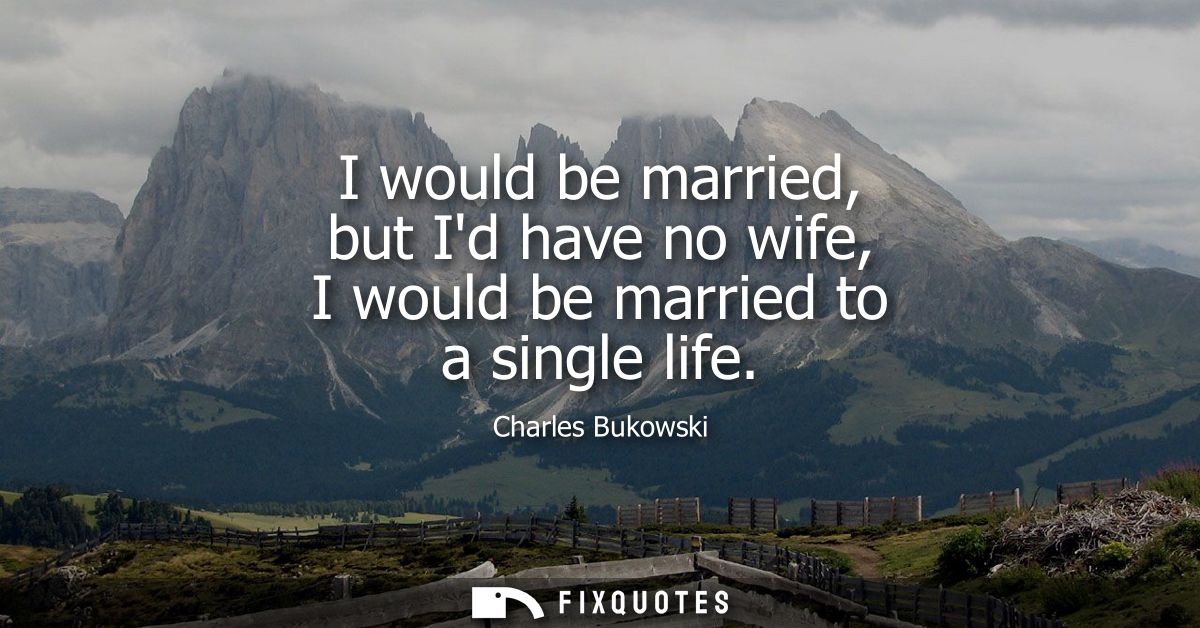
"I would be married, but I'd have no wife, I would be married to a single life"
About this Quote
The subtext is classic Bukowski: a man who’s seen love curdle into obligation, who distrusts respectable arrangements because they smell like soft cages. "Single life" isn’t framed as lack, but as partner and principle. It carries the bartender-poet pragmatism of someone who knows his own damage and would rather own it than export it. There’s also a sly self-mythology at work: the lone writer as spouse to freedom, to booze, to the page, to the messy sanctity of living unaccountable.
Context matters because Bukowski’s persona was built on antagonism toward middle-class virtue. In postwar America, marriage sold itself as stability and adulthood; he replies with a vow to remain unclaimed, even while borrowing marriage’s language of permanence. It works because it’s both confession and provocation: loneliness dressed up as autonomy, autonomy defended like a romance.
Quote Details
| Topic | Marriage |
|---|---|
| Source | Help us find the source |
| Cite |
Citation Formats
APA Style (7th ed.)
Bukowski, Charles. (2026, January 14). I would be married, but I'd have no wife, I would be married to a single life. FixQuotes. https://fixquotes.com/quotes/i-would-be-married-but-id-have-no-wife-i-would-be-160131/
Chicago Style
Bukowski, Charles. "I would be married, but I'd have no wife, I would be married to a single life." FixQuotes. January 14, 2026. https://fixquotes.com/quotes/i-would-be-married-but-id-have-no-wife-i-would-be-160131/.
MLA Style (9th ed.)
"I would be married, but I'd have no wife, I would be married to a single life." FixQuotes, 14 Jan. 2026, https://fixquotes.com/quotes/i-would-be-married-but-id-have-no-wife-i-would-be-160131/. Accessed 27 Mar. 2026.