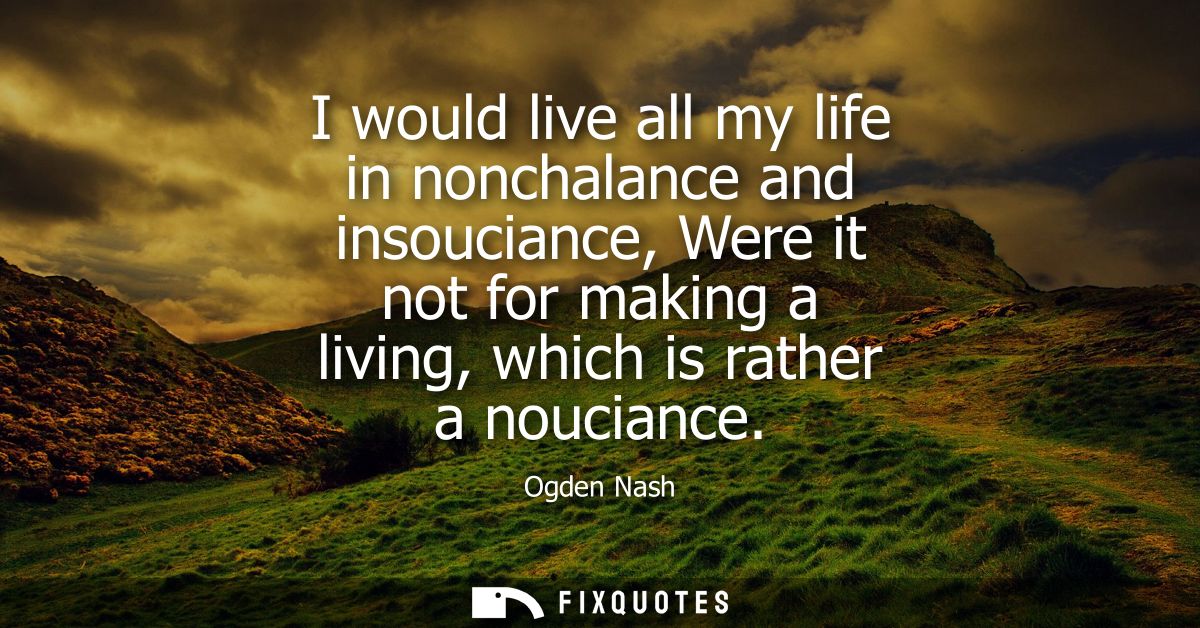
"I would live all my life in nonchalance and insouciance, were it not for making a living, which is rather a nouciance"
About this Quote
The joke hinges on a fake etymology: "insouciance" becomes "nouciance", a made-up annoyance to match the made-up serenity. It's schoolboy wordplay with adult despair embedded in it. Nash isn't merely punning; he's staging a miniature class between aspiration and obligation. The speaker's preferred identity is carefree, even aristocratic - the sort of leisure implied by French-derived elegance. The paycheck yanks him back into the unglamorous truth that most people can't afford their temperament.
Context matters: Nash wrote in a 20th-century America where mass office work and the cult of productivity were hardening into common sense, even as advertising sold effortless ease as a lifestyle. His genius is to let the complaint arrive in a chuckle. Instead of romanticizing rebellion, he admits the compromise: he'd be insouciant if he could, but rent has a punchline ready. The poem laughs because the alternative is to scream, and Nash always preferred rhymes that smuggled bitterness in under the door.
Quote Details
| Topic | Puns & Wordplay |
|---|---|
| Source | Help us find the source |
| Cite |
Citation Formats
APA Style (7th ed.)
Nash, Ogden. (2026, February 17). I would live all my life in nonchalance and insouciance, were it not for making a living, which is rather a nouciance. FixQuotes. https://fixquotes.com/quotes/i-would-live-all-my-life-in-nonchalance-and-13945/
Chicago Style
Nash, Ogden. "I would live all my life in nonchalance and insouciance, were it not for making a living, which is rather a nouciance." FixQuotes. February 17, 2026. https://fixquotes.com/quotes/i-would-live-all-my-life-in-nonchalance-and-13945/.
MLA Style (9th ed.)
"I would live all my life in nonchalance and insouciance, were it not for making a living, which is rather a nouciance." FixQuotes, 17 Feb. 2026, https://fixquotes.com/quotes/i-would-live-all-my-life-in-nonchalance-and-13945/. Accessed 27 Mar. 2026.