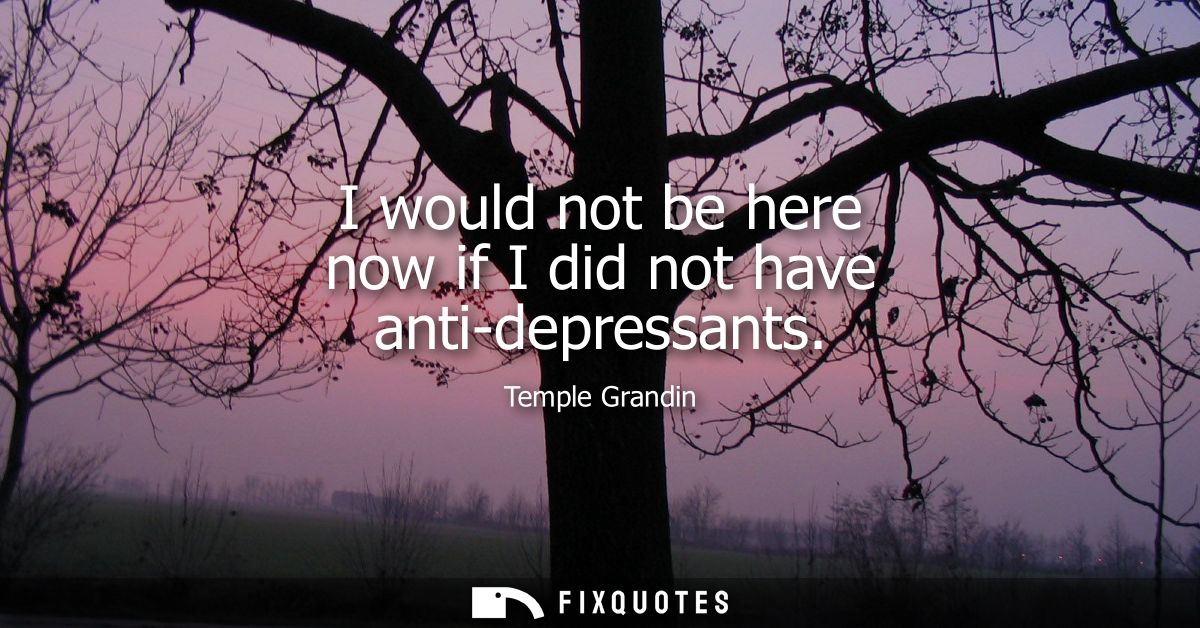
"I would not be here now if I did not have anti-depressants"
About this Quote
It is hard to overstate how much force sits in the bluntness of that conditional: if not for anti-depressants, she would not be here. Temple Grandin isn’t offering a lifestyle tip or a wellness-brand confession; she’s making survival legible in a culture that still treats psychiatric medication as either a moral failure or a punchline. The phrasing refuses inspirational varnish. No heroic arc, no triumphalist “mind over matter.” Just a stark causal link between treatment and continued existence.
The specific intent reads like permission-giving. Grandin’s public identity has long been tied to competence, rigorous thinking, and high achievement. By attaching medication to her own continuance, she punctures the fantasy that the “strong” don’t need chemical assistance. The subtext is strategic: if someone with her credibility can say this without apology, the listener is invited to downgrade shame and upgrade care. It also subtly reframes antidepressants from personality-altering shortcuts to medical tools that keep people alive long enough to do the rest of the work.
Context matters because Grandin is often cited in conversations about neurodiversity, where purity narratives can creep in: the idea that authenticity means suffering unmedicated, that accepting help somehow dilutes the self. Her sentence argues the opposite. Medication doesn’t erase identity; it can safeguard the person who has that identity. The rhetorical power comes from its simplicity: a single line that treats mental health treatment not as debate fodder, but as a fact of living.
The specific intent reads like permission-giving. Grandin’s public identity has long been tied to competence, rigorous thinking, and high achievement. By attaching medication to her own continuance, she punctures the fantasy that the “strong” don’t need chemical assistance. The subtext is strategic: if someone with her credibility can say this without apology, the listener is invited to downgrade shame and upgrade care. It also subtly reframes antidepressants from personality-altering shortcuts to medical tools that keep people alive long enough to do the rest of the work.
Context matters because Grandin is often cited in conversations about neurodiversity, where purity narratives can creep in: the idea that authenticity means suffering unmedicated, that accepting help somehow dilutes the self. Her sentence argues the opposite. Medication doesn’t erase identity; it can safeguard the person who has that identity. The rhetorical power comes from its simplicity: a single line that treats mental health treatment not as debate fodder, but as a fact of living.
Quote Details
| Topic | Mental Health |
|---|---|
| Source | Help us find the source |
| Cite |
Citation Formats
APA Style (7th ed.)
Grandin, Temple. (2026, January 18). I would not be here now if I did not have anti-depressants. FixQuotes. https://fixquotes.com/quotes/i-would-not-be-here-now-if-i-did-not-have-1966/
Chicago Style
Grandin, Temple. "I would not be here now if I did not have anti-depressants." FixQuotes. January 18, 2026. https://fixquotes.com/quotes/i-would-not-be-here-now-if-i-did-not-have-1966/.
MLA Style (9th ed.)
"I would not be here now if I did not have anti-depressants." FixQuotes, 18 Jan. 2026, https://fixquotes.com/quotes/i-would-not-be-here-now-if-i-did-not-have-1966/. Accessed 18 Mar. 2026.
More Quotes by Temple
Add to List