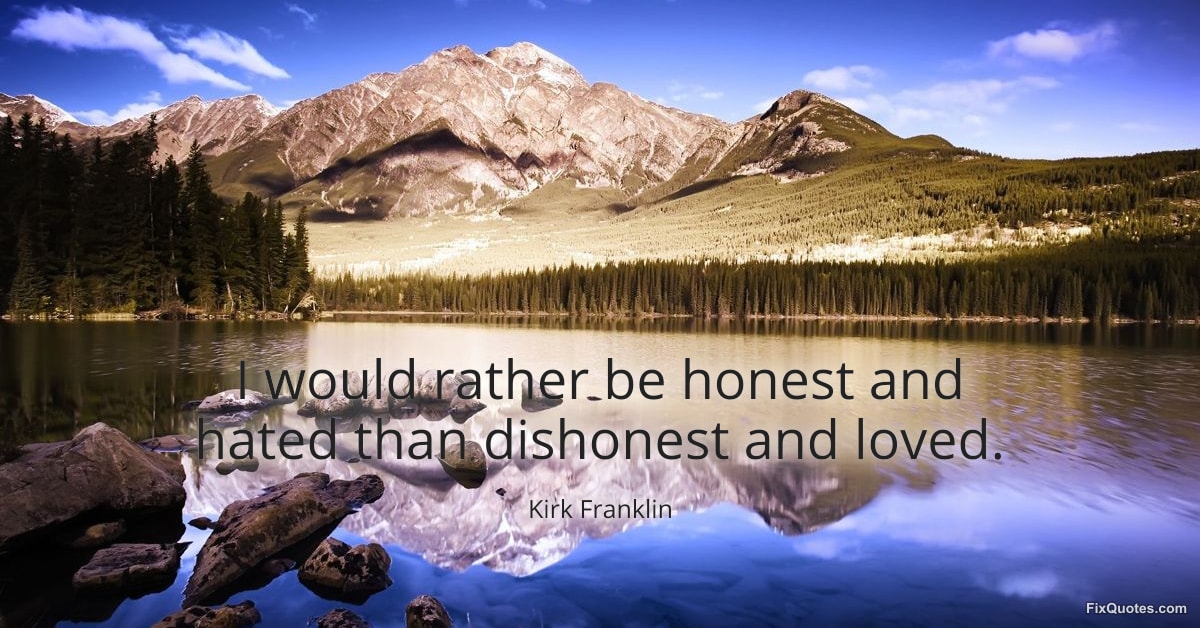
"I would rather be honest and hated than dishonest and loved"
About this Quote
Kirk Franklin’s line lands like a drummer’s rimshot: a clean, percussive choice that refuses to dress itself up in diplomacy. Coming from a gospel musician whose career lives at the intersection of church expectations, mainstream visibility, and personal scrutiny, the statement reads less like abstract virtue and more like survival strategy. In Franklin’s world, “love” can be a crowd’s applause, a congregation’s approval, an industry’s invitation, even the algorithm’s reward. Each is fickle. “Honest,” by contrast, is framed as costly but stable.
The intent is blunt: pick integrity over reputation. The subtext is sharper. He’s acknowledging that “being loved” often requires a kind of performance - not onstage, but in life: sanding down your edges, editing your testimony, keeping the brand clean, keeping the family story sanitized, keeping the faith palatable. Franklin’s insistence on honesty is a refusal of that bargain, especially in a genre where people want the messenger to embody the message flawlessly. He’s not promising sainthood; he’s demanding room to be real.
What makes it work is the asymmetry baked into the trade-off. “Dishonest and loved” isn’t just moral failure; it implies love obtained under false pretenses, which turns affection into something transactional. “Honest and hated” accepts the social penalty as proof of sincerity. It’s a line that doubles as a warning to fans: if you only love the curated version, you don’t actually love me.
The intent is blunt: pick integrity over reputation. The subtext is sharper. He’s acknowledging that “being loved” often requires a kind of performance - not onstage, but in life: sanding down your edges, editing your testimony, keeping the brand clean, keeping the family story sanitized, keeping the faith palatable. Franklin’s insistence on honesty is a refusal of that bargain, especially in a genre where people want the messenger to embody the message flawlessly. He’s not promising sainthood; he’s demanding room to be real.
What makes it work is the asymmetry baked into the trade-off. “Dishonest and loved” isn’t just moral failure; it implies love obtained under false pretenses, which turns affection into something transactional. “Honest and hated” accepts the social penalty as proof of sincerity. It’s a line that doubles as a warning to fans: if you only love the curated version, you don’t actually love me.
Quote Details
| Topic | Honesty & Integrity |
|---|---|
| Source | Kirk Franklin interview on The Breakfast Club (Power 105.1), March 18, 2019 |
| Cite |
Citation Formats
APA Style (7th ed.)
Franklin, Kirk. (2026, January 30). I would rather be honest and hated than dishonest and loved. FixQuotes. https://fixquotes.com/quotes/i-would-rather-be-honest-and-hated-than-dishonest-184830/
Chicago Style
Franklin, Kirk. "I would rather be honest and hated than dishonest and loved." FixQuotes. January 30, 2026. https://fixquotes.com/quotes/i-would-rather-be-honest-and-hated-than-dishonest-184830/.
MLA Style (9th ed.)
"I would rather be honest and hated than dishonest and loved." FixQuotes, 30 Jan. 2026, https://fixquotes.com/quotes/i-would-rather-be-honest-and-hated-than-dishonest-184830/. Accessed 11 Mar. 2026.
More Quotes by Kirk
Add to List