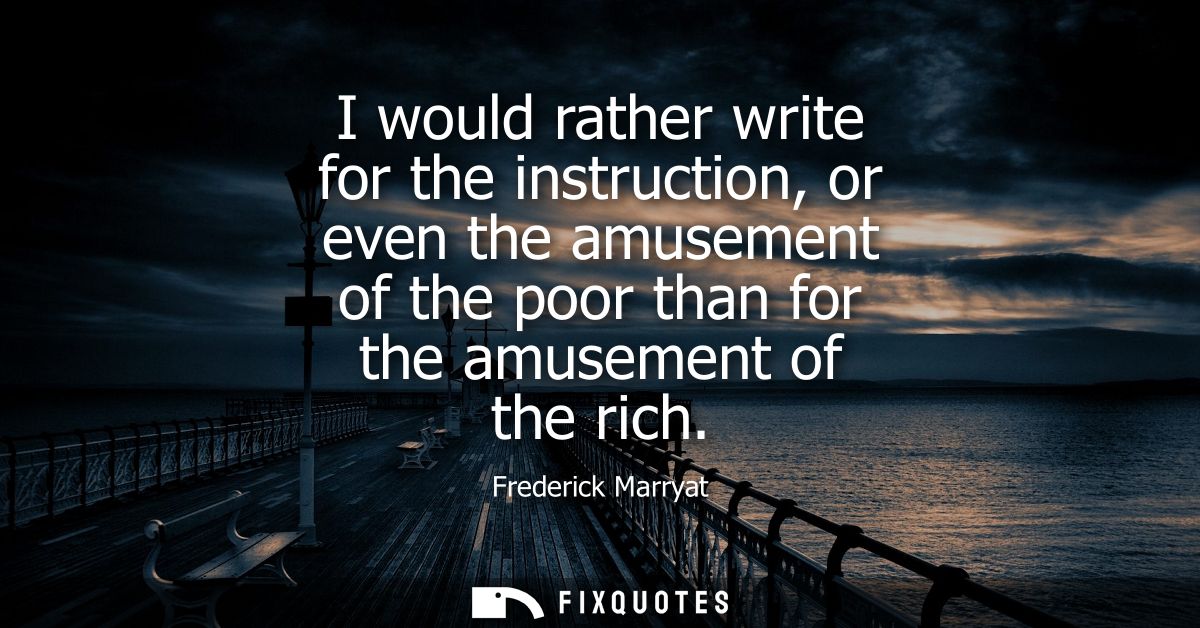
"I would rather write for the instruction, or even the amusement of the poor than for the amusement of the rich"
About this Quote
The subtext is both ethical and strategic. Marryat isn’t just claiming noble motives; he’s carving out a market and a mandate. The early-to-mid 19th century is when mass readership starts to become a force: cheaper print, expanding education, serialized fiction, a growing urban working class hungry for stories. A writer who aligns himself with that crowd signals modernity, relevance, and a kind of patriotic seriousness. It’s also self-protection. By positioning himself against elite “amusement,” Marryat preempts criticism that popular fiction is vulgar: if the work entertains, it does so with purpose, aimed at people for whom culture isn’t a hobby but a tool.
There’s a quiet provocation here, too. “Rather” suggests choice, as if the author is actively walking away from the drawing rooms where careers were made. It’s a declaration of literary allegiance - and a warning that the gatekeepers are no longer the only gate.
Quote Details
| Topic | Equality |
|---|---|
| Source | Help us find the source |
| Cite |
Citation Formats
APA Style (7th ed.)
Marryat, Frederick. (2026, January 16). I would rather write for the instruction, or even the amusement of the poor than for the amusement of the rich. FixQuotes. https://fixquotes.com/quotes/i-would-rather-write-for-the-instruction-or-even-130729/
Chicago Style
Marryat, Frederick. "I would rather write for the instruction, or even the amusement of the poor than for the amusement of the rich." FixQuotes. January 16, 2026. https://fixquotes.com/quotes/i-would-rather-write-for-the-instruction-or-even-130729/.
MLA Style (9th ed.)
"I would rather write for the instruction, or even the amusement of the poor than for the amusement of the rich." FixQuotes, 16 Jan. 2026, https://fixquotes.com/quotes/i-would-rather-write-for-the-instruction-or-even-130729/. Accessed 28 Mar. 2026.