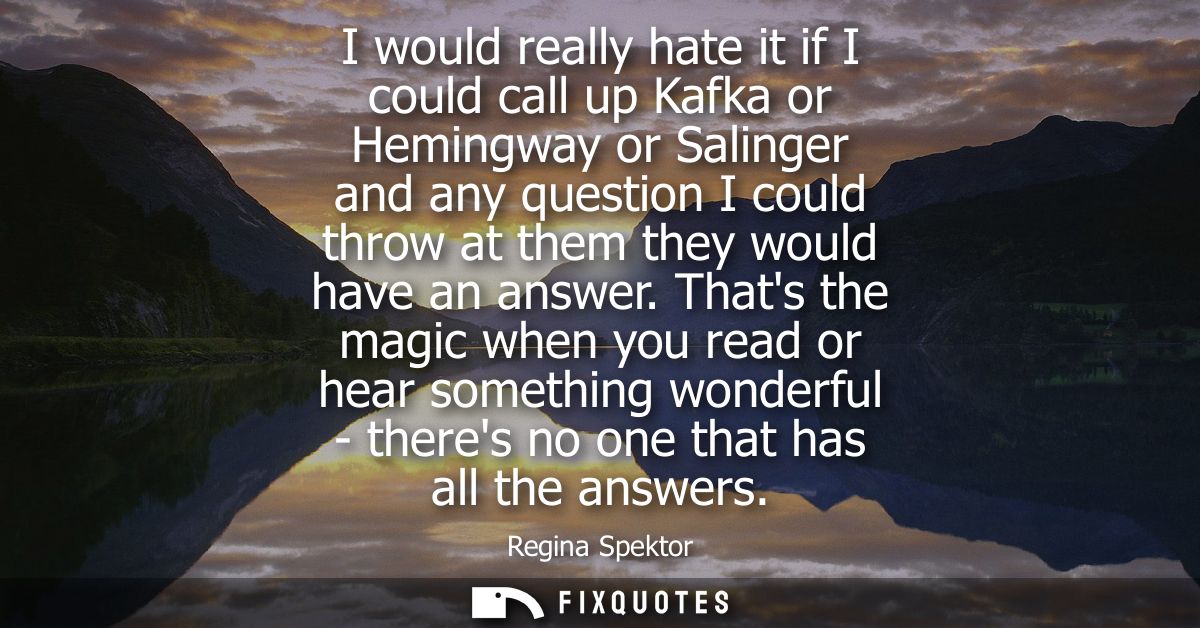
"I would really hate it if I could call up Kafka or Hemingway or Salinger, and any question I could throw at them, they would have an answer. That's the magic when you read or hear something wonderful - there's no one that has all the answers"
About this Quote
The subtext is a quiet rebuke of contemporary culture’s obsession with authorial clarification: the interview clip, the annotated lyric, the “what I really meant” thread. Spektor is pushing back against the idea that art’s job is to resolve. In her framing, the “magic” of reading isn’t the receipt of information, it’s the experience of being left with live questions you can’t outsource. The reader’s interpretive labor isn’t a second-best substitute for the author; it’s the actual point.
Contextually, it’s also a musician talking about literature in a media ecosystem that relentlessly pressures artists to explain themselves. Pop audiences are trained to demand lore, Easter eggs, and definitive canon. Spektor argues for something older and riskier: leaving meaning partially unowned, so the work can keep changing depending on who encounters it and when. Art that “has all the answers” becomes a brochure. Art that withholds stays alive.
Quote Details
| Topic | Writing |
|---|---|
| Source | Help us find the source |
| Cite |
Citation Formats
APA Style (7th ed.)
Spektor, Regina. (2026, February 16). I would really hate it if I could call up Kafka or Hemingway or Salinger, and any question I could throw at them, they would have an answer. That's the magic when you read or hear something wonderful - there's no one that has all the answers. FixQuotes. https://fixquotes.com/quotes/i-would-really-hate-it-if-i-could-call-up-kafka-109779/
Chicago Style
Spektor, Regina. "I would really hate it if I could call up Kafka or Hemingway or Salinger, and any question I could throw at them, they would have an answer. That's the magic when you read or hear something wonderful - there's no one that has all the answers." FixQuotes. February 16, 2026. https://fixquotes.com/quotes/i-would-really-hate-it-if-i-could-call-up-kafka-109779/.
MLA Style (9th ed.)
"I would really hate it if I could call up Kafka or Hemingway or Salinger, and any question I could throw at them, they would have an answer. That's the magic when you read or hear something wonderful - there's no one that has all the answers." FixQuotes, 16 Feb. 2026, https://fixquotes.com/quotes/i-would-really-hate-it-if-i-could-call-up-kafka-109779/. Accessed 11 Mar. 2026.