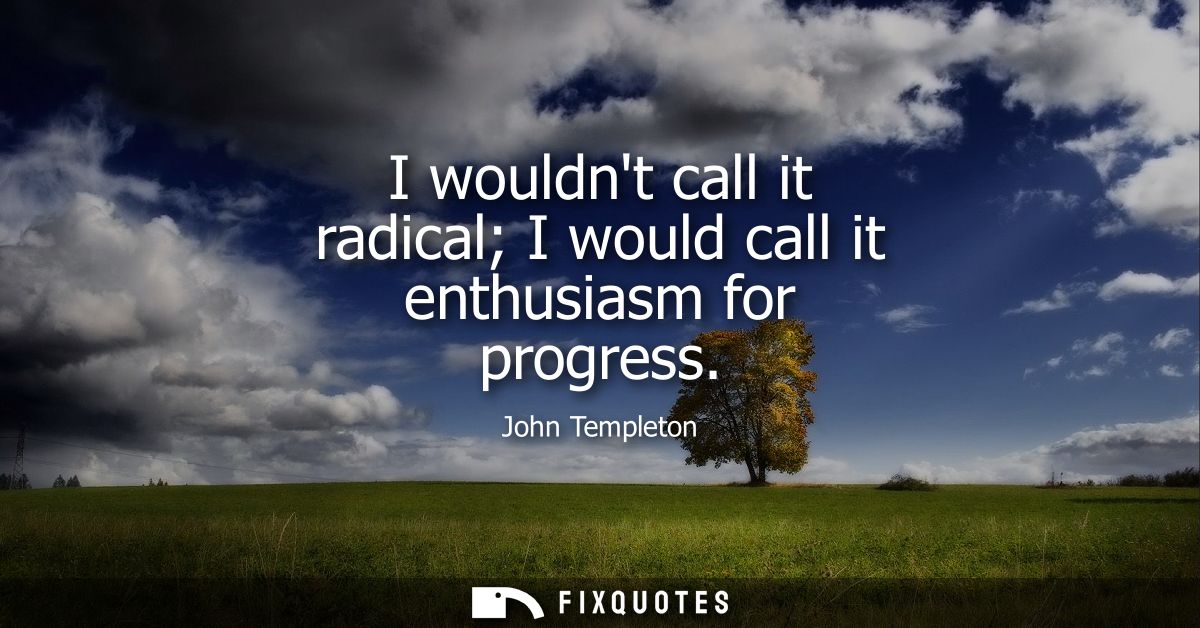
"I wouldn't call it radical; I would call it enthusiasm for progress"
About this Quote
Templeton’s line is a masterclass in rebranding: it doesn’t defend “radical” so much as it quietly deletes the category. “I wouldn’t call it” signals a refusal to accept someone else’s framing, the kind of polite pushback that reads as reasonable while sliding the debate onto friendlier terrain. Then comes the substitution: not “reform,” not even “change,” but “enthusiasm for progress.” That one word, enthusiasm, is doing a lot of PR. It turns ideology into temperament, conviction into mood. If you’re merely enthusiastic, you’re not threatening; you’re optimistic, energetic, future-facing. It’s hard to demonize a vibe.
The subtext is transactional and strategic, which fits Templeton’s world. As a businessman and famed investor-philanthropist, he operated in systems that reward novelty when it looks disciplined. “Radical” is volatility; “progress” is upside. The phrase offers listeners a low-risk way to applaud forward movement without endorsing anything that smells like upheaval. It’s progress with the sharp edges sanded down.
Context matters: Templeton lived through depression, world war, the Cold War, deregulation, and late-20th-century globalization - eras when “radical” could mean anything from social revolution to ideological extremism. In that climate, insisting on “progress” functions as inoculation. He’s telling critics: don’t mistake my appetite for innovation, reform, or new ideas as a threat to stability. It’s not rebellion; it’s momentum.
The subtext is transactional and strategic, which fits Templeton’s world. As a businessman and famed investor-philanthropist, he operated in systems that reward novelty when it looks disciplined. “Radical” is volatility; “progress” is upside. The phrase offers listeners a low-risk way to applaud forward movement without endorsing anything that smells like upheaval. It’s progress with the sharp edges sanded down.
Context matters: Templeton lived through depression, world war, the Cold War, deregulation, and late-20th-century globalization - eras when “radical” could mean anything from social revolution to ideological extremism. In that climate, insisting on “progress” functions as inoculation. He’s telling critics: don’t mistake my appetite for innovation, reform, or new ideas as a threat to stability. It’s not rebellion; it’s momentum.
Quote Details
| Topic | Motivational |
|---|---|
| Source | Help us find the source |
| Cite |
Citation Formats
APA Style (7th ed.)
Templeton, John. (2026, January 16). I wouldn't call it radical; I would call it enthusiasm for progress. FixQuotes. https://fixquotes.com/quotes/i-wouldnt-call-it-radical-i-would-call-it-99870/
Chicago Style
Templeton, John. "I wouldn't call it radical; I would call it enthusiasm for progress." FixQuotes. January 16, 2026. https://fixquotes.com/quotes/i-wouldnt-call-it-radical-i-would-call-it-99870/.
MLA Style (9th ed.)
"I wouldn't call it radical; I would call it enthusiasm for progress." FixQuotes, 16 Jan. 2026, https://fixquotes.com/quotes/i-wouldnt-call-it-radical-i-would-call-it-99870/. Accessed 8 Apr. 2026.
More Quotes by John
Add to List