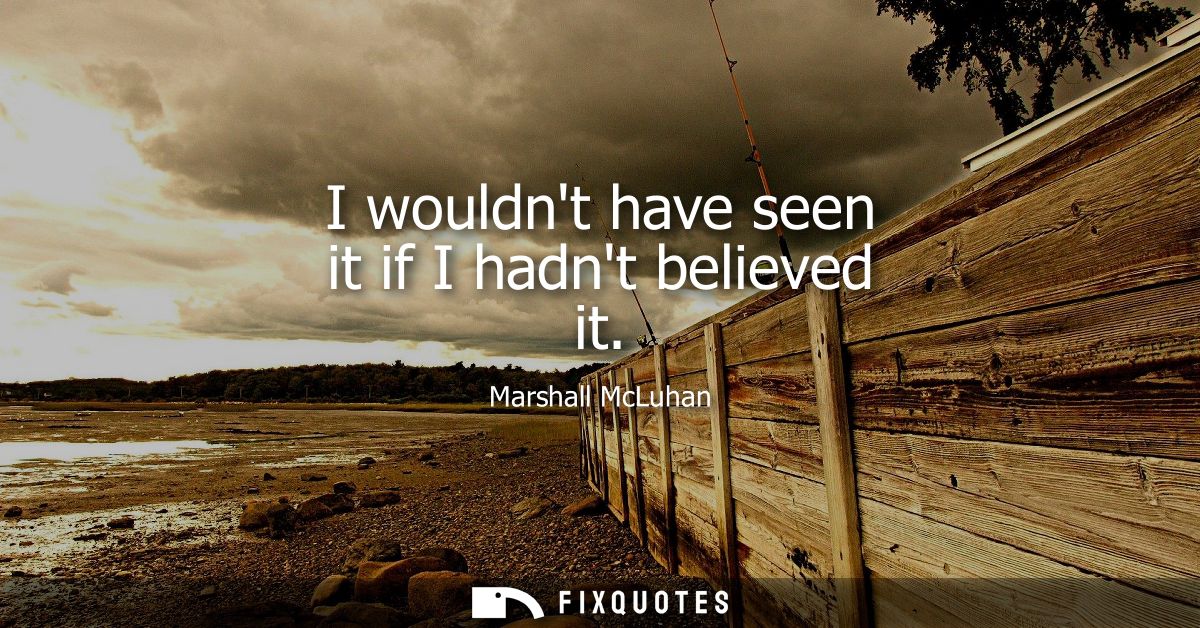
"I wouldn't have seen it if I hadn't believed it"
About this Quote
A neat boomerang of a sentence: it flips the respectable mantra "I'll believe it when I see it" into something more unsettling, and more accurate about how perception actually works. McLuhan is needling the modern faith in raw observation. He’s suggesting that seeing is not a neutral intake of reality but a trained, culturally edited act. Belief is the filter that makes certain patterns legible and leaves others invisible.
The intent is diagnostic, not mystical. In McLuhan’s media-saturated universe, our senses are extended and rearranged by the tools we use to communicate. A camera, a television broadcast, a newspaper layout, a feed algorithm: each one doesn’t just deliver information, it builds a worldview that tells you what counts as evidence in the first place. You don’t merely watch the news; you learn how to watch.
The subtext is a quiet indictment of "common sense" empiricism. The phrase "I wouldn't have seen it" implies there was something there all along, but it required a prior framework to recognize it. That’s how propaganda works, how scientific paradigms shift, how moral awakenings arrive late: not by adding facts, but by changing the interpretive grid that makes facts visible.
Contextually, this line sits comfortably beside McLuhan’s famous provocations ("the medium is the message"). It’s an aphorism designed to lodge in the brain and make you distrust your own certainty. The real punch: belief isn’t the enemy of perception; it’s the operating system.
The intent is diagnostic, not mystical. In McLuhan’s media-saturated universe, our senses are extended and rearranged by the tools we use to communicate. A camera, a television broadcast, a newspaper layout, a feed algorithm: each one doesn’t just deliver information, it builds a worldview that tells you what counts as evidence in the first place. You don’t merely watch the news; you learn how to watch.
The subtext is a quiet indictment of "common sense" empiricism. The phrase "I wouldn't have seen it" implies there was something there all along, but it required a prior framework to recognize it. That’s how propaganda works, how scientific paradigms shift, how moral awakenings arrive late: not by adding facts, but by changing the interpretive grid that makes facts visible.
Contextually, this line sits comfortably beside McLuhan’s famous provocations ("the medium is the message"). It’s an aphorism designed to lodge in the brain and make you distrust your own certainty. The real punch: belief isn’t the enemy of perception; it’s the operating system.
Quote Details
| Topic | Deep |
|---|---|
| Source | Help us find the source |
| Cite |
Citation Formats
APA Style (7th ed.)
McLuhan, Marshall. (2026, January 15). I wouldn't have seen it if I hadn't believed it. FixQuotes. https://fixquotes.com/quotes/i-wouldnt-have-seen-it-if-i-hadnt-believed-it-15889/
Chicago Style
McLuhan, Marshall. "I wouldn't have seen it if I hadn't believed it." FixQuotes. January 15, 2026. https://fixquotes.com/quotes/i-wouldnt-have-seen-it-if-i-hadnt-believed-it-15889/.
MLA Style (9th ed.)
"I wouldn't have seen it if I hadn't believed it." FixQuotes, 15 Jan. 2026, https://fixquotes.com/quotes/i-wouldnt-have-seen-it-if-i-hadnt-believed-it-15889/. Accessed 13 Feb. 2026.
More Quotes by Marshall
Add to List