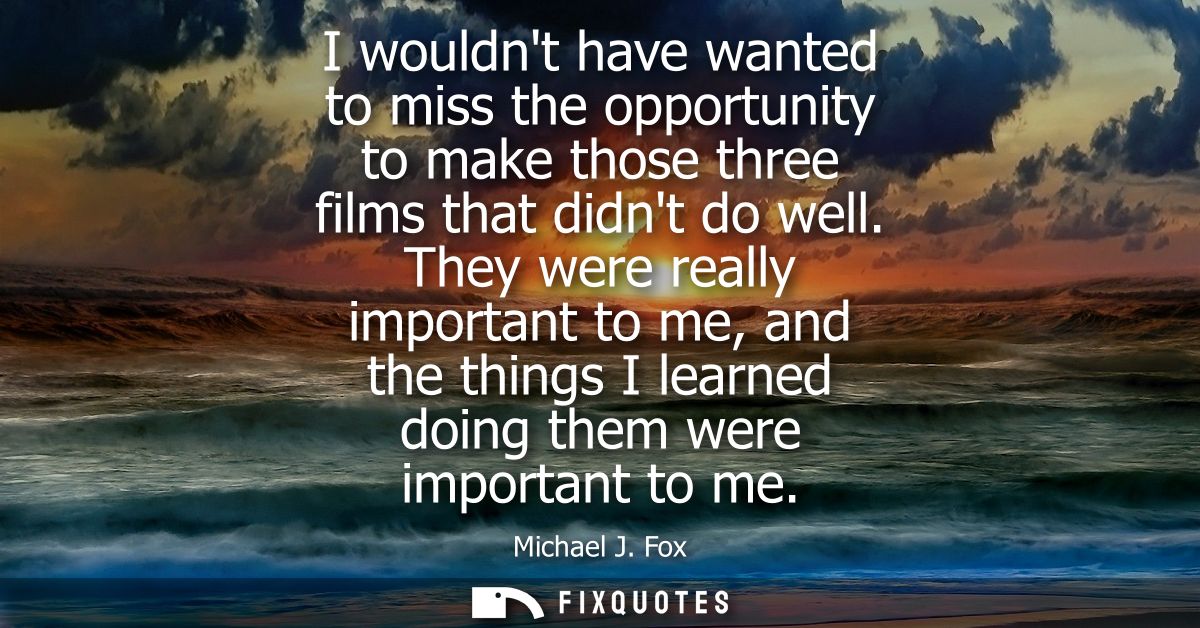
"I wouldn't have wanted to miss the opportunity to make those three films that didn't do well. They were really important to me, and the things I learned doing them were important to me"
About this Quote
The specificity - “those three films” - is doing a lot of work. He doesn’t romanticize failure in the abstract; he names a small cluster of misfires, suggesting he’s carried them around, studied them, maybe even protected them from the easy narrative of “mistakes.” It’s also a subtle correction to how audiences consume celebrity: we remember the iconic roles and pretend the rest didn’t happen. Fox insists the off-peak work counts, even if it didn’t “do well.”
The repetition of “important to me” is the tell. He’s not arguing that the films were misunderstood masterpieces; he’s asserting a private metric of value - learning, craft, resilience - in a system that rarely rewards any of those without a hit attached. The subtext lands like a career-long thesis: you don’t grow by curating only the flattering chapters, you grow by keeping the ones you’d be tempted to delete.
Quote Details
| Topic | Learning from Mistakes |
|---|---|
| Source | Help us find the source |
| Cite |
Citation Formats
APA Style (7th ed.)
Fox, Michael J. (2026, January 16). I wouldn't have wanted to miss the opportunity to make those three films that didn't do well. They were really important to me, and the things I learned doing them were important to me. FixQuotes. https://fixquotes.com/quotes/i-wouldnt-have-wanted-to-miss-the-opportunity-to-84993/
Chicago Style
Fox, Michael J. "I wouldn't have wanted to miss the opportunity to make those three films that didn't do well. They were really important to me, and the things I learned doing them were important to me." FixQuotes. January 16, 2026. https://fixquotes.com/quotes/i-wouldnt-have-wanted-to-miss-the-opportunity-to-84993/.
MLA Style (9th ed.)
"I wouldn't have wanted to miss the opportunity to make those three films that didn't do well. They were really important to me, and the things I learned doing them were important to me." FixQuotes, 16 Jan. 2026, https://fixquotes.com/quotes/i-wouldnt-have-wanted-to-miss-the-opportunity-to-84993/. Accessed 11 Mar. 2026.