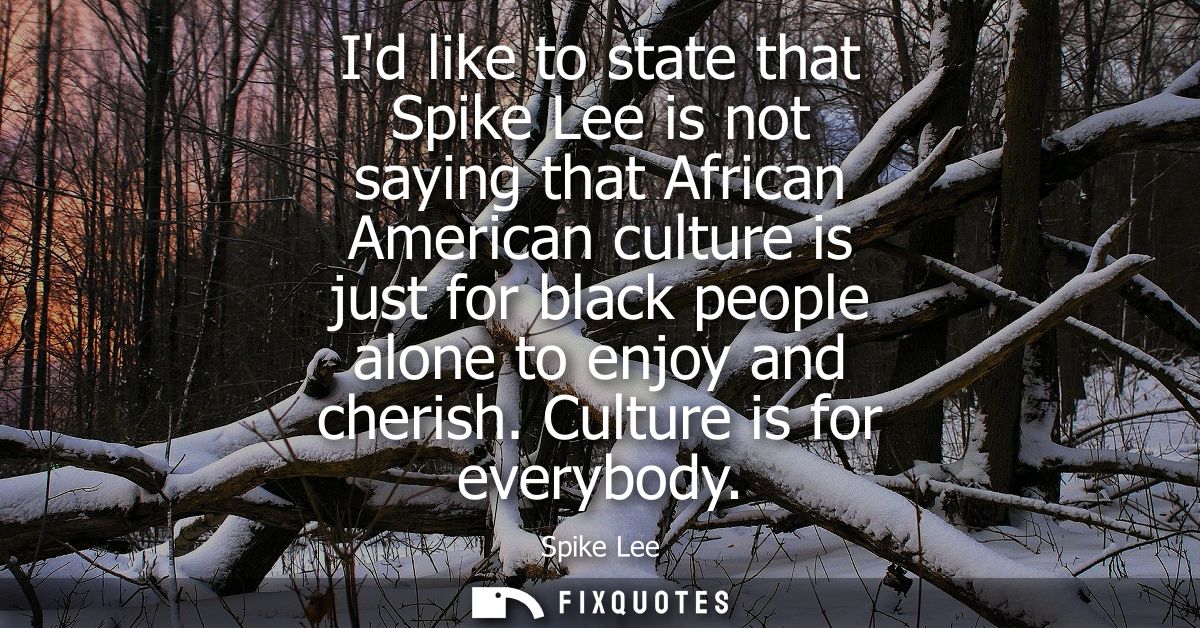
"I'd like to state that Spike Lee is not saying that African American culture is just for black people alone to enjoy and cherish. Culture is for everybody"
About this Quote
The intent is to cut off a familiar accusation aimed at Black artists: that centering Black life is the same as shutting everyone else out. By insisting that African American culture is “for everybody,” Lee appeals to an inclusive, democratic language that mainstream America finds legible. It’s also strategic: you can’t dismiss his films as niche or separatist if he’s already claimed them as part of the common cultural inheritance.
The subtext is more pointed. Yes, culture can be shared, but sharing is not the same as taking. Lee’s career has been a long argument that Black culture is routinely consumed without Black people being heard, protected, or paid. This line invites engagement while implicitly demanding respect for authorship, history, and power. It’s a reminder that appreciation without accountability is just a softer form of erasure.
Context matters: Lee emerged in an era when Black cultural production was both hyper-visible and heavily policed - celebrated for style, scolded for anger. This quote positions him as translator and gatekeeper, refusing the false choice between pride and openness.
Quote Details
| Topic | Equality |
|---|---|
| Source | Help us find the source |
| Cite |
Citation Formats
APA Style (7th ed.)
Lee, Spike. (2026, January 17). I'd like to state that Spike Lee is not saying that African American culture is just for black people alone to enjoy and cherish. Culture is for everybody. FixQuotes. https://fixquotes.com/quotes/id-like-to-state-that-spike-lee-is-not-saying-24056/
Chicago Style
Lee, Spike. "I'd like to state that Spike Lee is not saying that African American culture is just for black people alone to enjoy and cherish. Culture is for everybody." FixQuotes. January 17, 2026. https://fixquotes.com/quotes/id-like-to-state-that-spike-lee-is-not-saying-24056/.
MLA Style (9th ed.)
"I'd like to state that Spike Lee is not saying that African American culture is just for black people alone to enjoy and cherish. Culture is for everybody." FixQuotes, 17 Jan. 2026, https://fixquotes.com/quotes/id-like-to-state-that-spike-lee-is-not-saying-24056/. Accessed 31 Mar. 2026.