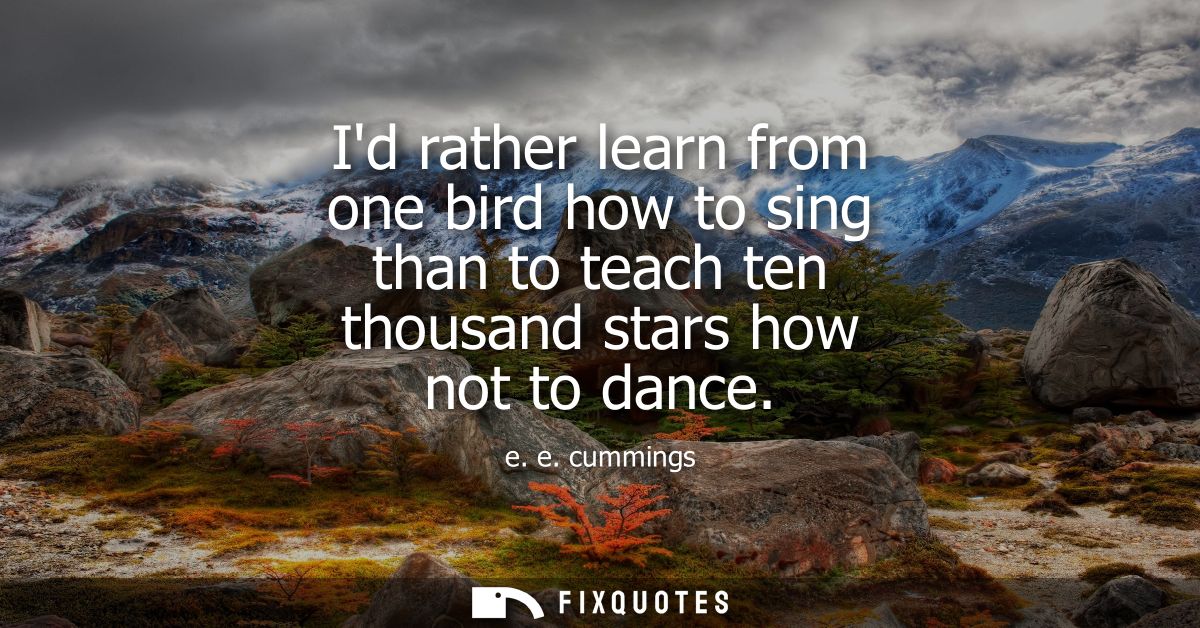
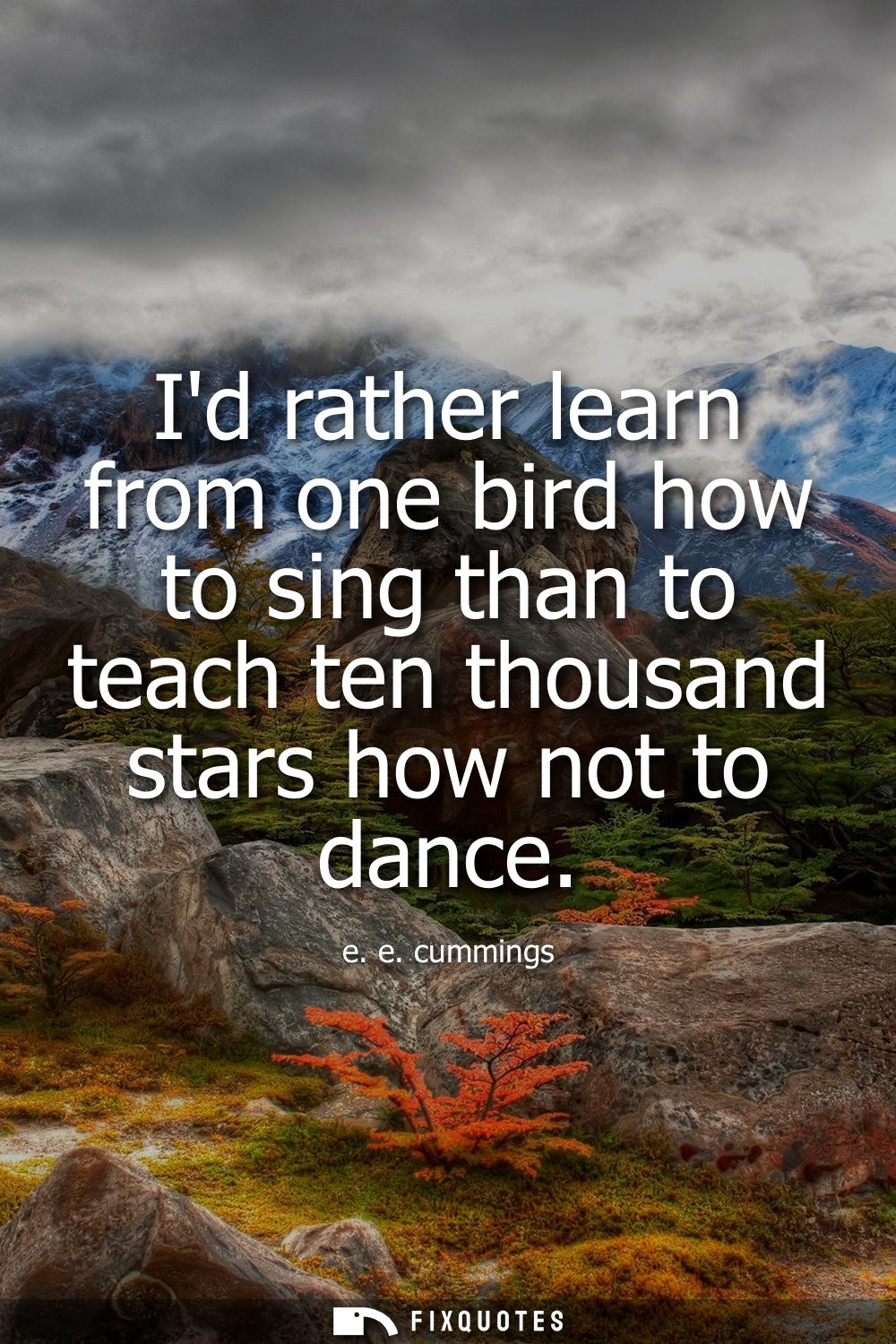
"I'd rather learn from one bird how to sing than to teach ten thousand stars how not to dance"
About this Quote
The bird, by contrast, is local, embodied, audible. “How to sing” isn’t a technical skill so much as an ethic: attention, responsiveness, the courage to make a sound because you’re alive. Cummings’ intent isn’t anti-knowledge; it’s anti-bullying and anti-committee. He’s skewering the posture of the moral instructor who wants the universe to behave, who prefers prohibitions (“how not to”) over creation (“how to”).
Context matters: Cummings wrote in a modernist moment allergic to pomp and institutional certainty, and he carried a lifelong suspicion of systems that flatten individuality. The subtext is a manifesto for artistic humility. Learn from what’s actual and vulnerable, not from what’s grand and untouchable. Trade the fantasy of fixing everything for the practice of listening well enough to be changed. That’s why the metaphor lands: it’s not escapist. It’s a rebuke to the kind of seriousness that can’t tell the difference between guidance and domination.
Quote Details
| Topic | Poetry |
|---|---|
| Source | Verified source: Poems, 1923-1954 (E. E. Cummings, 1954)
Evidence: I'd rather learn from one bird how to sing than teach ten thousand stars how not to dance (Page 345). This line is the closing couplet of Cummings' 14-line poem beginning “you shall above all things be glad and young”. A Google Books table-of-contents/snippet listing shows the poem’s entry on p. 345 in the 1954 Harcourt, Brace volume Poems, 1923–1954. This verifies the quote in a primary Cummings book, but it does NOT prove first publication. Other evidence strongly indicates the poem was part of the ‘New Poems’ section first issued in Cummings’ Collected Poems (Harcourt, Brace) in 1938; however, I did not retrieve a scan/snippet of the 1938 Collected Poems page itself in this search session due to access/copyright limits, so I cannot provide an exact page number for the 1938 first appearance. Other candidates (1) Keeping a Professional Journal (Mary Louise Holly, 2002) compilation95.0% ... I'd rather learn from one bird how to sing than to teach ten thousand stars how not to dance . 5 E. E. CUMMINGS K... |
| Cite |
Citation Formats
APA Style (7th ed.)
Cummings, E. E. (2026, March 1). I'd rather learn from one bird how to sing than to teach ten thousand stars how not to dance. FixQuotes. https://fixquotes.com/quotes/id-rather-learn-from-one-bird-how-to-sing-than-to-13960/
Chicago Style
Cummings, E. E. "I'd rather learn from one bird how to sing than to teach ten thousand stars how not to dance." FixQuotes. March 1, 2026. https://fixquotes.com/quotes/id-rather-learn-from-one-bird-how-to-sing-than-to-13960/.
MLA Style (9th ed.)
"I'd rather learn from one bird how to sing than to teach ten thousand stars how not to dance." FixQuotes, 1 Mar. 2026, https://fixquotes.com/quotes/id-rather-learn-from-one-bird-how-to-sing-than-to-13960/. Accessed 14 Mar. 2026.