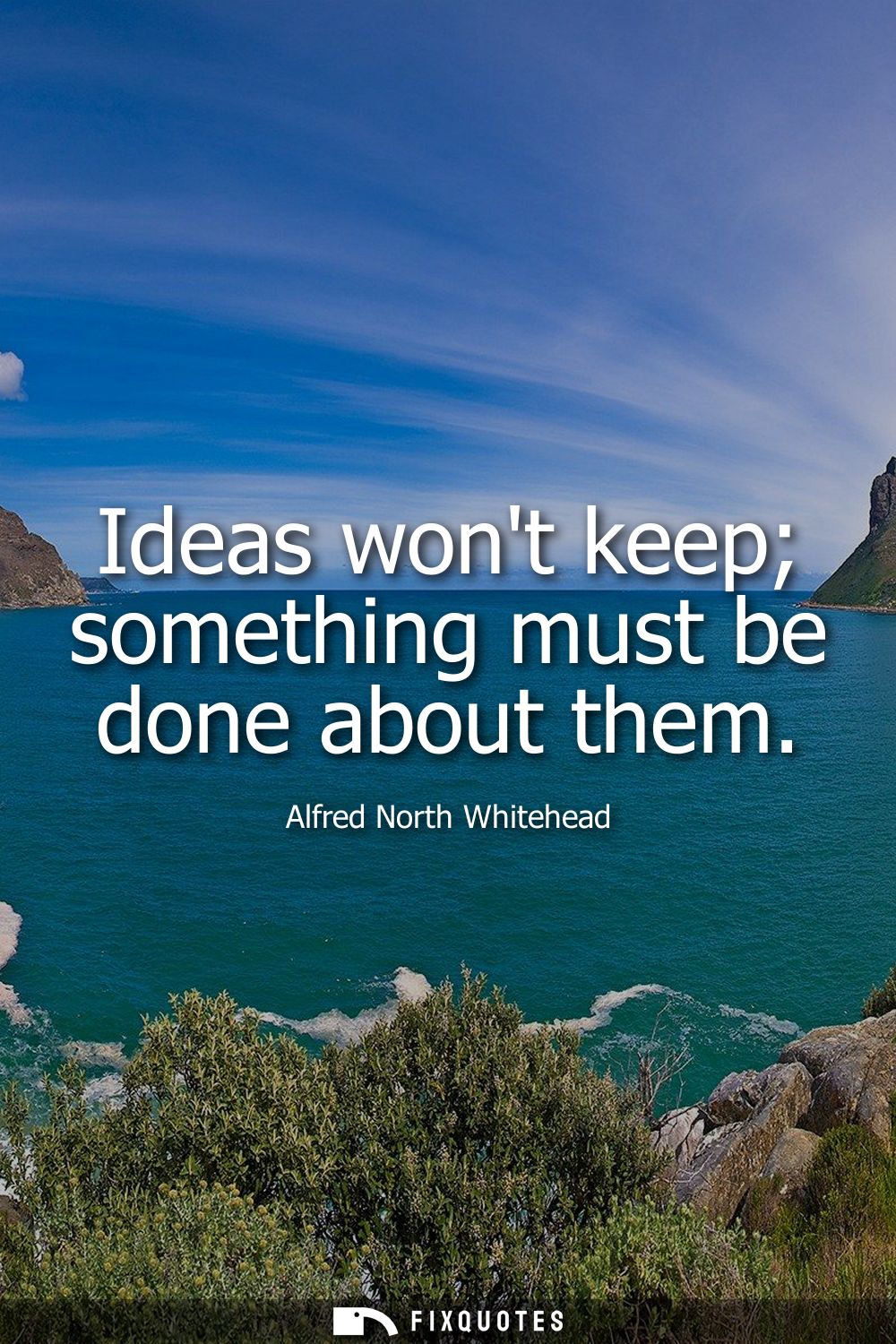
"Ideas won't keep; something must be done about them"
About this Quote
Ideas are perishable goods, and Whitehead treats them that way: not as precious artifacts to be archived, but as live forces that decay if they don’t get translated into practice. The line’s bite comes from its homely verb choice. “Keep” belongs to kitchens and closets, not philosophy seminars. He’s puncturing the romantic notion that an idea, once minted, sits safely in the mind like a coin in a vault. In Whitehead’s world, thought is process, not possession. If you don’t move it into action, teaching, institution-building, or revision, it spoils into slogan.
The subtext is a quiet indictment of intellectual complacency. An “idea” isn’t automatically a contribution; it can be a form of procrastination, a way to feel advanced without paying the cost of commitment. Whitehead’s insistence that “something must be done” shifts responsibility from the elegance of the concept to the discipline of follow-through. It’s also a warning about how quickly ideas get co-opted. Left unattended, they harden into doctrine, get misapplied by others, or become mere cultural decoration.
Context matters: Whitehead was a mathematician who became a major philosopher, writing in an era when science and industrial modernity were reorganizing daily life. For someone steeped in proof, systems, and application, “doing something” isn’t anti-intellectual; it’s the completion of thinking. The sentence reads like a principle for modern knowledge work: publish, test, teach, build, iterate. Otherwise your “ideas” become just another form of clutter.
The subtext is a quiet indictment of intellectual complacency. An “idea” isn’t automatically a contribution; it can be a form of procrastination, a way to feel advanced without paying the cost of commitment. Whitehead’s insistence that “something must be done” shifts responsibility from the elegance of the concept to the discipline of follow-through. It’s also a warning about how quickly ideas get co-opted. Left unattended, they harden into doctrine, get misapplied by others, or become mere cultural decoration.
Context matters: Whitehead was a mathematician who became a major philosopher, writing in an era when science and industrial modernity were reorganizing daily life. For someone steeped in proof, systems, and application, “doing something” isn’t anti-intellectual; it’s the completion of thinking. The sentence reads like a principle for modern knowledge work: publish, test, teach, build, iterate. Otherwise your “ideas” become just another form of clutter.
Quote Details
| Topic | Motivational |
|---|
More Quotes by Alfred
Add to List