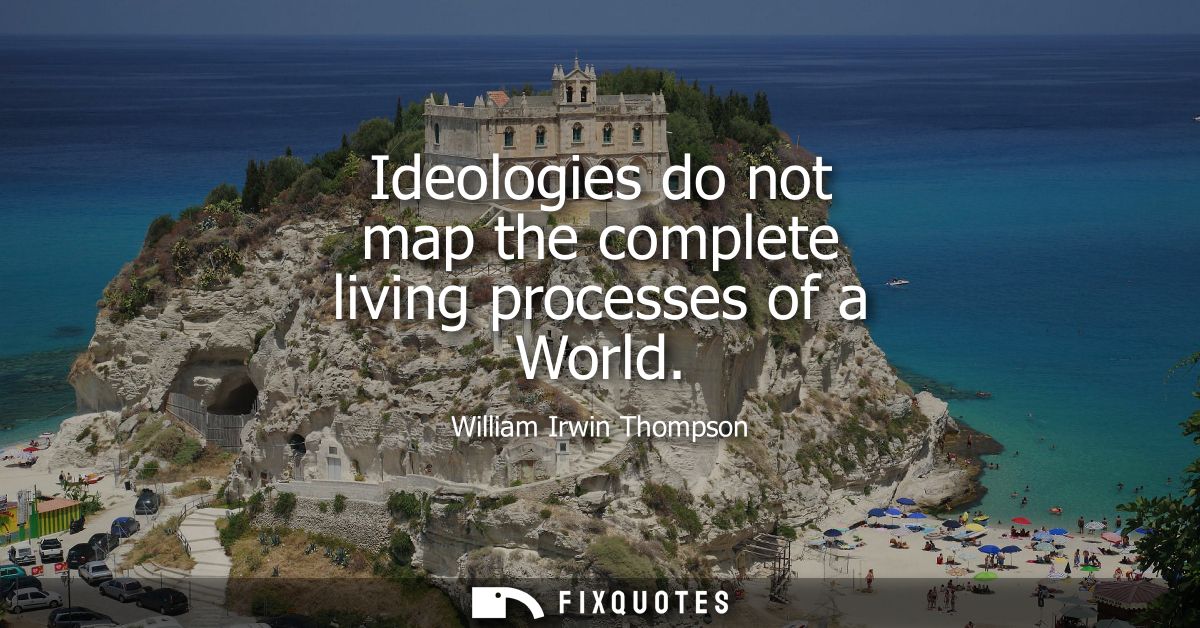
"Ideologies do not map the complete living processes of a World"
About this Quote
Ideology is a paper map held up to a moving river, and Thompson’s line quietly shames anyone who mistakes the legend for the water. The phrase “do not map” is doing surgical work: it concedes that ideologies can orient us, then immediately exposes their core failure as representations. A map is useful precisely because it simplifies; a “complete” map would be as large, messy, and ungraspable as the territory itself. Thompson’s jab is that the ideological mind pretends it can possess reality at scale, converting lived complexity into a closed system.
“Complete living processes” is the tell. He’s not arguing about facts in the abstract; he’s arguing about metabolism, emergence, the way cultures, ecologies, and consciousness evolve in feedback loops. The subtext is anti-totalizing: Marxism, capitalism, nationalism, technocratic “rationality,” even certain spiritual programs can become explanatory machines that flatten what they claim to serve. When people cling to ideology, they often crave the comfort of a finished story - villains, heroes, inevitable outcomes - because it reduces the anxiety of change. Thompson is warning that the world isn’t a solved equation; it’s an ongoing event.
Contextually, this reads like late-20th-century systems thinking and postmodern suspicion of grand narratives, but with a philosopher’s impatience for mere relativism. He’s not saying “nothing means anything.” He’s saying your framework must stay provisional, humble, revisable - because life exceeds any grid you lay over it. The danger isn’t having an ideology; it’s letting it replace attention.
“Complete living processes” is the tell. He’s not arguing about facts in the abstract; he’s arguing about metabolism, emergence, the way cultures, ecologies, and consciousness evolve in feedback loops. The subtext is anti-totalizing: Marxism, capitalism, nationalism, technocratic “rationality,” even certain spiritual programs can become explanatory machines that flatten what they claim to serve. When people cling to ideology, they often crave the comfort of a finished story - villains, heroes, inevitable outcomes - because it reduces the anxiety of change. Thompson is warning that the world isn’t a solved equation; it’s an ongoing event.
Contextually, this reads like late-20th-century systems thinking and postmodern suspicion of grand narratives, but with a philosopher’s impatience for mere relativism. He’s not saying “nothing means anything.” He’s saying your framework must stay provisional, humble, revisable - because life exceeds any grid you lay over it. The danger isn’t having an ideology; it’s letting it replace attention.
Quote Details
| Topic | Truth |
|---|
More Quotes by William
Add to List