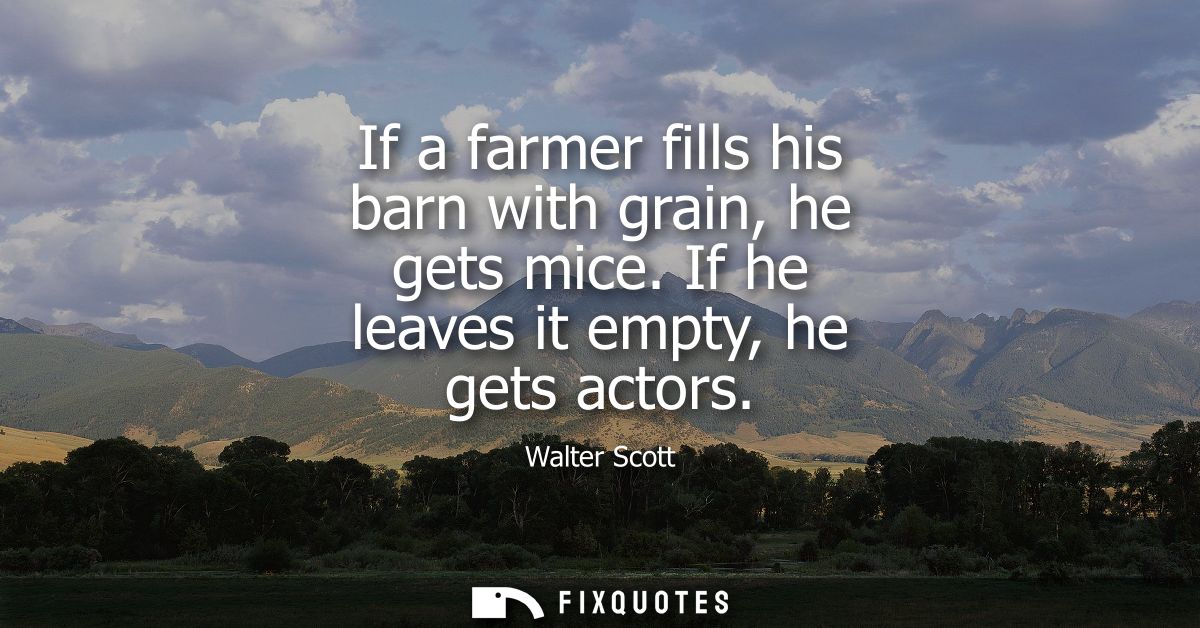
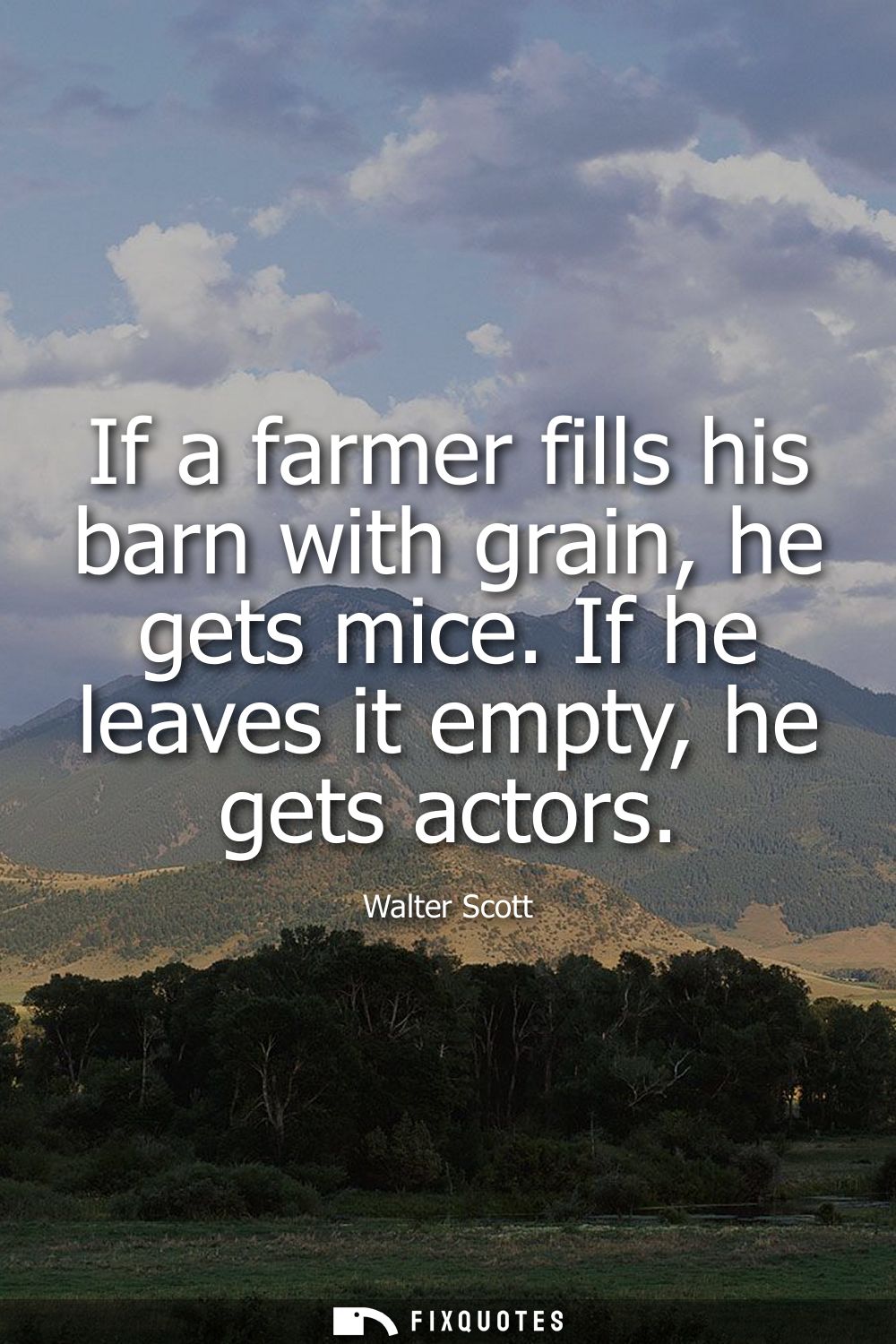
"If a farmer fills his barn with grain, he gets mice. If he leaves it empty, he gets actors"
About this Quote
The subtext is class anxiety wearing work boots. Grain represents productive surplus, the kind that signals stability and property; mice are the predictable tax on abundance. Actors, though, arrive when there’s nothing to steal. They’re cast as opportunists who live off hospitality, patronage, or spectacle - feeding on households and communities the way mice feed on stores. Scott isn’t just mocking the stage; he’s policing social boundaries. The barn is “for” labor and storage, not for itinerant people whose value is hard to quantify.
Context matters: Scott’s Britain was a place where theater carried a whiff of moral suspicion and social liminality, even as celebrity culture was starting to modernize. Novelists were busy laundering fiction into respectability; actors were still tagged as unreliable, mobile, and faintly scandalous. The line lands as a defensive joke from a man of letters staking out status: my invention is literature; theirs is noise in your empty building.
Quote Details
| Topic | Witty One-Liners |
|---|---|
| Source | Help us find the source |
| Cite |
Citation Formats
APA Style (7th ed.)
Scott, Walter. (2026, January 17). If a farmer fills his barn with grain, he gets mice. If he leaves it empty, he gets actors. FixQuotes. https://fixquotes.com/quotes/if-a-farmer-fills-his-barn-with-grain-he-gets-66527/
Chicago Style
Scott, Walter. "If a farmer fills his barn with grain, he gets mice. If he leaves it empty, he gets actors." FixQuotes. January 17, 2026. https://fixquotes.com/quotes/if-a-farmer-fills-his-barn-with-grain-he-gets-66527/.
MLA Style (9th ed.)
"If a farmer fills his barn with grain, he gets mice. If he leaves it empty, he gets actors." FixQuotes, 17 Jan. 2026, https://fixquotes.com/quotes/if-a-farmer-fills-his-barn-with-grain-he-gets-66527/. Accessed 27 Mar. 2026.