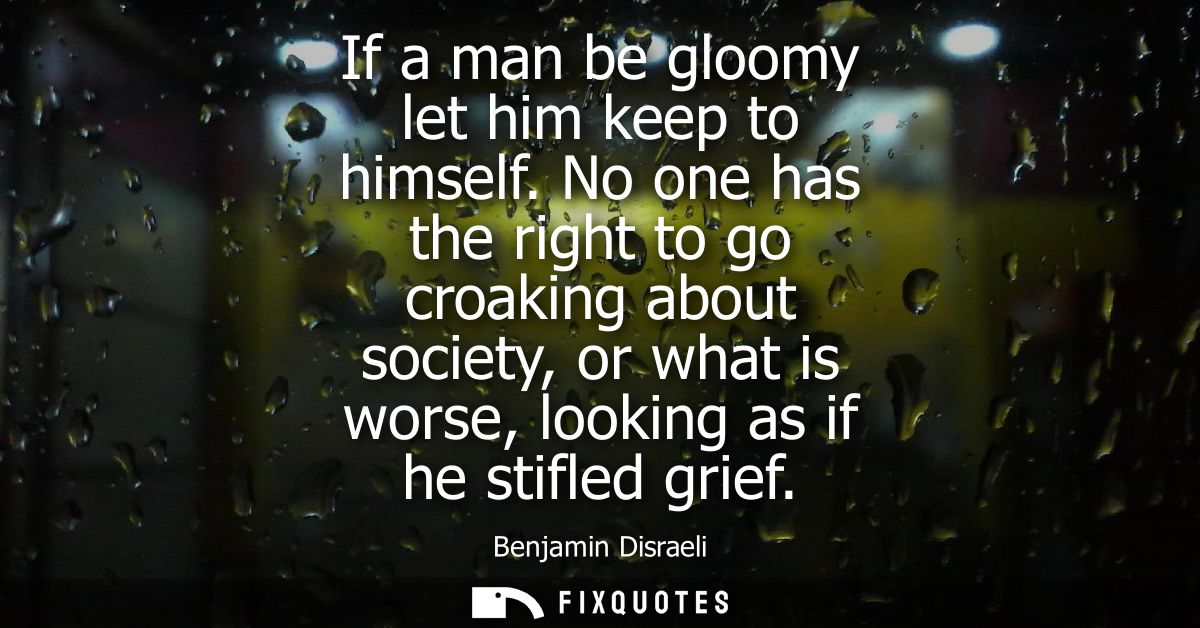
"If a man be gloomy, let him keep to himself. No one has the right to go croaking about society, or what is worse, looking as if he stifled grief"
About this Quote
The sharper barb comes next: “or what is worse, looking as if he stifled grief.” That “worse” is revealing. Loud melancholy is irritating; theatrical restraint is dangerous. The person who seems to choke back sorrow projects accusation without stating it, solicits sympathy while denying it, and makes everyone else feel implicated. Disraeli’s contempt is for emotional blackmail - the social sabotage of implied suffering.
As a Victorian statesman, Disraeli spoke from a culture that prized self-command and treated public feeling as a civic resource. He also operated in the brutal theatre of Parliament, where mood could be weaponized and “gloom” could stand in for pessimism about the nation, the economy, the empire. The intent, then, is disciplinary: keep your private darkness private, because public melancholy isn’t authenticity; it’s a bid for power without accountability.
Quote Details
| Topic | Sadness |
|---|---|
| Source | Help us find the source |
| Cite |
Citation Formats
APA Style (7th ed.)
Disraeli, Benjamin. (2026, February 20). If a man be gloomy, let him keep to himself. No one has the right to go croaking about society, or what is worse, looking as if he stifled grief. FixQuotes. https://fixquotes.com/quotes/if-a-man-be-gloomy-let-him-keep-to-himself-no-one-18628/
Chicago Style
Disraeli, Benjamin. "If a man be gloomy, let him keep to himself. No one has the right to go croaking about society, or what is worse, looking as if he stifled grief." FixQuotes. February 20, 2026. https://fixquotes.com/quotes/if-a-man-be-gloomy-let-him-keep-to-himself-no-one-18628/.
MLA Style (9th ed.)
"If a man be gloomy, let him keep to himself. No one has the right to go croaking about society, or what is worse, looking as if he stifled grief." FixQuotes, 20 Feb. 2026, https://fixquotes.com/quotes/if-a-man-be-gloomy-let-him-keep-to-himself-no-one-18628/. Accessed 31 Mar. 2026.