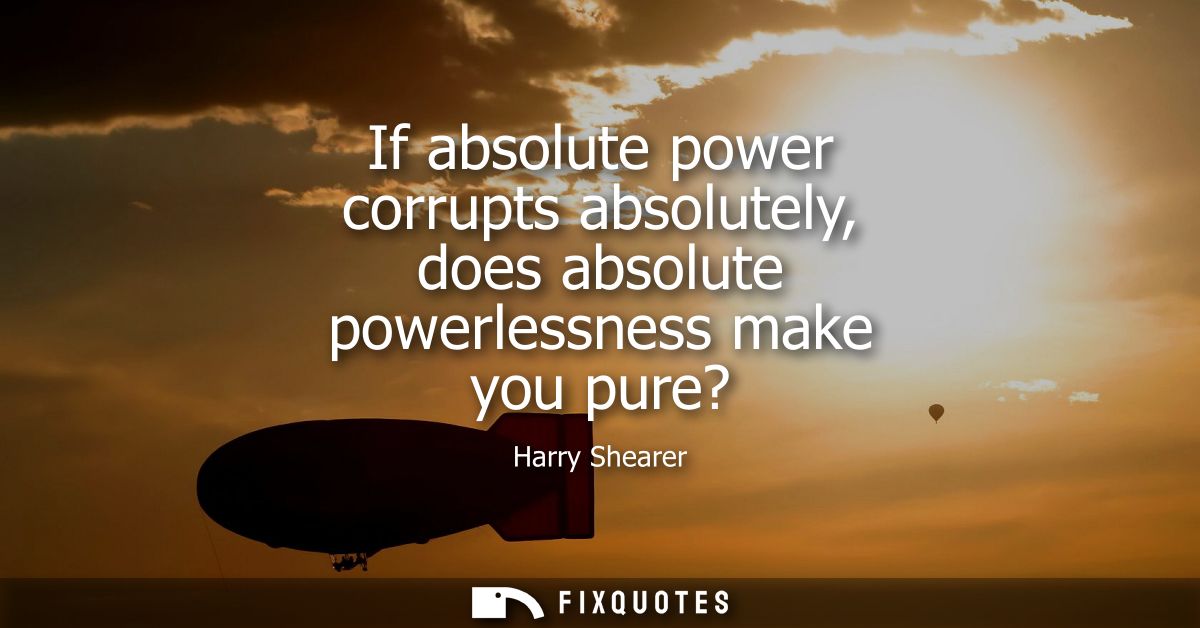
"If absolute power corrupts absolutely, does absolute powerlessness make you pure?"
About this Quote
The intent isn’t to rehabilitate “powerlessness” as noble; it’s to puncture the romance of it. In American culture, especially in entertainment and political commentary (Shearer’s home turf), victimhood can become a moral credential, a way of winning arguments without taking responsibility. Shearer is needling the idea that being shut out of institutions automatically makes you ethically superior. The subtext: plenty of people are powerless not because they’re pure, but because they’re disorganized, compromised, apathetic, or simply unlucky - and many would wield power brutally if handed it tomorrow.
It also doubles as a warning to the powerful: don’t dismiss the powerless as harmless. Powerlessness doesn’t cleanse desire; it concentrates it. The line’s real sting is that it removes everyone’s alibi. If corruption isn’t only a product of access, then virtue isn’t only a product of constraint. Purity, Shearer implies, is a practice, not a position.
Quote Details
| Topic | Ethics & Morality |
|---|---|
| Source | Help us find the source |
| Cite |
Citation Formats
APA Style (7th ed.)
Shearer, Harry. (2026, January 17). If absolute power corrupts absolutely, does absolute powerlessness make you pure? FixQuotes. https://fixquotes.com/quotes/if-absolute-power-corrupts-absolutely-does-71217/
Chicago Style
Shearer, Harry. "If absolute power corrupts absolutely, does absolute powerlessness make you pure?" FixQuotes. January 17, 2026. https://fixquotes.com/quotes/if-absolute-power-corrupts-absolutely-does-71217/.
MLA Style (9th ed.)
"If absolute power corrupts absolutely, does absolute powerlessness make you pure?" FixQuotes, 17 Jan. 2026, https://fixquotes.com/quotes/if-absolute-power-corrupts-absolutely-does-71217/. Accessed 6 Mar. 2026.