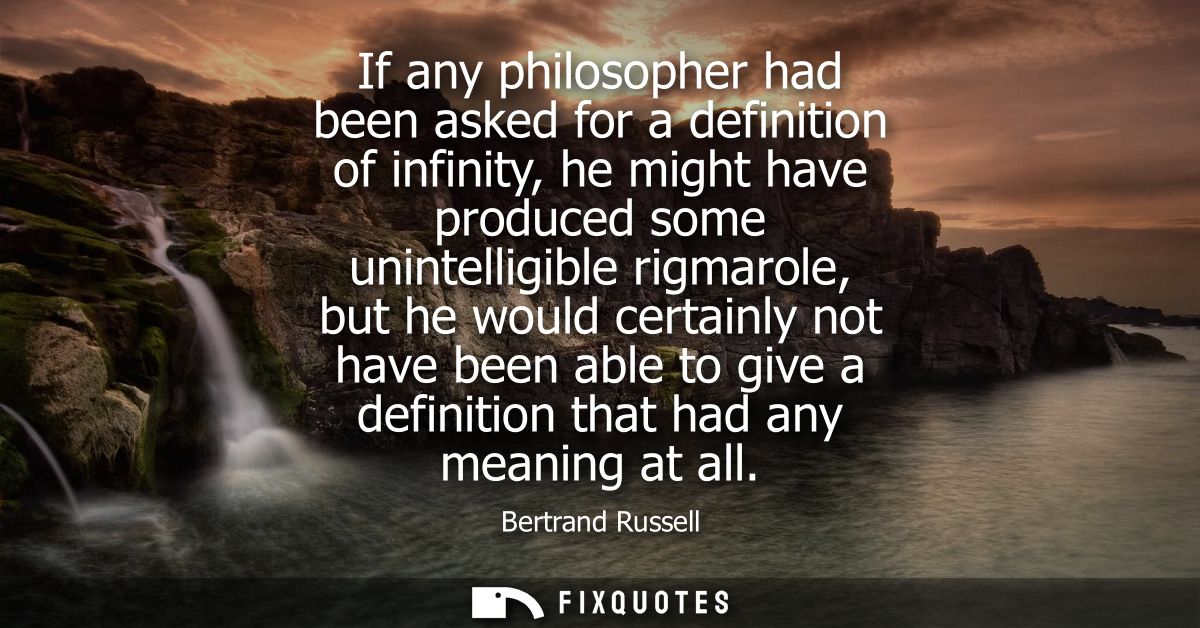
"If any philosopher had been asked for a definition of infinity, he might have produced some unintelligible rigmarole, but he would certainly not have been able to give a definition that had any meaning at all"
About this Quote
The subtext is a methodological revolt. In the late 19th and early 20th centuries, “infinity” wasn’t a poetic horizon; it was a mathematical minefield. Cantor’s set theory had turned infinity into a family of different sizes, while paradoxes (Russell’s own included) showed that loose talk about “the infinite” could blow up entire systems. Russell is warning that philosophy, when it treats infinity as a metaphysical mist, mistakes linguistic fog for depth. He’s also quietly advertising a new model of philosophical seriousness: analysis, logic, and the willingness to let mathematics discipline metaphysical ambition.
The line works because it’s both a sneer and a diagnosis. It punctures the romantic image of the philosopher as someone who can “define” the biggest concepts by sheer mental force. Infinity, Russell implies, is not conquered by grand pronouncements but by careful formal tools - and by admitting that some questions become meaningful only when you specify the rules of the game.
Quote Details
| Topic | Reason & Logic |
|---|---|
| Source | Help us find the source |
| Cite |
Citation Formats
APA Style (7th ed.)
Russell, Bertrand. (2026, January 18). If any philosopher had been asked for a definition of infinity, he might have produced some unintelligible rigmarole, but he would certainly not have been able to give a definition that had any meaning at all. FixQuotes. https://fixquotes.com/quotes/if-any-philosopher-had-been-asked-for-a-4918/
Chicago Style
Russell, Bertrand. "If any philosopher had been asked for a definition of infinity, he might have produced some unintelligible rigmarole, but he would certainly not have been able to give a definition that had any meaning at all." FixQuotes. January 18, 2026. https://fixquotes.com/quotes/if-any-philosopher-had-been-asked-for-a-4918/.
MLA Style (9th ed.)
"If any philosopher had been asked for a definition of infinity, he might have produced some unintelligible rigmarole, but he would certainly not have been able to give a definition that had any meaning at all." FixQuotes, 18 Jan. 2026, https://fixquotes.com/quotes/if-any-philosopher-had-been-asked-for-a-4918/. Accessed 28 Mar. 2026.