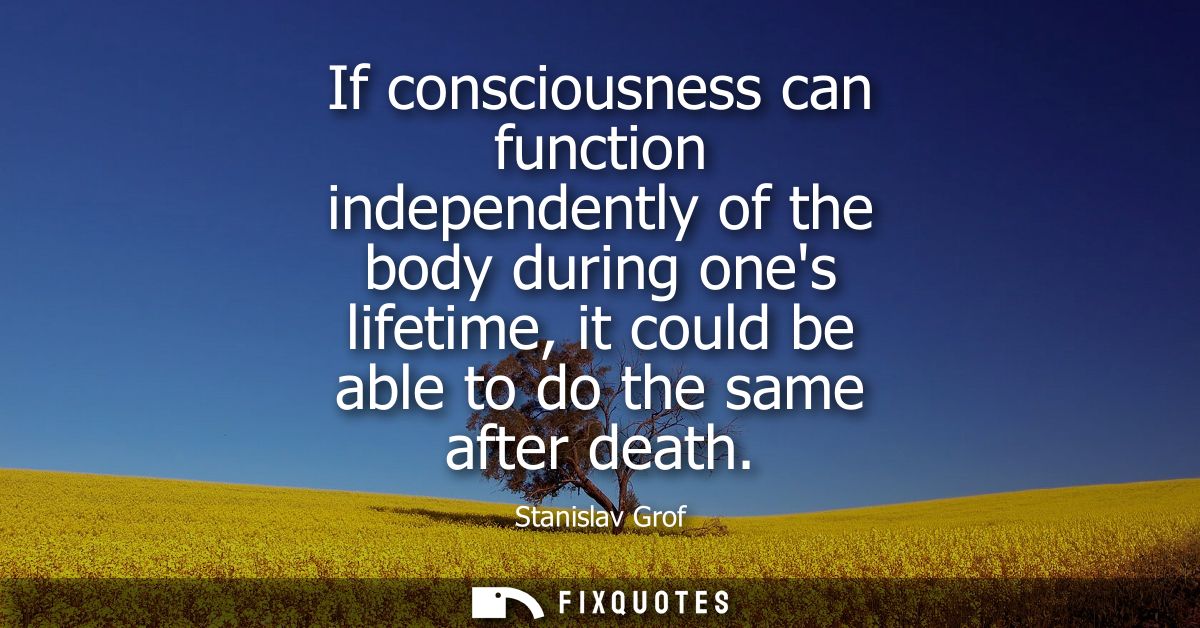
"If consciousness can function independently of the body during one's lifetime, it could be able to do the same after death"
About this Quote
The subtext sits in what counts as “independently.” In mainstream psychology, consciousness is typically treated as an emergent property of the brain, inseparable from its hardware. Grof, shaped by psychedelic research, transpersonal psychology, and reports from altered states and near-death experiences, is pressing on the edge cases where people claim perception without normal sensory channels. He’s not merely arguing about death; he’s challenging the jurisdiction of materialism over the mind.
Context matters because Grof’s work has long lived in a contested border zone: too clinical for mystics, too mystical for clinicians. This line is aimed at that tension. It reads like an invitation to skeptics: accept the premise only hypothetically, then notice how quickly your framework has to expand. It also reassures believers by framing spiritual survival as reasonable inference rather than doctrine.
The move is strategic: shift the debate from “Is there an afterlife?” to “What is consciousness such that independence is even thinkable?” Grof’s intent is less to win a proof than to pry open a worldview.
Quote Details
| Topic | Mortality |
|---|---|
| Source | Help us find the source |
| Cite |
Citation Formats
APA Style (7th ed.)
Grof, Stanislav. (2026, January 16). If consciousness can function independently of the body during one's lifetime, it could be able to do the same after death. FixQuotes. https://fixquotes.com/quotes/if-consciousness-can-function-independently-of-92085/
Chicago Style
Grof, Stanislav. "If consciousness can function independently of the body during one's lifetime, it could be able to do the same after death." FixQuotes. January 16, 2026. https://fixquotes.com/quotes/if-consciousness-can-function-independently-of-92085/.
MLA Style (9th ed.)
"If consciousness can function independently of the body during one's lifetime, it could be able to do the same after death." FixQuotes, 16 Jan. 2026, https://fixquotes.com/quotes/if-consciousness-can-function-independently-of-92085/. Accessed 12 Feb. 2026.