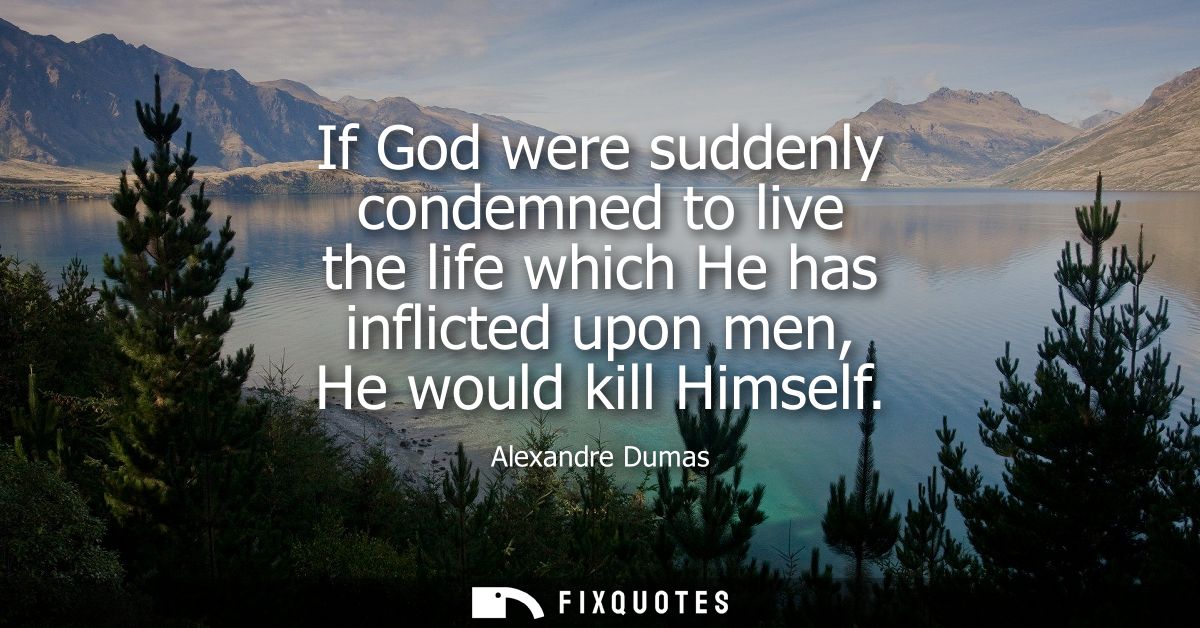
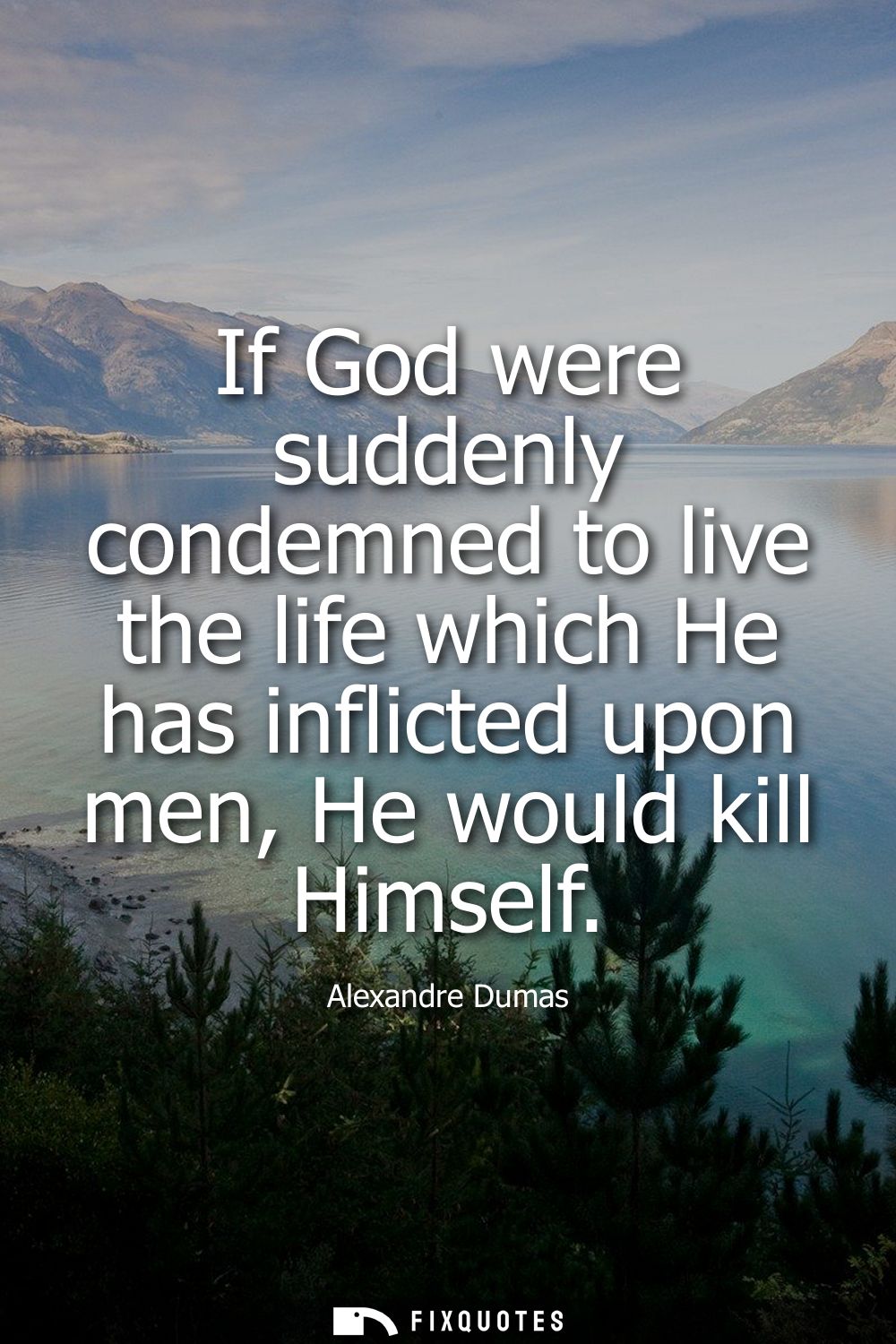
"If God were suddenly condemned to live the life which He has inflicted upon men, He would kill Himself"
About this Quote
The subtext is a revolt against the easy theology that treats pain as character-building or “mysterious.” Dumas writes in a 19th-century France where Catholic moral authority is both culturally dominant and increasingly challenged by political upheaval, class strain, and a growing appetite for secular critique. As a dramatist, he understands the stagecraft of the sentence: “suddenly condemned” implies a courtroom, a verdict, a punishment. God becomes the defendant and the convict at once. “Inflicted” is the tell; it frames human life not as a gift but as an injury administered from above.
The shock value isn’t decorative. It’s a demand for accountability that religion often dodges by shifting the burden onto human sin, human weakness, human misunderstanding. Dumas flips that reflex. If the maker can’t bear the product, what does that say about the moral credibility of the maker, and about the stories we tell to keep the world’s cruelty spiritually legible?
Quote Details
| Topic | God |
|---|---|
| Source | Later attribution: The Wisdom of the Great (Sam Majdi, 2012) modern compilationISBN: 9781462053315 · ID: 8r6D1Ck073AC
Evidence:
... If God were suddenly condemned to live the life which He has inflicted upon men, He would kill himself. Nothing ... Alexandre Dumas (The Elder) |
| Cite |
Citation Formats
APA Style (7th ed.)
Dumas, Alexandre. (2026, February 9). If God were suddenly condemned to live the life which He has inflicted upon men, He would kill Himself. FixQuotes. https://fixquotes.com/quotes/if-god-were-suddenly-condemned-to-live-the-life-166920/
Chicago Style
Dumas, Alexandre. "If God were suddenly condemned to live the life which He has inflicted upon men, He would kill Himself." FixQuotes. February 9, 2026. https://fixquotes.com/quotes/if-god-were-suddenly-condemned-to-live-the-life-166920/.
MLA Style (9th ed.)
"If God were suddenly condemned to live the life which He has inflicted upon men, He would kill Himself." FixQuotes, 9 Feb. 2026, https://fixquotes.com/quotes/if-god-were-suddenly-condemned-to-live-the-life-166920/. Accessed 3 Apr. 2026.