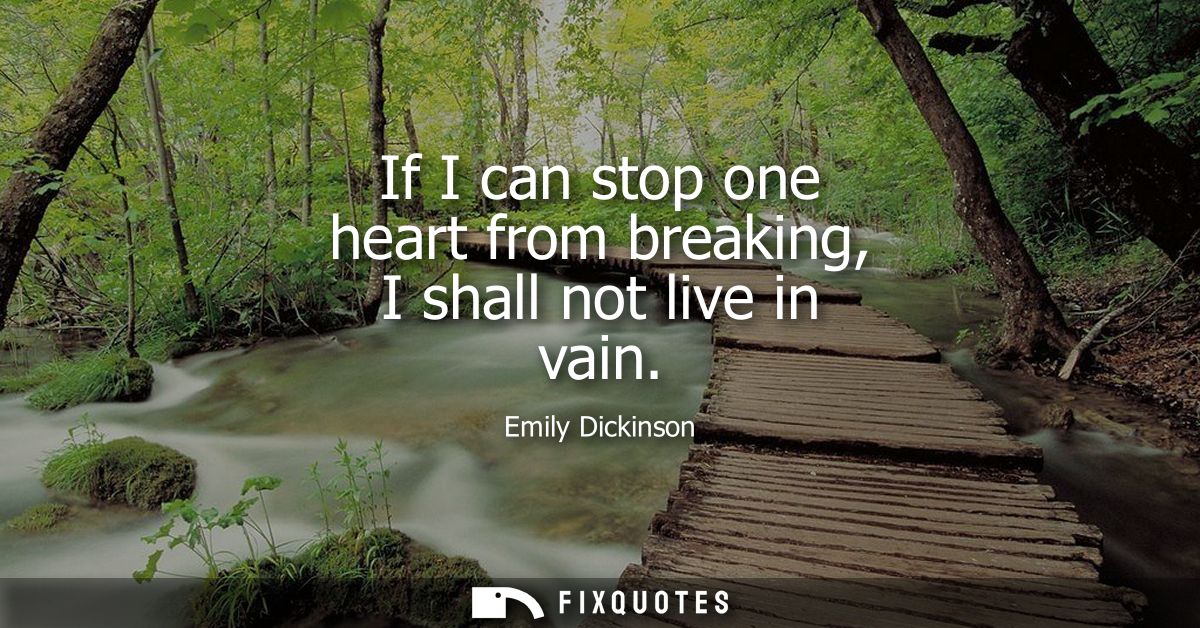
"If I can stop one heart from breaking, I shall not live in vain"
About this Quote
Dickinson’s line lands like a moral ledger entry, but it’s written in the delicate ink of someone who distrusted grand public gestures. “If I can stop one heart from breaking” shrinks the scale of salvation down to a single, almost anonymous unit: one heart, one rupture, one intervention. That smallness is the point. In a culture thick with Protestant ideals of purpose and usefulness, Dickinson quietly renegotiates what counts as a “life well spent.” Not fame, not a monument, not even a sweeping reform - just a prevented fracture.
The conditional “If” matters. She doesn’t claim she has saved anyone; she frames meaning as a hoped-for exchange. It’s humility, but also a kind of bargaining with the universe: grant me one true effect, and my existence clears the bar. “Stop” suggests urgency and proximity, as if heartbreak is a physical event you might interrupt by arriving in time. Dickinson makes emotional care sound almost kinetic.
“I shall not live in vain” is the hard, plain-faced phrase that gives the poem its steel. “Vain” implies not only emptiness but a wasted performance, the dread that a life can be all motion and no consequence. For a poet who published little in her lifetime and lived largely out of view, the subtext is bracing: the work doesn’t have to be witnessed to be real. The line argues for a private ethics of attention - where preventing pain, even once, justifies the entire experiment of being alive.
The conditional “If” matters. She doesn’t claim she has saved anyone; she frames meaning as a hoped-for exchange. It’s humility, but also a kind of bargaining with the universe: grant me one true effect, and my existence clears the bar. “Stop” suggests urgency and proximity, as if heartbreak is a physical event you might interrupt by arriving in time. Dickinson makes emotional care sound almost kinetic.
“I shall not live in vain” is the hard, plain-faced phrase that gives the poem its steel. “Vain” implies not only emptiness but a wasted performance, the dread that a life can be all motion and no consequence. For a poet who published little in her lifetime and lived largely out of view, the subtext is bracing: the work doesn’t have to be witnessed to be real. The line argues for a private ethics of attention - where preventing pain, even once, justifies the entire experiment of being alive.
Quote Details
| Topic | Kindness |
|---|---|
| Source | Emily Dickinson — poem beginning "If I can stop one heart from breaking" (first line of a Dickinson poem). |
| Cite |
Citation Formats
APA Style (7th ed.)
Dickinson, Emily. (2026, January 18). If I can stop one heart from breaking, I shall not live in vain. FixQuotes. https://fixquotes.com/quotes/if-i-can-stop-one-heart-from-breaking-i-shall-not-23485/
Chicago Style
Dickinson, Emily. "If I can stop one heart from breaking, I shall not live in vain." FixQuotes. January 18, 2026. https://fixquotes.com/quotes/if-i-can-stop-one-heart-from-breaking-i-shall-not-23485/.
MLA Style (9th ed.)
"If I can stop one heart from breaking, I shall not live in vain." FixQuotes, 18 Jan. 2026, https://fixquotes.com/quotes/if-i-can-stop-one-heart-from-breaking-i-shall-not-23485/. Accessed 25 Mar. 2026.
More Quotes by Emily
Add to List