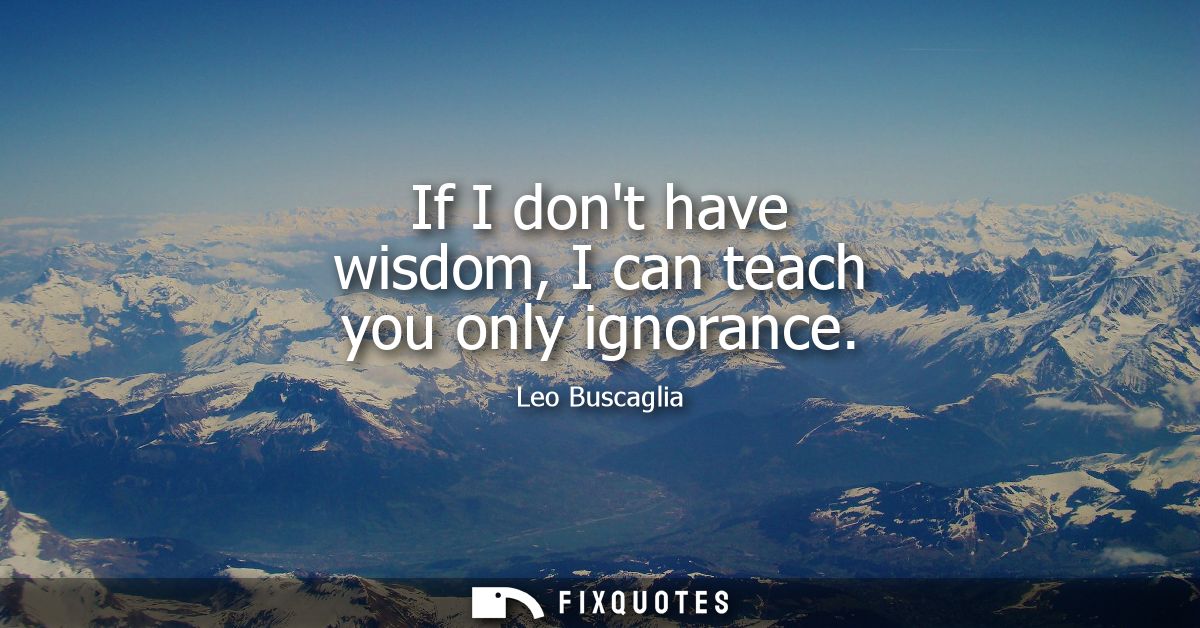
"If I don't have wisdom, I can teach you only ignorance"
About this Quote
Buscaglia’s line lands with the disarming bluntness of a teacher refusing to cosplay as an authority. “If I don’t have wisdom” isn’t false modesty so much as a warning label: education is not value-neutral, and the instructor’s inner life leaks into the lesson. The sentence is built like a moral syllogism, but it’s also a confession. He’s saying the curriculum isn’t just content; it’s character in transmission.
The word choice does the heavy lifting. “Wisdom” is not intelligence, not credentials, not information. It’s judgment, humility, proportion - the ability to hold knowledge without turning it into a weapon or a vanity project. Against that, “only ignorance” isn’t merely not knowing; it’s the active, contagious kind: certainty without understanding, technique without ethics, rhetoric without responsibility. Buscaglia frames ignorance as something you can teach, which is the uncomfortable point. We tend to treat ignorance as an absence, but he treats it as a product.
Context matters: Buscaglia became a popular voice in late-20th-century humanistic education, when self-help and psychology-inflected warmth were entering mainstream culture. In that world, the line doubles as a critique of institutional performance. The subtext: a teacher can deliver polished lectures and still be passing along fear, cynicism, or ego. Wisdom, here, is less a trophy than a prerequisite - the quiet competence of knowing what you don’t know and refusing to make students pay for it.
The word choice does the heavy lifting. “Wisdom” is not intelligence, not credentials, not information. It’s judgment, humility, proportion - the ability to hold knowledge without turning it into a weapon or a vanity project. Against that, “only ignorance” isn’t merely not knowing; it’s the active, contagious kind: certainty without understanding, technique without ethics, rhetoric without responsibility. Buscaglia frames ignorance as something you can teach, which is the uncomfortable point. We tend to treat ignorance as an absence, but he treats it as a product.
Context matters: Buscaglia became a popular voice in late-20th-century humanistic education, when self-help and psychology-inflected warmth were entering mainstream culture. In that world, the line doubles as a critique of institutional performance. The subtext: a teacher can deliver polished lectures and still be passing along fear, cynicism, or ego. Wisdom, here, is less a trophy than a prerequisite - the quiet competence of knowing what you don’t know and refusing to make students pay for it.
Quote Details
| Topic | Wisdom |
|---|---|
| Source | Help us find the source |
More Quotes by Leo
Add to List