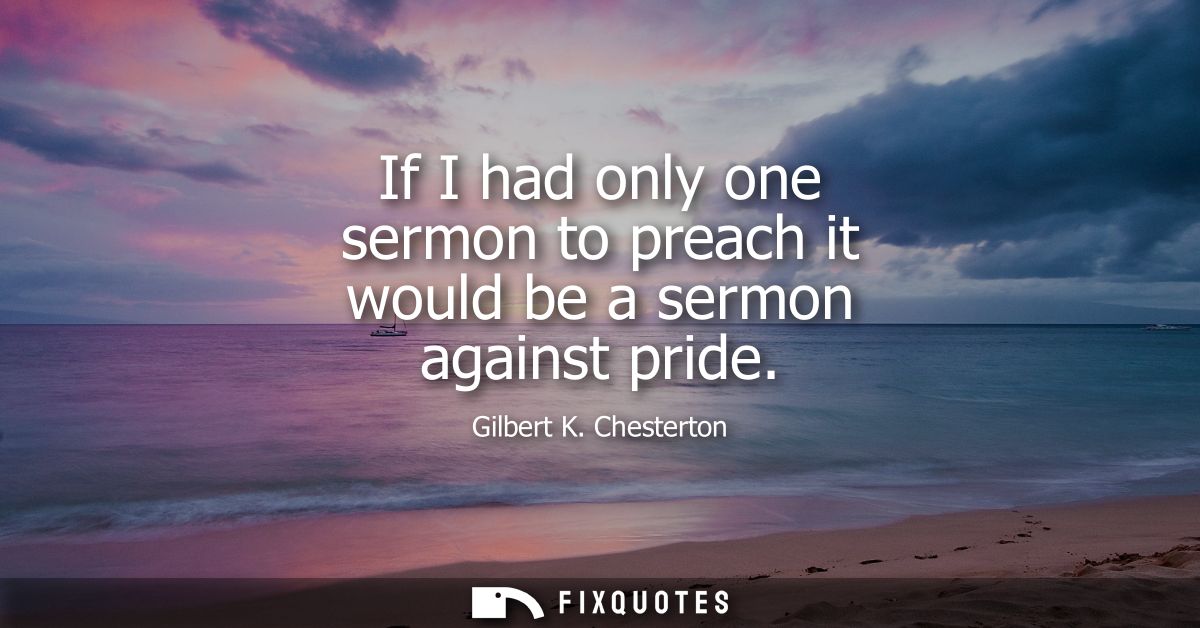
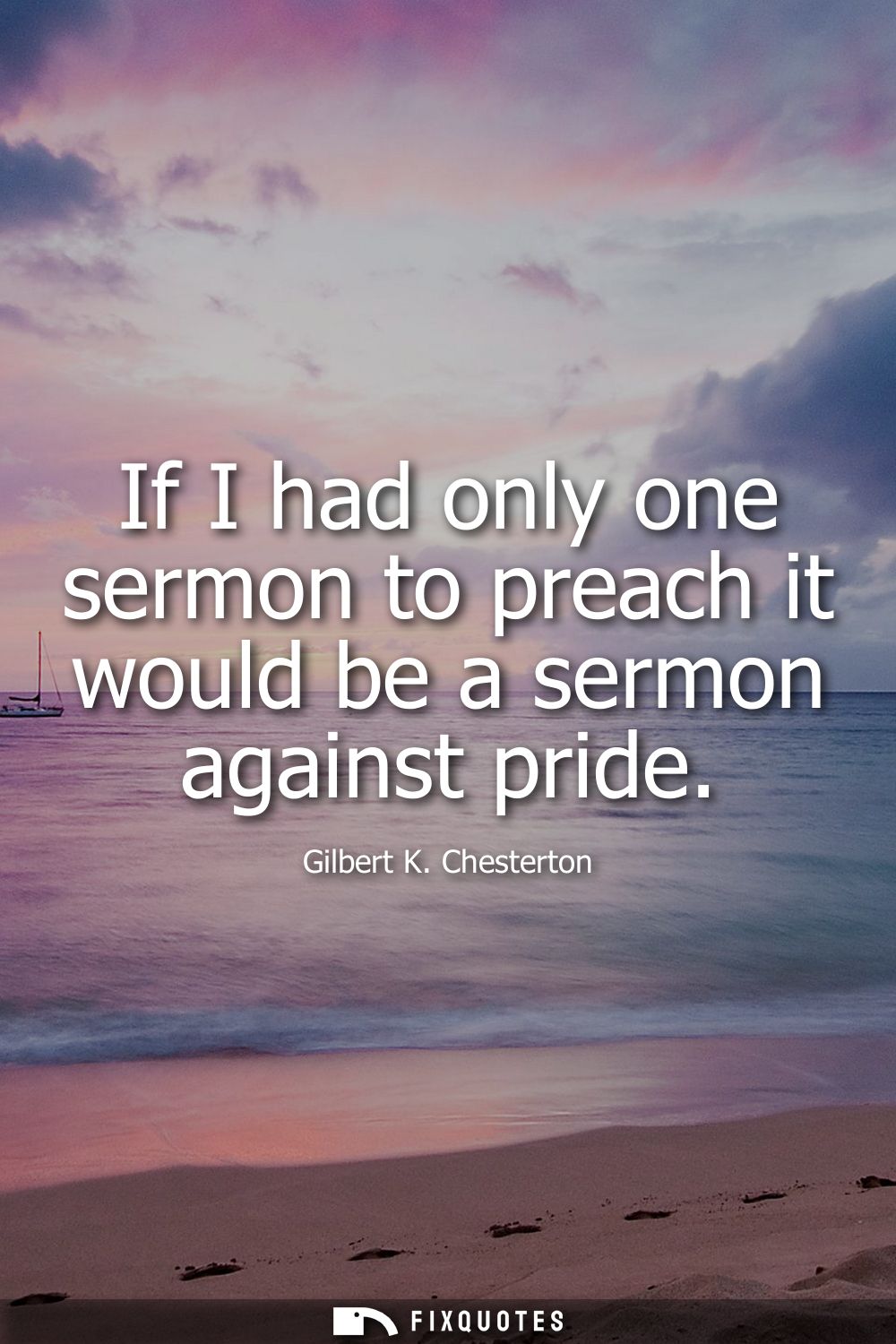
"If I had only one sermon to preach, it would be a sermon against pride"
About this Quote
The line’s tight conditional - “If I had only one” - is rhetorical pressure: he’s forcing a hierarchy. Not “pride is bad,” but “pride is upstream.” In Christian moral logic, pride isn’t merely one vice among many; it’s the vice that recruits the others. Greed, cruelty, even supposedly righteous anger become instruments of the self. Chesterton, a convert to Catholicism writing against the grain of late-Victorian self-improvement culture and early-20th-century ideological zeal, is warning that moral crusades can become ego projects.
There’s also a sly political edge. Pride is the engine of fanaticism: the refusal to be corrected, the need to dominate reality rather than receive it. A society drunk on pride doesn’t just produce arrogant individuals; it produces movements that can’t admit error. Chesterton’s intent isn’t to humiliate the proud; it’s to puncture the glamour around self-importance before it metastasizes into certainty, and certainty into harm.
Quote Details
| Topic | Humility |
|---|---|
| Source | Help us find the source |
| Cite |
Citation Formats
APA Style (7th ed.)
Chesterton, Gilbert K. (2026, February 19). If I had only one sermon to preach, it would be a sermon against pride. FixQuotes. https://fixquotes.com/quotes/if-i-had-only-one-sermon-to-preach-it-would-be-a-35782/
Chicago Style
Chesterton, Gilbert K. "If I had only one sermon to preach, it would be a sermon against pride." FixQuotes. February 19, 2026. https://fixquotes.com/quotes/if-i-had-only-one-sermon-to-preach-it-would-be-a-35782/.
MLA Style (9th ed.)
"If I had only one sermon to preach, it would be a sermon against pride." FixQuotes, 19 Feb. 2026, https://fixquotes.com/quotes/if-i-had-only-one-sermon-to-preach-it-would-be-a-35782/. Accessed 2 Apr. 2026.