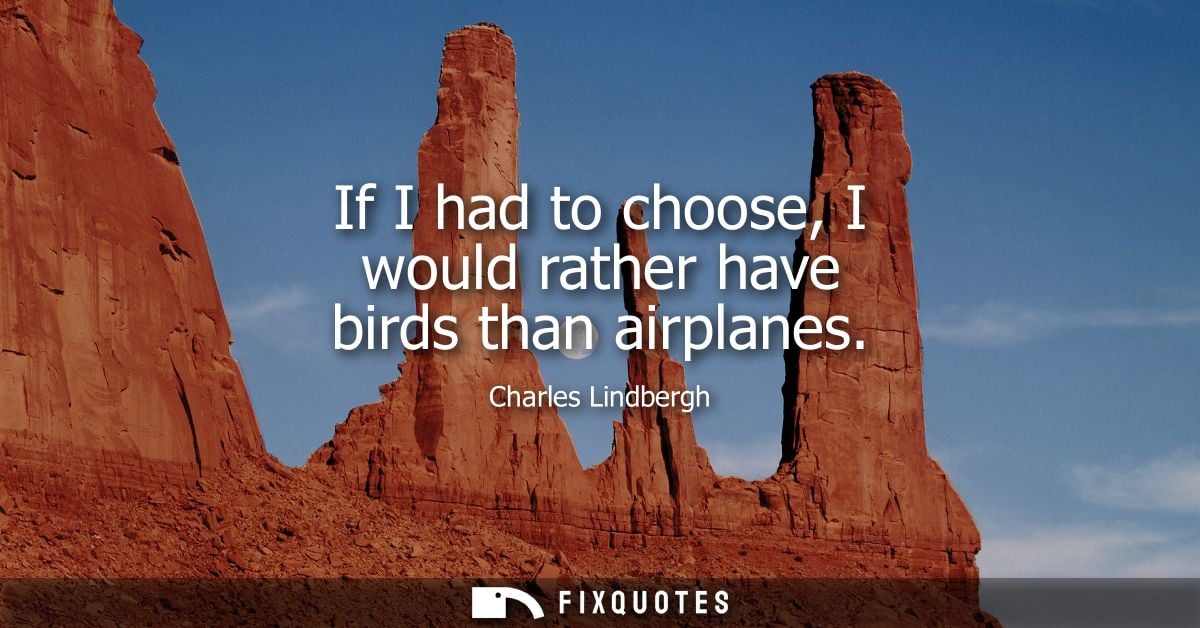
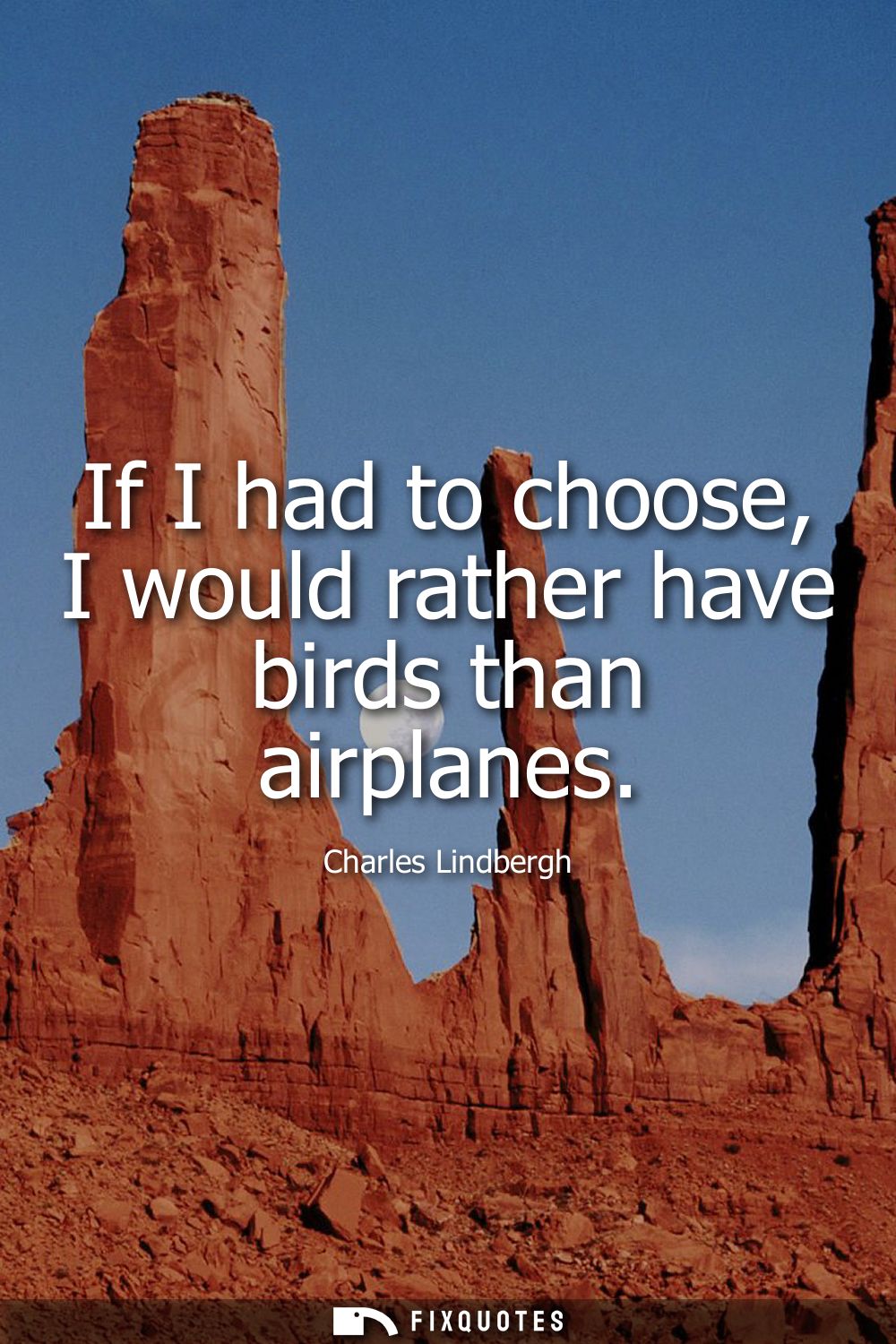
"If I had to choose, I would rather have birds than airplanes"
About this Quote
Coming from the man who made the airplane feel like destiny, this line lands as a small act of heresy. Lindbergh isn’t rejecting flight so much as questioning what flight became once it stopped being miraculous and started being normal. “If I had to choose” frames the thought like a moral triage: progress versus life, machinery versus the living world that machinery quietly replaces. It’s a confession of ambivalence from an aviator whose fame was built on the romance of the skies, now sounding like someone who has seen the bill come due.
The subtext is ecological before “environmentalism” had mainstream cultural traction. Birds stand in for an older kind of freedom: self-propelled, unburned by fuel, integrated into an ecosystem instead of hovering above it. Airplanes, by contrast, imply scale and speed, the industrial logic that treats distance as a problem to be solved and landscapes as things to be crossed, not inhabited. Lindbergh’s preference isn’t sentimental nature worship; it’s a warning about what gets sacrificed when efficiency becomes a sacred value.
Context matters. After his 1927 transatlantic flight, Lindbergh became a symbol of modernity’s confidence, then a complicated public figure tangled in nationalism and the technocratic thinking of his era. In later years he spoke more about conservation and indigenous cultures. This quote reads like a late-life recalibration: the pioneer of the machine admitting that wonder has a natural benchmark, and that human invention, however thrilling, can still be a poorer substitute for a sky that’s alive.
The subtext is ecological before “environmentalism” had mainstream cultural traction. Birds stand in for an older kind of freedom: self-propelled, unburned by fuel, integrated into an ecosystem instead of hovering above it. Airplanes, by contrast, imply scale and speed, the industrial logic that treats distance as a problem to be solved and landscapes as things to be crossed, not inhabited. Lindbergh’s preference isn’t sentimental nature worship; it’s a warning about what gets sacrificed when efficiency becomes a sacred value.
Context matters. After his 1927 transatlantic flight, Lindbergh became a symbol of modernity’s confidence, then a complicated public figure tangled in nationalism and the technocratic thinking of his era. In later years he spoke more about conservation and indigenous cultures. This quote reads like a late-life recalibration: the pioneer of the machine admitting that wonder has a natural benchmark, and that human invention, however thrilling, can still be a poorer substitute for a sky that’s alive.
Quote Details
| Topic | Nature |
|---|---|
| Source | Help us find the source |
| Cite |
Citation Formats
APA Style (7th ed.)
Lindbergh, Charles. (2026, January 18). If I had to choose, I would rather have birds than airplanes. FixQuotes. https://fixquotes.com/quotes/if-i-had-to-choose-i-would-rather-have-birds-than-3743/
Chicago Style
Lindbergh, Charles. "If I had to choose, I would rather have birds than airplanes." FixQuotes. January 18, 2026. https://fixquotes.com/quotes/if-i-had-to-choose-i-would-rather-have-birds-than-3743/.
MLA Style (9th ed.)
"If I had to choose, I would rather have birds than airplanes." FixQuotes, 18 Jan. 2026, https://fixquotes.com/quotes/if-i-had-to-choose-i-would-rather-have-birds-than-3743/. Accessed 29 Mar. 2026.
More Quotes by Charles
Add to List