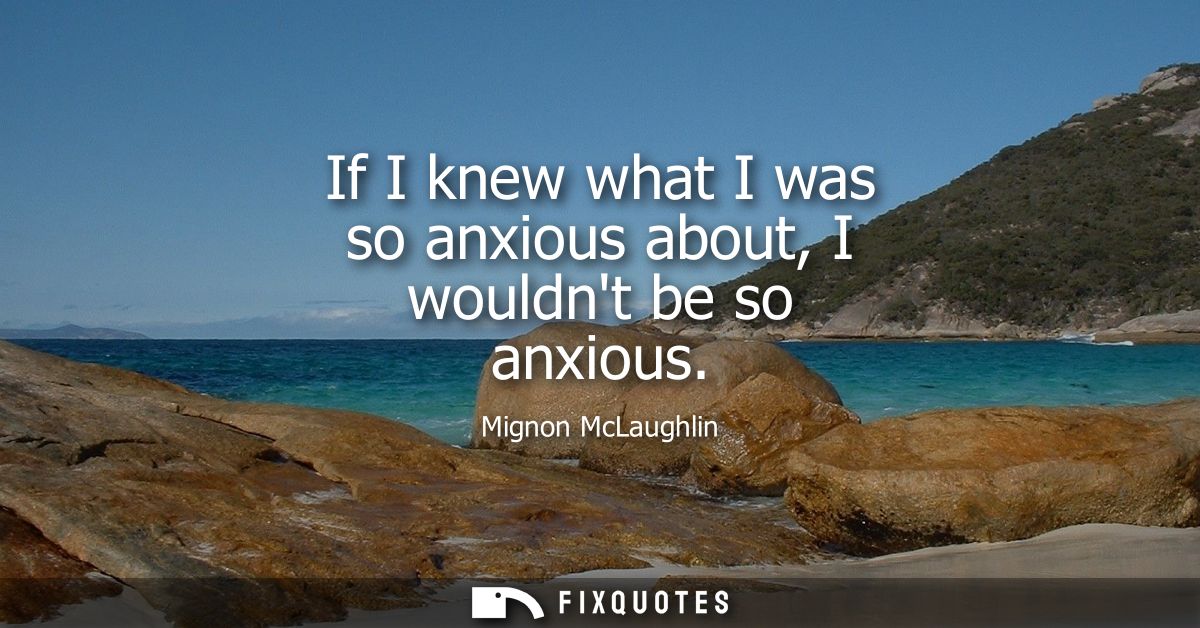
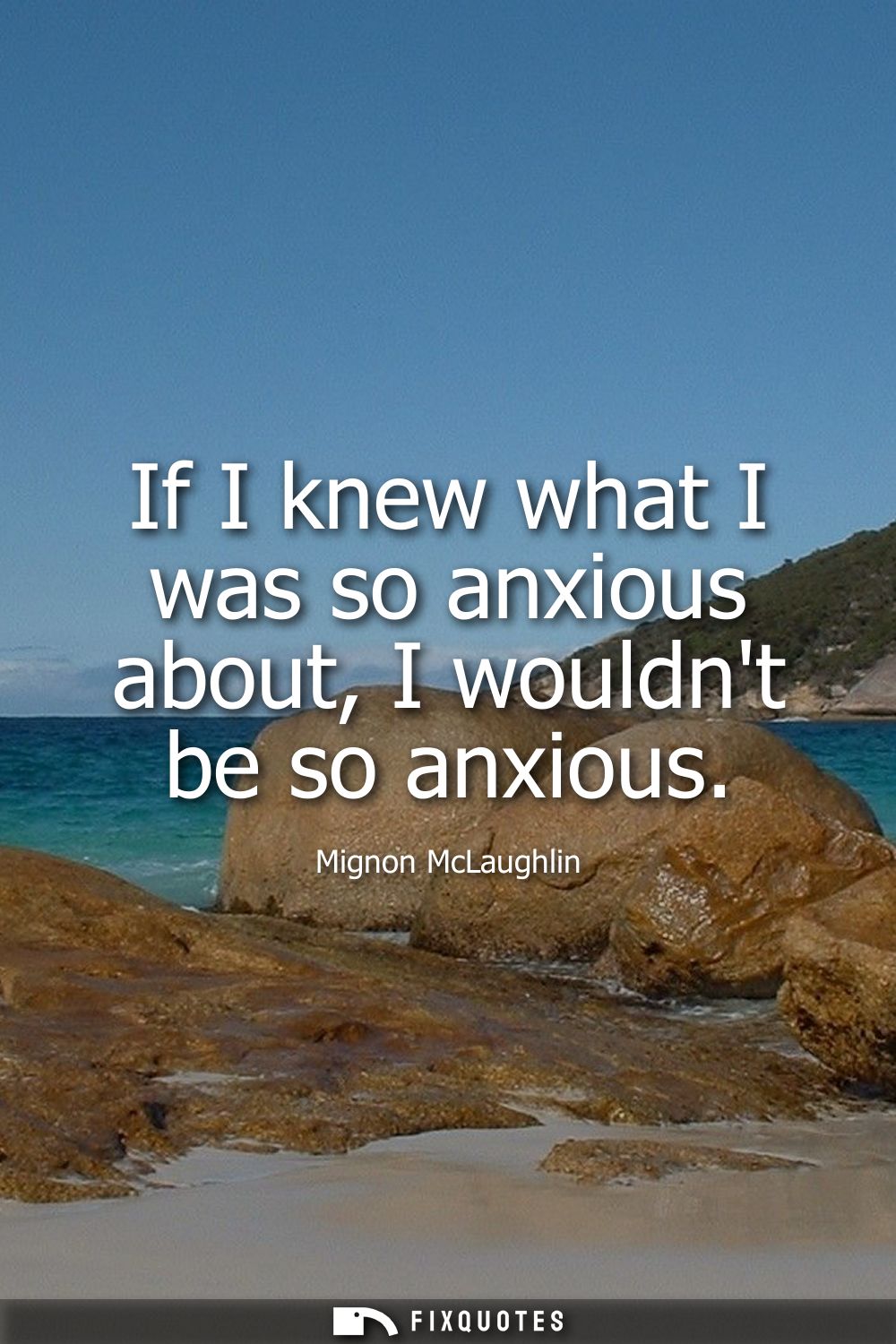
"If I knew what I was so anxious about, I wouldn't be so anxious"
About this Quote
Anxiety feeds on ambiguity. The mind scans for threats, finds none it can name, and then grows more frantic because it cannot decide where to point its defenses. The line captures that loop with a wry twist: certainty shrinks fear, while vagueness magnifies it. When a danger is specific, it can be prepared for, reasoned with, or dismissed; when it is diffuse, it becomes a fog that seeps into everything. The humor is the sting of recognition. Anyone who has felt free-floating dread knows that not knowing is the hardest part.
Mignon McLaughlin had a gift for distilling the modern, neurotic condition into sharp aphorisms. Writing in mid-20th century America and collecting her insights in The Neurotic's Notebook, she caught the rhythms of an age enthralled by progress yet riddled with private unease. Her line reads like a compact map of generalized anxiety: no single object causes the worry, so the worry cannot be contained. It also hints at a deeper truth about control. Naming gives leverage. Once a cause is identified, one can evaluate probabilities, gather information, and choose a course. Without a cause, the only action available is rumination, which breeds more anxiety.
There is a therapeutic echo here. Modern psychology often starts with labeling feelings and tracing their triggers. The simple act of saying, I am scared because of X, diminishes the unsettlement. The paradox is that the anxious person is often least able to do this, because anxiety itself blurs attention and multiplies maybes. McLaughlin turns that predicament into a compact joke, but the punchline is compassionate. It points to a way out: cultivate clarity. Ask what, where, when, and how big. The fear may not vanish, but it becomes something measurable and movable. Until then, not knowing is not merely a symptom of anxiety; it is one of its causes.
Mignon McLaughlin had a gift for distilling the modern, neurotic condition into sharp aphorisms. Writing in mid-20th century America and collecting her insights in The Neurotic's Notebook, she caught the rhythms of an age enthralled by progress yet riddled with private unease. Her line reads like a compact map of generalized anxiety: no single object causes the worry, so the worry cannot be contained. It also hints at a deeper truth about control. Naming gives leverage. Once a cause is identified, one can evaluate probabilities, gather information, and choose a course. Without a cause, the only action available is rumination, which breeds more anxiety.
There is a therapeutic echo here. Modern psychology often starts with labeling feelings and tracing their triggers. The simple act of saying, I am scared because of X, diminishes the unsettlement. The paradox is that the anxious person is often least able to do this, because anxiety itself blurs attention and multiplies maybes. McLaughlin turns that predicament into a compact joke, but the punchline is compassionate. It points to a way out: cultivate clarity. Ask what, where, when, and how big. The fear may not vanish, but it becomes something measurable and movable. Until then, not knowing is not merely a symptom of anxiety; it is one of its causes.
Quote Details
| Topic | Anxiety |
|---|
More Quotes by Mignon
Add to List