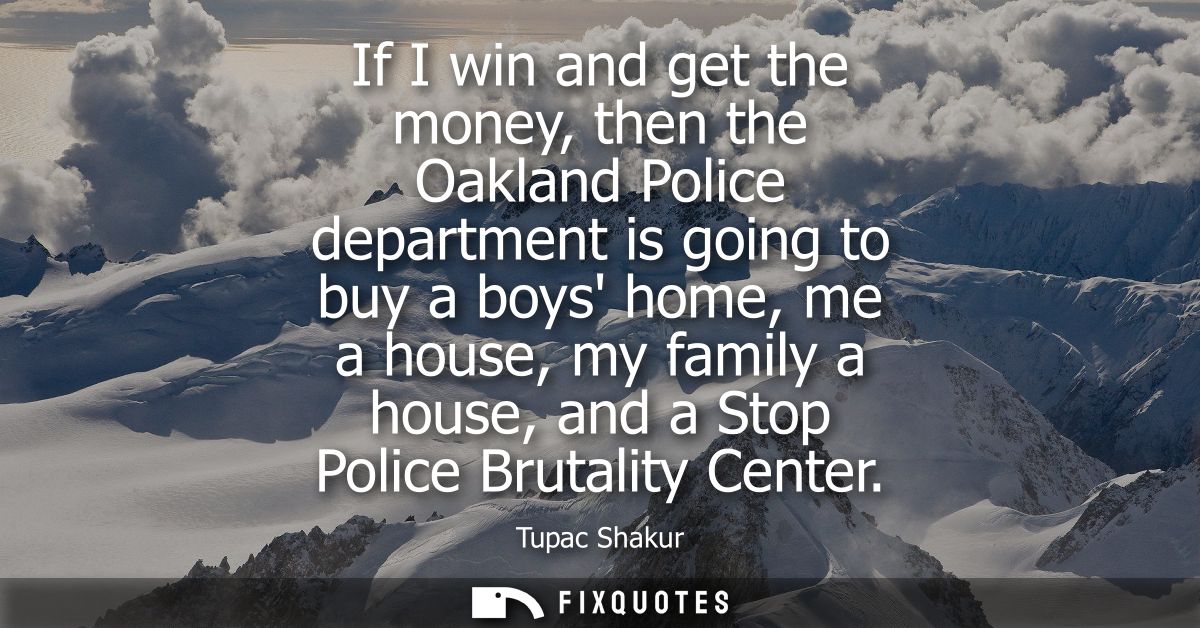
"If I win and get the money, then the Oakland Police Department is going to buy a boys' home, me a house, my family a house, and a Stop Police Brutality Center"
About this Quote
The subtext is classic Tupac duality, sharpened into a budget. He’s not pretending he’s above personal desire (“me a house”), but he refuses the respectability script where uplift must be pure, selfless, and polite. The list moves from community (“boys’ home”) to family (“my family a house”) to self, then snaps back to politics with the center. That rhythm matters: it’s a portrait of obligation in concentric circles, the way poverty actually structures priorities, not the way moral lectures do.
Contextually, this lands in the early-to-mid ’90s, when Los Angeles was still burning in public memory after Rodney King, when “gangsta rap” was being prosecuted in the court of mainstream opinion, and when Tupac was already a lightning rod for contradictions: activist instincts inside a fame-and-survival hustle. The genius is how he turns that contradiction into strategy. “If I win” isn’t just about a payout; it’s about beating a rigged game and then rewriting the terms of what victory owes the streets.
Quote Details
| Topic | Justice |
|---|---|
| Source | Help us find the source |
| Cite |
Citation Formats
APA Style (7th ed.)
Shakur, Tupac. (2026, February 20). If I win and get the money, then the Oakland Police Department is going to buy a boys' home, me a house, my family a house, and a Stop Police Brutality Center. FixQuotes. https://fixquotes.com/quotes/if-i-win-and-get-the-money-then-the-oakland-2168/
Chicago Style
Shakur, Tupac. "If I win and get the money, then the Oakland Police Department is going to buy a boys' home, me a house, my family a house, and a Stop Police Brutality Center." FixQuotes. February 20, 2026. https://fixquotes.com/quotes/if-i-win-and-get-the-money-then-the-oakland-2168/.
MLA Style (9th ed.)
"If I win and get the money, then the Oakland Police Department is going to buy a boys' home, me a house, my family a house, and a Stop Police Brutality Center." FixQuotes, 20 Feb. 2026, https://fixquotes.com/quotes/if-i-win-and-get-the-money-then-the-oakland-2168/. Accessed 4 Mar. 2026.