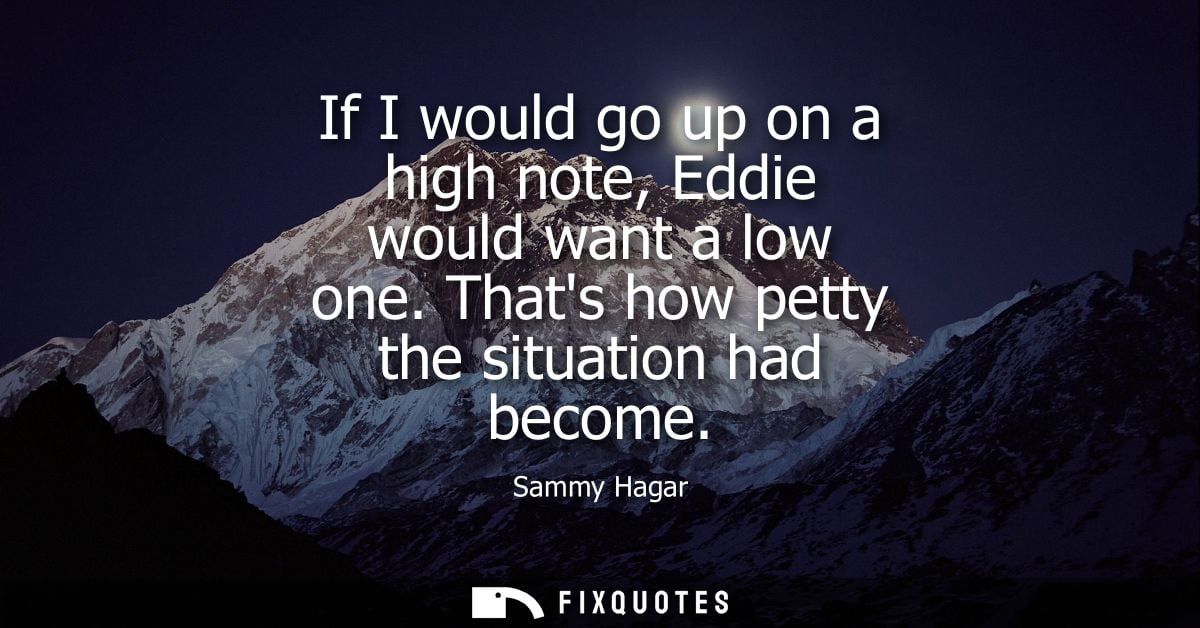
"If I would go up on a high note, Eddie would want a low one. That's how petty the situation had become"
About this Quote
The intent is damage control and self-portrait at once. Hagar positions himself as the adult narrator looking back, naming pettiness as a kind of diagnosis. He is also implicitly defending his own choices as musical rather than personal: “I wanted up” reads as energy, lift, crowd release; “Eddie wanted low” reads as contrarian control, a reflex to deny Hagar the climactic flourish that singers use to own a song. Subtext: this wasn’t just about notes. It was about authorship, spotlight, and who gets to define “Van Halen” after the band’s sound had already become a proxy war between eras and fan loyalties.
Context matters because Van Halen’s public story was always a tension between virtuosity and charisma: Eddie’s guitar as the sacred object, the frontman as the billboard. By reducing their conflict to high versus low, Hagar reveals how fame can turn collaboration into scoreboard behavior, where even melody becomes a negotiation over status. The tragedy is that the audience only hears the finished chorus; the band hears the power struggle underneath it.
Quote Details
| Topic | Broken Friendship |
|---|---|
| Source | Red: My Uncensored Life in Rock — Sammy Hagar (2011), memoir; contains Hagar's account of tensions with Eddie Van Halen. |
| Cite |
Citation Formats
APA Style (7th ed.)
Hagar, Sammy. (2026, January 16). If I would go up on a high note, Eddie would want a low one. That's how petty the situation had become. FixQuotes. https://fixquotes.com/quotes/if-i-would-go-up-on-a-high-note-eddie-would-want-93581/
Chicago Style
Hagar, Sammy. "If I would go up on a high note, Eddie would want a low one. That's how petty the situation had become." FixQuotes. January 16, 2026. https://fixquotes.com/quotes/if-i-would-go-up-on-a-high-note-eddie-would-want-93581/.
MLA Style (9th ed.)
"If I would go up on a high note, Eddie would want a low one. That's how petty the situation had become." FixQuotes, 16 Jan. 2026, https://fixquotes.com/quotes/if-i-would-go-up-on-a-high-note-eddie-would-want-93581/. Accessed 5 Apr. 2026.