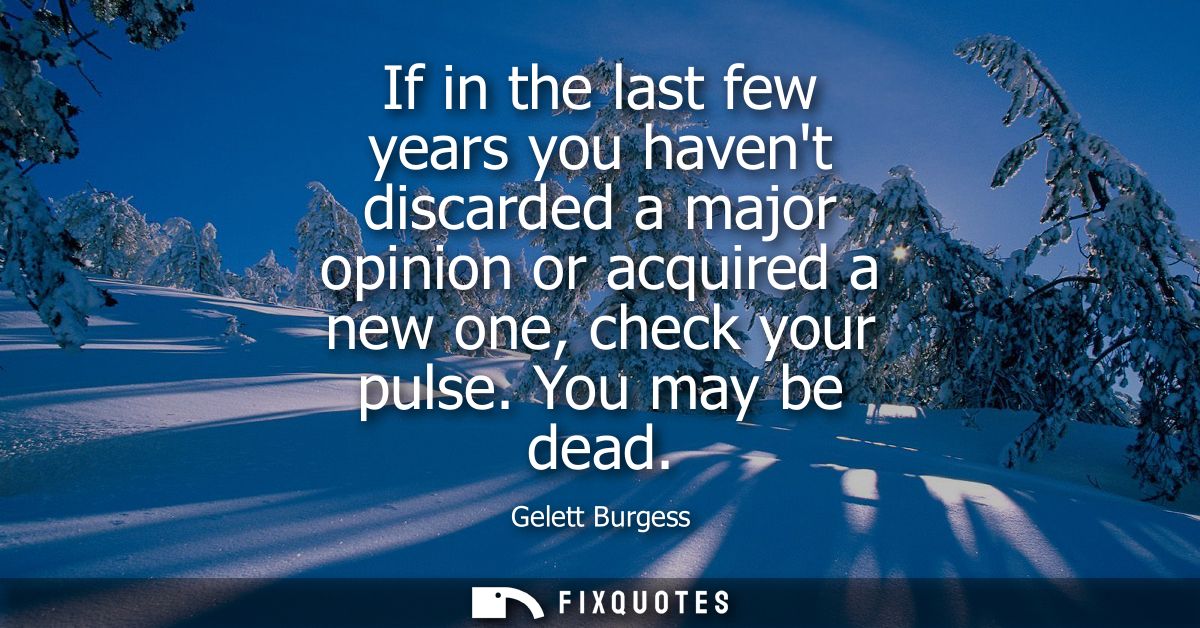
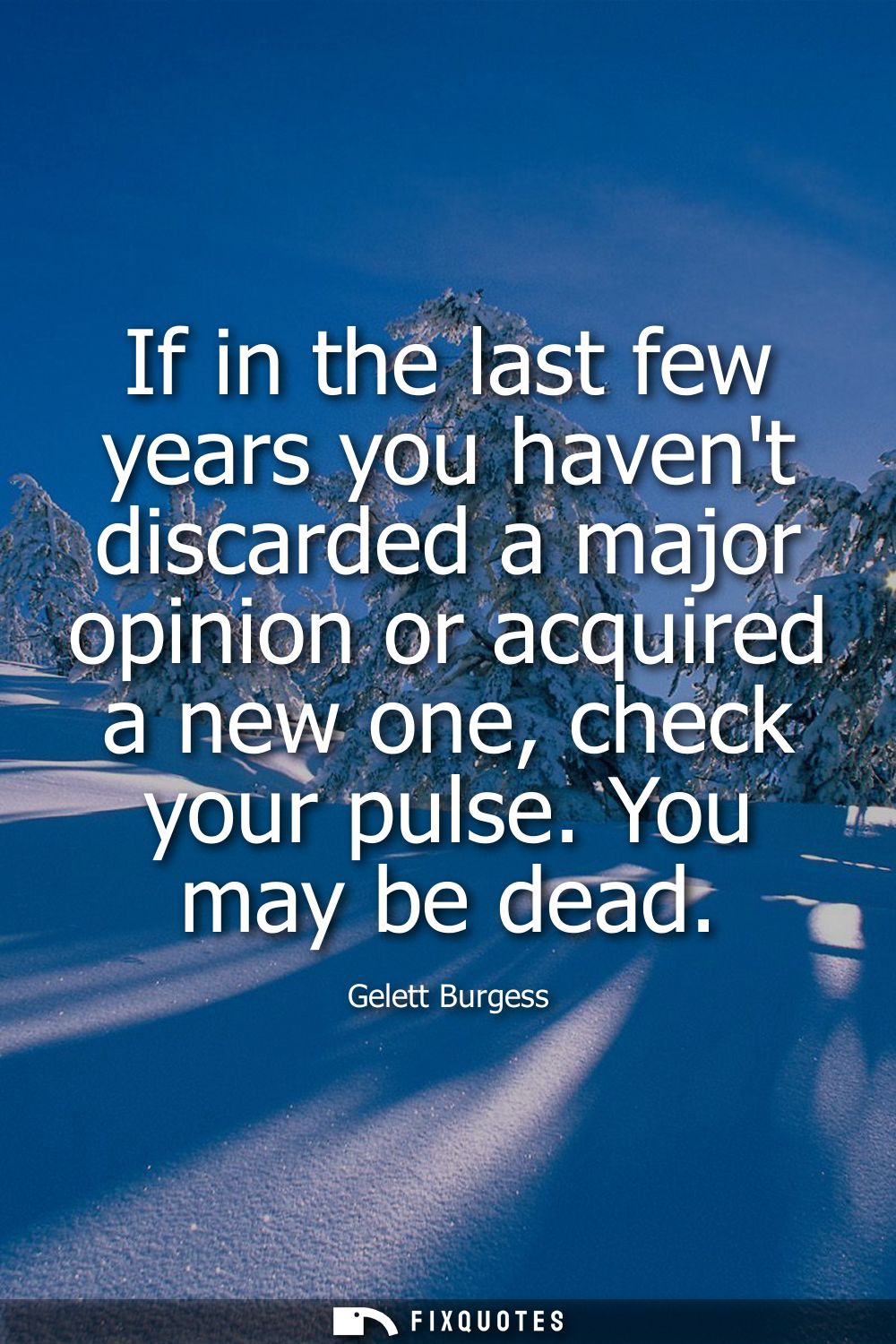
"If in the last few years you haven't discarded a major opinion or acquired a new one, check your pulse. You may be dead"
About this Quote
The intent is goading, not comforting. Burgess frames changing your mind as the default setting of a functioning person, which flips the social script. In most rooms, especially in public life, consistency is treated as virtue and revision as weakness. He calls that bluff. The subtext is that we cling to "major opinions" less because they’re true than because they’re ours - identity badges we’ve paid for with ego and social belonging. Discarding one costs you face; acquiring a new one risks making you look impressionable. Burgess’s joke makes stubbornness, not revision, the embarrassing condition.
Context matters. Writing in a period when modernism was breaking old forms and America was churning through new technologies, wars, and mass media, Burgess belonged to a culture learning that the world can change faster than inherited certainties. The line carries a quietly modern anxiety: if reality keeps updating and you don’t, you become a museum exhibit in real time. The wit lands because it’s ruthless and intimate - it asks you to audit your own mental timestamps, then dares you to claim you’re still alive.
Quote Details
| Topic | Change |
|---|---|
| Source | Help us find the source |
| Cite |
Citation Formats
APA Style (7th ed.)
Burgess, Gelett. (2026, January 16). If in the last few years you haven't discarded a major opinion or acquired a new one, check your pulse. You may be dead. FixQuotes. https://fixquotes.com/quotes/if-in-the-last-few-years-you-havent-discarded-a-130934/
Chicago Style
Burgess, Gelett. "If in the last few years you haven't discarded a major opinion or acquired a new one, check your pulse. You may be dead." FixQuotes. January 16, 2026. https://fixquotes.com/quotes/if-in-the-last-few-years-you-havent-discarded-a-130934/.
MLA Style (9th ed.)
"If in the last few years you haven't discarded a major opinion or acquired a new one, check your pulse. You may be dead." FixQuotes, 16 Jan. 2026, https://fixquotes.com/quotes/if-in-the-last-few-years-you-havent-discarded-a-130934/. Accessed 31 Mar. 2026.